As the war between the Sudanese army and the Rapid Support Forces (RSF) continues for more than 18 months, gold smuggling is flourishing on the country’s border with Egypt.
The trade, which involves tens of thousands of people and has attracted people from countries outside Sudan and Egypt, is part of an organized crime network that runs along the border.
Egypt has about 125 traditional mining areas in Sudan’s Nuba region in southern Egypt. Gold can be found in the Eastern Desert, a 223,000 square kilometer area of the Sahara Desert located east of the Nile River, along the Red Sea coast and in the triangular border area between Egypt, Sudan and Libya.
According to Egypt’s Mineral Resources Authority, the main mining companies are the state-owned Shalateen Company, Hamasha Misr, and El-Sakry, which is owned by the multinational gold mining company Centamin based on the tax haven island of Jersey.
Britain, Russia, Australia and other international players are involved in gold exploration in the region, with Egypt recently opening new gold mining areas in the Eastern Desert in the “Golden Triangle” region.
Ahmed Hussein, a Sudanese miner who recently arrived in Aswan, said that more than 10 new gold mining areas have been opened in Aswan governorate recently by local miners operating on their own initiative and without government oversight.
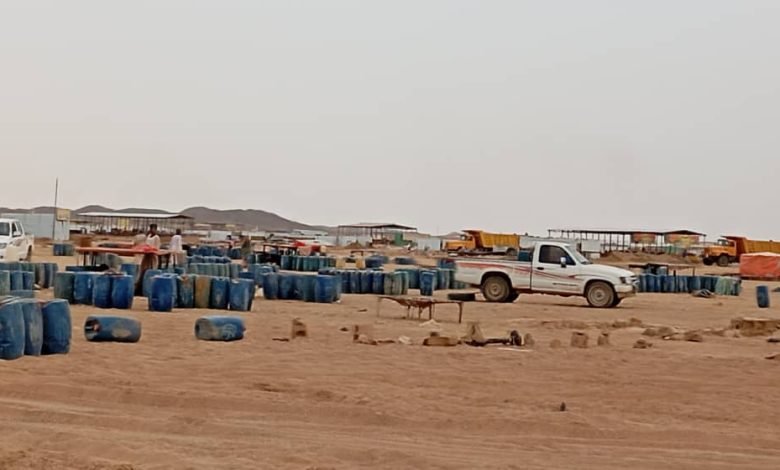
On the other side of the border, Sudanese mining areas have been opened or expanded in the Red Sea, Northern and Nile River states since the outbreak of war in April 2023. Sites near the Egyptian border are enjoying notable success for logistical reasons, especially the ease of transportation of supplies from Egypt.
Prospector Ibrahim said: “There are new mining areas that have been opened or old areas that have been expanded in the Red Sea state near the desert that stretches between Egypt and Sudan. “This area has flourished, with mining taking place in the areas of Al Matar, Al Miraj, Jabal Nimr, Nuraya, Ansari, Tabreeda, Al Abar and others.
Ibrahim pointed to the Salah mining area in southern Egypt, which has expanded near Shalateen, the largest city in the Halayeb Triangle, a disputed area between Egypt and Sudan.
Ibrahim started working in 2017 and worked in the Salah area until 2023. He said there are about 20,000 other Sudanese working with him and thousands of Egyptians.
“I was working in that place for about three years,” he told Middle East Eye. “We used to go with the gold to the country where the prices are higher. In the past we used to go to Sudan but recently Egypt has become more feasible for us because the prices have become higher recently,” he told Middle East Eye. Organized tactics:
Dozens of Sudanese gold miners come to Aswan’s gold markets to sell their gold to buyers, but because the activity is illegal, the gold is usually smuggled into Egypt by organized gangs and smugglers.
According to multiple sources, massive amounts of gold have been smuggled from Sudan into Egypt, with cheap fuel, weapons and other goods flowing in the other direction.
A Sudanese smuggler told Middle East Eye that they bought gold either directly from small-scale miners or sometimes from markets in Sudan’s Nile River and Red Sea states.
He explained the tactics smugglers use to smuggle gold from Sudan to Egypt, with the methods used varying depending on the amount of gold being transported.
The smuggler told Middle East Eye: “People who come legally across the border always try to hide gold in their clothes or women hide it in their bodies.”
He said that when people are smuggled in themselves – if they are crossing the border illegally – the smuggler driving the car they were in may ask them to hide the gold, sometimes in exchange for a free ride.
Another miner noted that the mountains and deserts of northern Sudan and southern Egypt provide the perfect environment for a people smuggling network – not only from Sudan but also from Ethiopia, Eritrea and elsewhere in Africa.
The miner added that armed strongmen from the Ababda, Rashaida and Bashari tribes, who now live on both sides of the border, are the main traders bringing gold from Sudan to Egypt.
The miner said: “I send my gold through these powerful tribesmen, who know the secret routes through the mountains and deserts. They take a commission from the gold coming from Sudan,” the miner said.
In the mountains surrounding Aswan and other areas in southern Egypt, including Luxor, Kom Ombo and Edfu, the gold is delivered at specific meeting points agreed upon in advance between the smuggler and the group taking it. The miner explained to Middle East Eye that the payment, which is in dollars, is sometimes made ahead of time. “In other cases, the payment is made at the same time the gold is delivered. In other cases, gold is exchanged for other illegal goods, including fuel, mercury, cyanide and other things.”
A driver involved in smuggling operations told Middle East Eye: “One of the main tactics to cover operations is to change the car you use to transport gold across the border. “Sometimes I sell the car as soon as I enter Egypt. Sometimes I sell it as spare parts after dismantling it.”
Egyptian authorities turn a blind eye:
As smuggling becomes more widespread, Egyptian authorities are accused of turning a blind eye to the illegal trade, as the country needs to increase its gold reserves to support the Egyptian pound, which has fallen sharply against the dollar.
Egypt devalued its currency in January 2023 by 40 percent to $0.03 and then floated it in March 2024, bringing the value down to $0.02. Meanwhile, Egypt’s gold reserves increased in 2023 to 126 tons, an all-time high.
According to Egypt’s Ministry of Petroleum and Mining, Egypt has focused on expanding gold production since 2019, when it passed new legislation aimed at attracting local and international bids for companies to enter the sector.
As of 2023, only 11 international and local companies, eyeing the Eastern Desert and the Red Sea coast, had responded to this request, but with revenues of only $65 million in about three years. These revenues, according to various statistics, have risen since then. Egypt has rapidly increased its revenue from gold production from $6 billion in 2022 to $8.4 billion in December 2023, reaching $9.5 billion in the first half of 2024.
Egypt produces about 15.8 tons of gold annually, most of which comes from the Sukari mine in the Eastern Desert, according to a report by the World Gold Council in January 2024.
Egypt’s policy of increasing its gold reserves has led to increased demand and higher gold prices in Egypt over the past two years, according to a Sudanese researcher.
“The policy has raised gold prices in Egypt above international prices,” said the researcher, who requested anonymity for security reasons, adding that” since 2022, global gold prices have risen by about 2% while in Egypt they have risen by 16%.
A Sudanese gold trader who worked in a gold market in Khartoum before the war said that the price of gold in Egypt is higher than in Sudan. This is especially true for 21-carat gold, which is very rare in Egypt. In Sudan, the price of a gram of 21-carat gold is $60, while in Egypt it is more than $80.
The gold trader explained that 21-karat gold is more marketable in Egypt than other locally produced forms of gold, such as 24-karat.
The trader, who requested anonymity for security reasons, told Middle East Eye: “For this reason, Sudanese gold has become very desirable in the Egyptian market, and this has fueled the ambitions of gold traders and smugglers looking to profit.”
“Moreover, we are not only talking about individual traders, but the Egyptian authorities have ambitions to build up large gold reserves in the Central Bank of Egypt in order to help stabilize the currency and the economy.”