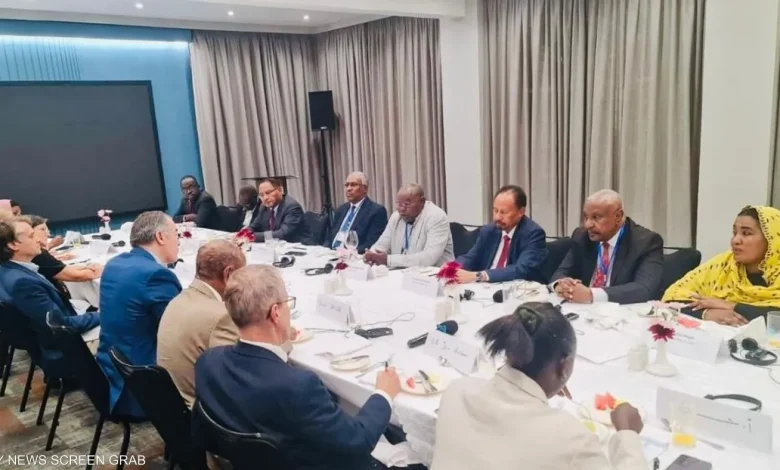
The Sudanese Declaration of Principles coalition announced that it would not participate in the consultative meeting convened by the Quintet on Sudan in Addis Ababa on July 31, arguing that the invitation perpetuates a course of action that disregards the will of the Sudanese people and prolongs the war, reflecting what it described as a “flawed approach” to managing the political process.
In a press release issued on Tuesday, the coalition stated, that they had received an invitation from the Quintet Mechanism—comprising the United Nations, the European Union, the African Union, IGAD, and the League of Arab States—to participate in a meeting described as an exploratory session to form the preparatory committee for the political process; however, they decided not to participate after evaluating the content of the invitation and the manner in which it was prepared.
The Forces of the Declaration of Principles criticized what they considered a flaw in the way the invitation was issued, as it was addressed to what was called the “Nairobi Declaration Platform,” while they emphasized that the Nairobi Declaration is not a political alliance in its own right, but rather a coordinating framework comprising a number of anti-war civil and democratic forces, arguing that this reveals confusion in identifying the parties involved in the political process and the mechanisms for consulting with them.
The Forces of the Declaration of Principles accused the Quintet Mechanism of ignoring demands they had previously put forward following the meeting on June 3, which included a call for a comprehensive review of the previous political process and addressing what they described as the shortcomings and deviations that marred it, before moving forward with any new arrangements.
She added that these demands were reiterated during meetings with representatives of the Quintet in Nairobi on July 20 and 21, but they went unanswered—a fact that the forces viewed as evidence that a new path was being pursued without addressing the causes that led to the failure of the previous one.
The Forces of the Declaration of Principles viewed the current call as bypassing the fundamental issues that must be agreed upon before launching any credible political process, foremost among which are ending the war, identifying the parties to the political process, and agreeing on its foundations and agenda. They warned that continuing with this approach could, in practice, entrench the status quo and prolong the conflict, rather than opening a genuine path toward peace.
They emphasized that any political settlement must be “Sudanese in ownership and will,” such that Sudanese people themselves determine the participants in the political process, formulate its agenda, and chart its course, with the role of regional and international parties limited to facilitation and support—not to managing the process or determining its outcomes.
She stressed that sustainable peace cannot be achieved through procedural arrangements or preparatory meetings that lack consensus among Sudanese forces, but rather through a comprehensive political process that addresses the root causes of the war, leads to its permanent cessation, restores democratic civilian rule, achieves justice, and builds a state based on citizenship and the rule of law.
It called for the formation of a preparatory committee through a purely Sudanese consultative process to identify the parties to the political process, draft its agenda, agree on the venue and timing of the meetings, and define the roles of the regional and international communities as facilitators and supporters.
The Forces of the Declaration of Principles called on the Quintet Mechanism to hold a face-to-face meeting to review and evaluate the previous experience, discuss the observations they had submitted, and address shortcomings before launching any new arrangements, while also calling for a review of the approach to managing the political process in a way that strengthens trust among the Sudanese parties.
They emphasized that boycotting the Addis Ababa meeting does not mean withdrawing from mediation efforts or rejecting dialogue but rather aims to correct the course of the political process and ensure the launch of a more inclusive and credible process, based on ending the war and restoring democratic civilian rule, while stressing the exclusion of the National Congress Party, the Islamic Movement, and their proxies from any future political arrangements.