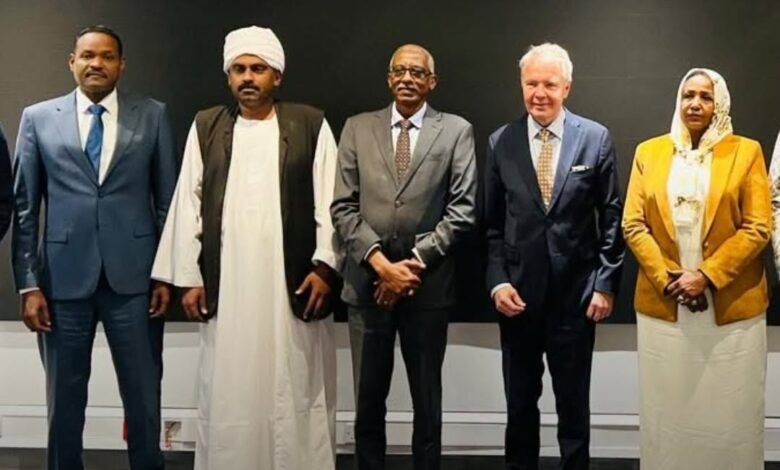
Rhino: follow up – On Saturday, August 29, 2026, in Nairobi, representatives of the Forces of the Declaration of Principles met with Mr. Peka Havisto, the UN Secretary-General’s Personal Envoy for Sudan, to discuss developments in the political landscape and efforts to end the war and launch a credible peace process.
The representatives conveyed to the UN envoy their position regarding the call for political dialogue issued by Army Commander and Chairman of the Sovereign Council Abdel Fattah al-Burhan, emphasizing that their rejection is not a principled stance against dialogue itself, but rather against the nature of the proposed framework and the risks it poses of entrenching the political and geographical reality created by the war.
In line with this position, they explained that any political process initiated by one of the warring centers of power—or managed through arrangements that reproduce unilateral control over the state—would not constitute a genuine path to ending the crisis; rather, it would open the door to legitimizing the existing division and entrenching parallel de facto authorities.
Conversely, the forces behind the Declaration of Principles believe that the required dialogue must be part of a broader process aimed at ending the war, protecting civilians, addressing the humanitarian crisis, and restoring the unity of state institutions, leading to a unified, democratic civilian authority.
On another front, the UN envoy was briefed on the latest developments in the anti-war civil society movement, the growing number of forces rejecting polarization between the two sides of the conflict, as well as the outcomes of the consultative meeting in Addis Ababa on August 22 and 23, which revealed a growing convergence among civil and political forces regarding the foundations for ending the war and designing a more broadly representative political process.
The meeting also addressed the anti-war forces’ position on the Quintet mechanism, as well as existing reservations regarding its working methods and the mechanism for determining the parties and their representation within the political process.
Representatives of the Forces of the Declaration of Principles emphasized that these reservations do not imply a refusal to engage with the five-party mechanism, but they do require—prior to any participation—agreement on clear points regarding the nature of the political process, its parties, and its terms of reference, as well as a guarantee of the independence of civilian decision-making and that no single party monopolizes representation of the anti-war forces.
In conclusion, the forces of the Declaration of Principles reaffirmed their readiness to engage with all regional and international efforts aimed at ending the war, on a basis that preserves Sudan’s unity, prevents the entrenchment of de facto authorities, and leads to a sustainable, democratic civilian transition.