An international organization warned that Sudan is moving towards “total collapse” under the eyes and “silence” of the world, noting that the indicators of collapse are accelerating alarmingly in light of the catastrophic consequences of the war that has been going on in the country for more than 19 months.
Norwegian Refugee Council (NRC) Secretary General Jan Egeland said at the end of his visit to Sudan on Friday that a year and a half of war has triggered a “relentless countdown to total collapse in Sudan,” where more than 20 million people are suffering from raging violence, increasing hunger and forced displacement.
Egeland described the current crisis in Sudan as “the world’s worst humanitarian crisis ever,” noting the need to wake up the world and compel it to do everything possible to save the lives of millions of Sudanese. He explained: “When the war in Darfur broke out twenty years ago, we had presidents and prime ministers engaged in stopping the atrocities there, but today, even though there are exponentially more lives at stake, the world is deafeningly silent.”
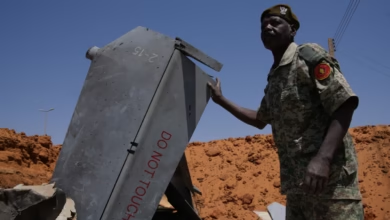
“I have just seen with my own eyes, in Darfur and in the east, the devastating result of indiscriminate attacks and senseless warfare. “The communities we serve tell us of horrific violence where entire villages have been destroyed, civilians executed, women raped and homes destroyed by shelling and airstrikes.
Sudan is living a “scorched earth” policy and is close to a “free fall” as suffering continues and millions face the threat of famine, he said, warning that delayed action and inadequate diplomatic efforts will only add to the suffering of the Sudanese people.
Shocking consequences: The ongoing war in Sudan since mid-April 2023 has caused shocking humanitarian, security and economic consequences.
On the humanitarian side, the war has displaced more than a third of the population, stripped about 18 percent of families of their sources of income, 70 percent have been unable to enroll their children in school, and the percentage of those able to access health services has fallen to less than 15 percent of the estimated population of 48 million, according to a study conducted by the United Nations.
The percentage of food-secure urban households has dropped from about 54 percent to just 20 percent, 76 percent of whom face significant difficulties in receiving aid.
Economically, the war has accelerated the country’s dire economic deterioration, amid estimates of direct monthly losses of about $500 million.
GDP has declined by more than 70 percent, the national currency has lost more than 400 percent of its value, with one dollar currently trading at about 2,300 pounds compared to 600 pounds before the outbreak of the war, inflation rates have risen to more than 200 percent, and the prices of basic commodities have doubled by as much as 400 percent.
On the security side, aerial and ground bombardment and the heavy presence of armed militias have caused a complete collapse in many areas of the country.
The most prominent manifestations of the collapse: More than 61,000 people died in Khartoum between April 2023 and June 2024, according to the London School of Hygiene and Tropical Medicine.
Through October 2024, attacks on civilians and fighting across the country killed about 2,600 people and displaced more than 27,000, according to the Norwegian Refugee Council.
The conflict in Sudan has caused the largest displacement crisis in the world. More than 11 million people have been displaced within the country, and another 3 million have crossed borders to seek refuge in neighboring countries, according to the United Nations.
The war has prevented about 17 million children from continuing their education, while 3.7 million children suffer from malnutrition and more than 3 million children live in displacement camps that lack the basic necessities of life, according to UNICEF.
60 percent of Sudanese have lost their sources of income, the economy has lost hundreds of billions, and 80 percent of its capacities have been disrupted.
About 70 percent of health institutions have been knocked out of service amid a great scarcity of medicine and the widespread spread of epidemic and infectious diseases, according to the Sudanese Doctors Syndicate.
Most areas of the country are in complete chaos, with the war covering more than 70 percent of the country’s area and the presence of more than 100 armed movements. Sky News Arabia