Observers have warned against a repeat of the scenario of the Sudanese Islamic Movement (“the Brotherhood”)’s rule in the 1990s, when the regime’s wars and massacres led to the deaths of hundreds of thousands of Sudanese in the country’s outlying regions, including tens of thousands in Blue Nile State, in southeastern Sudan, who fell under the banner of “jihad” during the war then raging between the army and the Popular Movement forces led by John Garang.
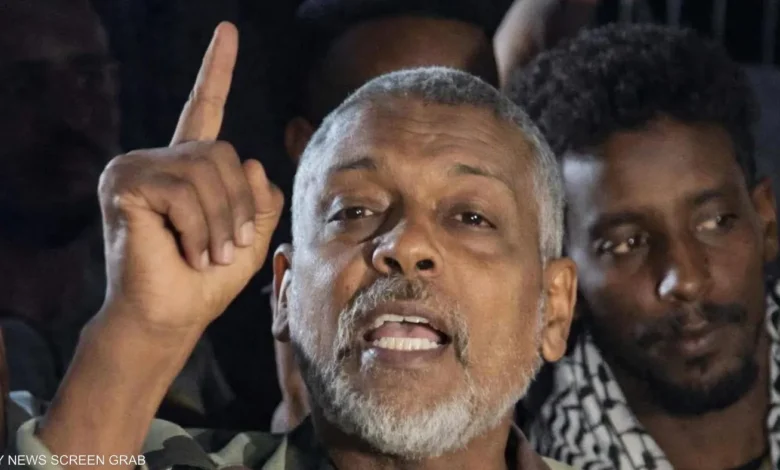
Amid a notable escalation in recent days in the intensity of fighting in Blue Nile between army forces and their allied groups on one side, and the “Tasis” coalition forces, composed of the Rapid Support Forces and the Sudan People’s Liberation Movement–North (SPLM-N), on the other, jihadist leader Al-Naji Abdullah appeared last Monday, accompanied by a number of members of the Islamic Movement’s armed battalions, in one of the region’s villages, calling on residents to take up arms and join the war.
In a scene reminiscent of what happened in 1997, when the Muslim Brotherhood mobilized popular groups to fight against the People’s Movement forces, Al-Naji Abdullah intensified his use of jihadist rhetoric in his speeches—the same rhetoric echoed by leaders of the Brotherhood’s factions during their previous wars, which spanned many years.
Human rights activist Abdullah Abd al-Sadiq says: “History is repeating itself; the very same group led by al-Naji Abdullah participated in 1997 in the wars of al-Karmak and Qaysan, southeast of the Blue Nile, amid reports of major violations committed by the group.”
Turning Civilians into Fuel for War
International, regional, and local demands have intensified, calling on all parties to refrain from dragging civilians into the fighting. However, Al-Naji Abdullah’s tour of a number of villages and areas in Blue Nile focused on mobilization, as he called on local residents to take up arms and defend their areas.
According to Bakhita, a nurse who lives in a village east of the city of Qaisan, near Damazin, the capital of Blue Nile State, these calls fall on deaf ears among the local population, who experienced all manner of death and destruction during the 1990s and early 2000s and are no longer receptive to them.
For Bakhita, who lost four family members during the fierce fighting in Qisan in 2002, these calls bring back memories of the long tragedy the residents endured during that period.
She told “Sky News Arabia”: “The people of the region are fed up with wars; for the past three decades, there isn’t a single household that hasn’t lost one of its sons. Schools have been destroyed and services have deteriorated due to the prolonged wars the region has witnessed.”
In 1998, armed jihadist groups in the region—including forces led by Al-Naji Abdullah—organized large-scale mobilization campaigns to recruit residents and force them to fight against the Popular Movement forces led by the late John Garang, following the Movement’s takeover of the city of Qisan in 1997.
A Controversial Return
Al-Naji Abdullah’s reappearance in the areas of operations came after a disappearance that lasted several months. In March, reports surfaced that Abdullah had been arrested following public statements in which—while wearing a Sudanese army uniform—he declared their readiness to fight alongside Iran against countries in the region. He also announced that they did not recognize the United Nations, the Security Council, or regional organizations.
While observers at the time considered the talk of Abdullah’s arrest a “maneuver,” asserting that al-Burhan and his army—which is controlled by the Islamic Movement—would not dare to touch any of its leaders, al-Naji appeared weeks later on a number of occasions. However, his current appearance within the operational zones in Blue Nile was particularly notable.
This new development reinforced international reports that cast doubt on Army Commander Abdel Fattah al-Burhan’s ability to sever ties with the Muslim Brotherhood, which the United States has designated as a terrorist organization.
Al-Burhan publicly states that he will not allow the Brotherhood to return to power, but numerous media and research reports—including one published by *Eurasia Review*—have confirmed that Al-Burhan relies in this war on the organizational depth of the Brotherhood’s network, its financial channels, and its capacity for ideological mobilization.
The organization, which wields significant influence within the military and security apparatus, has managed to rebuild itself since the outbreak of the war, taking the form of a network of armed groups embedded within and around the army.
Ahmed Abbas, a senior leader of the organization who served as governor of Sennar State during the reign of ousted President Omar al-Bashir, confirmed in a recorded video that members of the organization are currently running the war, noting that they make up 75 percent of the fighters fighting alongside al-Burhan.
The reappearance of Al-Naji Abdullah in the areas of operations reveals that jihadist rhetoric is no longer merely a legacy of the wars of the 1990s, but rather a tool for mobilization under the guise of the army and in the midst of a new war.
While Burhan denies empowering the “Brotherhood,” its leaders and battalions are active on the ground, pushing to arm civilians and reignite a war for which the people of Blue Nile have paid the price for decades. This places the army leadership under direct responsibility for the expansion of these groups and for once again turning villages and their residents into fuel for the Islamist movement’s project to return to power through war.