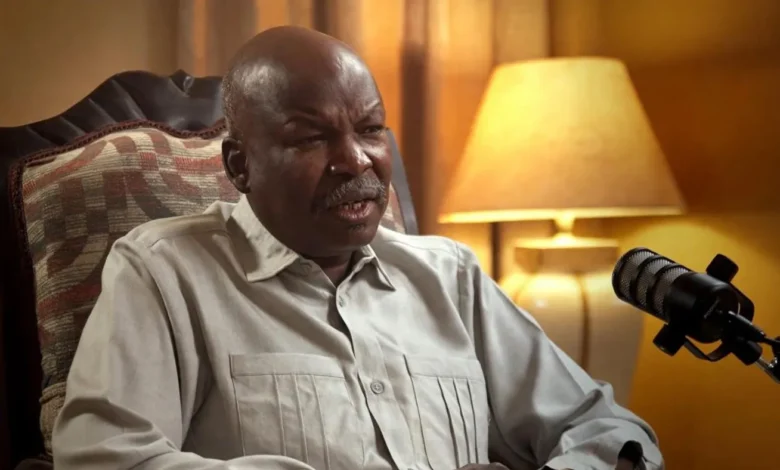
The recent media appearance by Sudanese Muslim Brotherhood leader Ahmed Haroun, chairman of the National Congress Party—the political arm of the Sudanese Islamic Movement (the Muslim Brotherhood)—via a podcast last Friday marked a revealing turning point in the nature of Sudan’s political and military landscapes.
Through his public remarks, the location where the interview was recorded, and the organic link between the leaders of the former regime and the authorities in Port Sudan, Haroun lifted the veil on the inner workings of the system and the close ties between the Islamic Movement and the army leadership in Sudan.
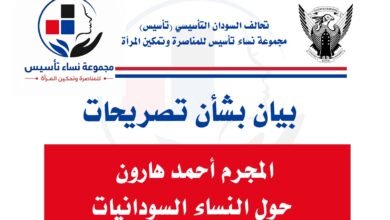
Haroun has been wanted by the International Criminal Court since 2007, on charges of committing war crimes and crimes against humanity in Darfur, among 42 counts that included murder, persecution, forced displacement of the population, rape, torture, imprisonment or severe deprivation of liberty, inhumane acts, looting, and attacks on personal dignity, while he served as Minister of State for the Interior and was responsible for coordinating government agencies involved in the campaign of genocide in Darfur during the previous regime’s rule, from 1989 to 2019.
In his interview, Haroun—who lives in areas controlled by and under the protection of the army—revealed the nature of the current alignment with the army, their stance in support of continuing the war, and the necessity for the army to remain in effective control of the reins of power.
This appearance was particularly troubling because it took place in a safe and comfortable setting inside a hotel in central Khartoum, which drew widespread ridicule from leaders of political forces, who viewed the meeting as irrefutable evidence of the Islamic Movement’s control over the army, as well as the Port Sudan authorities’ inaction and clear collusion in providing complete freedom for figures of the former regime to move about and express their views, at a time when millions of Sudanese are suffering and dying.
Arrest on Stage
Faced with a storm of domestic and international criticism sparked by Haroun’s appearance, security authorities—controlled by the organization of which Haroun is a leader—leaked news of his arrest yesterday, marking a new chapter in the theatrical saga of his appearance and arrest, which observers have described as farcical.
Sources close to the military confirmed to “Sky News Arabia” that Ahmed Haroun’s interview, followed by the leak of news of his arrest, represent a premeditated plan to polish Burhan’s image—whom the Islamic Movement (the Muslim Brotherhood) seeks to install in place of the ousted President Omar al-Bashir—and to deceive the world into believing he has no connection to the Islamic Movement or the former regime.
In this context, Khalid Omar Youssef, a leader of the “Sumoud” Alliance of Democratic Civil Forces, said that what took place was nothing more than a “tacky, transparent, and poorly directed charade” aimed solely at circumventing mounting regional and international pressure.
He added: “Al-Burhan did not discover Haroun’s whereabouts by chance; he is one of the warlords, and it was he who dubbed their current destructive war the ‘War of Dignity’—a phrase Al-Burhan echoes—while moving under the protection of the security and military apparatus, whose key positions are controlled by his comrades.”
For his part, veteran Sudanese politician Yasser Arman, head of the Popular Movement—Revolutionary Current, mocked the charade surrounding Haroun’s appearance and his swift arrest, saying: “Was the man who gave the interview detained at the Al-Salam Rotana Hotel or at another hotel? I think it’s appropriate to detain him at the Al-Salam Rotana, since the services—including communications—are better there.”
Freedom of Movement for Muslim Brotherhood Leaders
The emergence of Ahmed Haroun was no coincidence; rather, it was consistent with the broad freedom of movement that he and his colleagues enjoyed within the country throughout the war, including the repeated trips by the Secretary-General of the Islamic Movement, Ali Karati, which took him to capitals outside Sudan.
This empowerment stems from the deep organizational roots of both Ahmed Haroun and Ali Karati, who rose early in the ranks to manage the organization’s offices and military wings within the army and security agencies; Karti assumed responsibility for the “Popular Defense,” a parallel military force affiliated with the organization, while Haroun led the “People’s Police”—the organization’s parallel police force—and oversaw security and military operations during the genocide in Darfur.
This historical military background confirms that the Islamists never left the decision-making forefront; rather, they repositioned themselves within the power structures of Port Sudan and the army to ensure the survival of their influence and the continuation of the war machine.
Absent Justice and the Port Sudan Dilemma
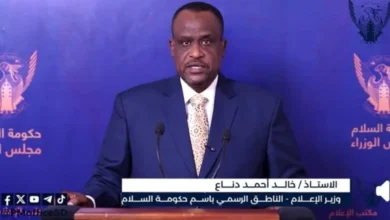
In the same context, Haroun’s blatant public appearance placed the Port Sudan authorities in a critical legal and moral dilemma, which Ambassador Al-Sadiq Al-Mugli clearly unpacked in his legal analysis of the situation’s implications.
Al-Mugli told “Sky News Arabia” that the appearance of Haroun—who is wanted internationally and is supposed to be in prison or subject to house arrest following his controversial release at the start of the war—exposes the complicity of the official judicial system and its evasion of the requirements of both international and domestic justice.
In short, observers and public opinion believe that these attempts to obfuscate the issue will not fool the Sudanese people, who fully realize that this war is a war waged by the Islamists to regain their armed power, and that any theatrical staging of the arrest will not change the fact that the course of the revolution and the blood of the martyrs cannot be undone.
The issue now is not whether Haroun is in custody, nor the reason for his arrest, his location, or the duration of his detention, but rather whether the Port Sudan authorities will execute the International Criminal Court’s arrest warrant and bring him to justice.
Anything less than that will remain a mere formality that does not dispel the reality of the protection he has enjoyed, nor does it erase what his appearance has revealed about the depth of the alliance between the army leadership and the Islamic Movement.