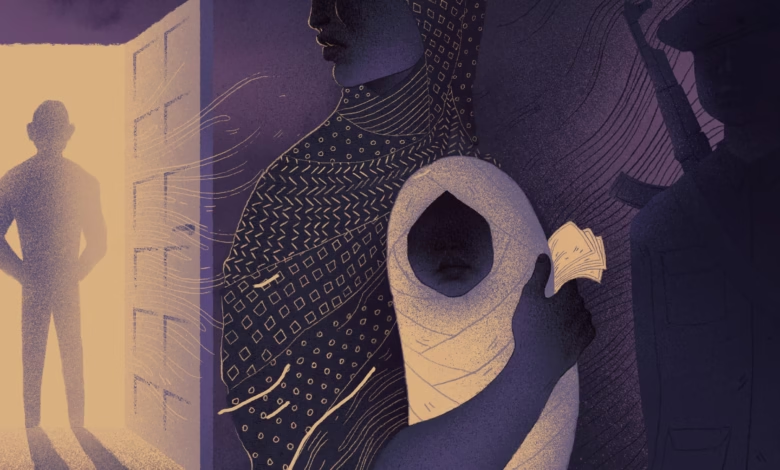
A report by the British newspaper The Guardian stated that Sudanese women who fled to Egypt to escape the war in their country are facing increasing levels of sexual exploitation. The newspaper revealed that single mothers have been forced to sell their bodies in order to survive and feed their children.
According to the report, many of these women did not previously work in Sudan, where conservative social norms dictate that men are typically responsible for financial support. Because they lack established trades or professions, and with the death or disappearance of their husbands and other family members, many female refugees are struggling to cover the costs of food, medical care, and rent.
The Guardian reported that it spoke with 19 aid workers, refugees, and medical professionals who stated that the lack of health care, education, and sometimes food has caused the situation of Sudanese women in Egypt to deteriorate desperately.
The civil war in Sudan has led to the world’s worst displacement crisis, forcing more than 4.5 million people to flee to neighboring countries such as Chad, South Sudan, Libya, and Egypt. Conditions have worsened significantly in Egypt, which has received the largest number of arrivals, with an estimated 1.5 million people having crossed the border.
Thousands found themselves stranded with scarce resources after funding shortfalls at the United Nations High Commissioner for Refugees (UNHCR) led to the suspension of the limited support that had been available, in addition to the cancellation of the agency’s programs. (UNHCR) to halt the limited support that had been available, in addition to the cancellation of the parent agencies”.
In addition to the abolition of the U.S. Agency for International Development (USAID). Because they are unable to work legally and often live in poor and unsafe neighborhoods, women—who were among the groups hardest hit by the war—are in a particularly vulnerable position.
The newspaper quoted Mariam—a pseudonym—who runs a group providing aid to refugees in Cairo, as saying that 90% of Sudanese women in her neighborhood, where rents are cheap, have been sexually exploited.
Mariam says: “Women who have no husband but have children are targeted because they know she won’t have enough to feed them. She thinks she’ll do it just once to cover her immediate expenses, but she’ll be forced to do it again and again.” Even many of those with husbands are not safe, because their husbands are away from home, working long shifts or looking for work in other cities.
Khadija, who works for the same group that provides support to refugees, says: “I know a girl who was exploited, and then the same man who assaulted her began assaulting her daughter. Her husband divorced her when he found out what had happened.”
Without legal status or proof of their university degrees, even women with professional qualifications—such as teachers and doctors—find it difficult to find work. Most of them end up either working in the informal sector in factories, where the net wage for a 10-hour workday is about 150 Egyptian pounds (EGP; about 2.20 British pounds), or as domestic workers, where they often receive no pay and are subjected to sexual assault.
Sex work has increasingly become a last resort for women seeking a way out of extreme poverty. Alaa, who works for an organization that helps these women, says, “These women have been here since the war began, and they are in a state of despair.”
“Five women described their experiences to *The Guardian*, on condition of anonymity.
Staff at refugee organizations also describe how some women are lured into sex work when they first arrive in Egypt, with offers to expedite their residency paperwork.
Aisha—a pseudonym—an aid worker, says that homeless women are “easy targets” and often turn to sex work in exchange for money or food. (The person offering her a meal will say, “I can give you more if you come with me for a few hours,” and she’ll go.) Anyone who has just arrived from Sudan would not refuse such an offer.
The Guardian quoted aid workers as saying that cases of exploitation remain underreported because fear and shame surround the topic of sex outside of marriage, even in the context of abuse. Some women fear being killed by their families, but most fear being ostracized by their communities.
“Mohamed, a doctor at a health facility in Cairo, says he treats at least 10 women every week who report having been sexually exploited or who have been working in the sex trade. Many of them come to him pregnant, seeking an abortion,” the article states. He adds that the large number of unwanted pregnancies he and his colleagues see highlights the scale of the problem.
For these women, pregnancy presents yet another impossible situation: in Egypt, children born out of wedlock are not legally recognized, while abortion is illegal. Mohamed says that those who can scrape together between 3,000 and 4,000 Egyptian pounds buy misoprostol tablets on the black market—an abortion drug that induces uterine contractions.
Those who cannot afford it are often forced to resort to dangerous home abortions. Mohamed says that each month
“As for those who cannot afford it, they are often forced to resort to dangerous home abortions. Mohammed says that last month alone, two pregnant women who could not afford the pills died after attempting to insert pieces of wood into their bodies, having been told that this would dilate the cervix and induce an abortion”.
Mohammed says that the lack of legal reproductive health care and the high cost of medication impose a cruel secondary burden on women who are already suffering from trauma. He adds, “It is exploitation of the consequences of previous exploitation.”