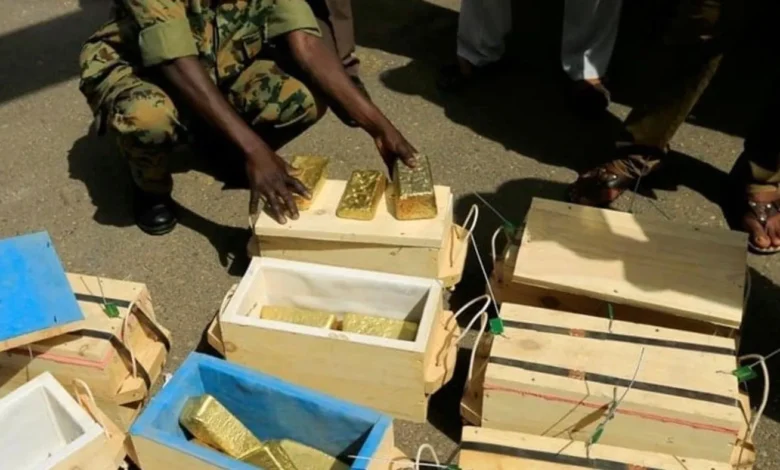
Switzerland has imposed a ban on the purchase, import, and transport of gold from Sudan, in a move aimed at cutting off one of the main sources of funding that contributes to prolonging the war, and expanding the scope of international and European pressure on the war economy and networks trafficking in Sudanese resources.
The Swiss Federal Council announced that the new measures will take effect as of today, Thursday, September 10, and include a ban on the purchase, import, and transit of Sudanese gold through Swiss territory, as well as a prohibition on providing services and financial assistance related to its trade.
The Council also decided to ban the sale and supply to Sudan of certain chemicals used in gold mining and extraction, in an effort that targets not only the proceeds from the precious metal but also extends to its production chains and the materials necessary for its processing.
The Council emphasized that its decision stems from grave concern over the continuing deterioration of the humanitarian situation in Sudan, and in light of reports indicating that gold has become a key resource fueling the conflict and providing the liquidity necessary to sustain military operations.
Tightening the Noose on Sudan’s Gold
With this move, Switzerland has joined the path initiated by the European Union on July 13, when it imposed restrictions on the trade in Sudanese gold, including a ban on its purchase, import, or transport, as well as a ban on the sale, supply, or export of mercury and cyanide to Sudan, as these are essential materials used in gold extraction.
The European Union stated that gold is being used to finance the ongoing war between the Sudanese Armed Forces and the Rapid Support Forces.
The Swiss move represents an important extension of the European decision, given Switzerland’s pivotal role in the global gold trade and refining, It also reflects a growing international trend toward shifting from sanctions targeting individuals and entities to targeting the economic resources and supply chains that enable warring parties to purchase weapons, finance fighters, and continue military operations.
Gold: The Fuel of War
Since the outbreak of the war in April 2023, gold has become one of the pillars of Sudan’s war economy, amid the decline of productive sectors and the collapse of much of the formal economic activity.
International reports indicate that both sides of the conflict have benefited, to varying degrees and through different mechanisms, from controlling mining areas, production and trading companies, and cross-border smuggling routes, making the precious metal a source of foreign currency and a channel for financing the war effort.
Estimates indicate that Sudan produced approximately 80 metric tons of gold in 2024, with a value exceeding $6 billion, while about 70 percent of the production was channeled through unofficial channels. Reports have also linked control over gold assets to the financing of warring factions, whether through mines located in areas of military influence or through networks of companies, intermediaries, and smugglers.
In 2025, officially reported production reached about 70 metric tons, generating nearly $1.8 billion, according to figures from the Sudanese Mineral Resources Company, while UN estimates indicated that more than half of the gold produced does not pass through official channels but is smuggled abroad, making it difficult to trace its proceeds and allowing them to be converted into cash, weapons, and military equipment.
The new ban will be included in the “Decree on Measures Against Sudan,” which the Swiss government has been using since 2005 to implement UN sanctions and to which measures adopted by the European Union have been added since 2023.
The decree also includes an arms embargo, financial sanctions, and travel restrictions currently targeting 36 individuals, entities, and companies.
Although Switzerland already enforces strict due diligence requirements for the import of gold and precious metals, the new decision shifts the approach to Sudanese gold from verifying its origin to a direct ban, thereby placing the responsibility on banks, traders, refineries, and transport companies to verify the sources, routes, and beneficiaries of the gold.
The Challenge of Smuggling and Altering the Country of Origin
The effectiveness of these measures remains tied to the ability of the countries involved to track gold that is smuggled through intermediary countries or re-exported after the documents of origin have been altered. Therefore, cracking down on the war economy requires broader international coordination targeting networks of intermediaries, front companies, and money laundering operations—rather than merely banning shipments declared as originating in Sudan.
Following the European move, the Swiss decision sends an increasingly clear message that Sudanese gold is no longer viewed merely as an export commodity, but rather as a strategic resource within the war economy.
Without coordinated international oversight of its extraction, smuggling, and the transfer of its proceeds, the precious metal will remain one of the lifelines that give the war the financial capacity to continue, while civilians pay the escalating human cost.