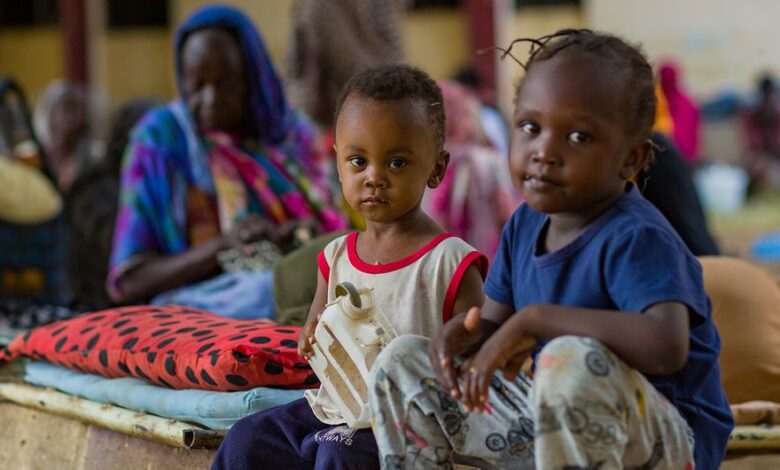
Millions of children in Sudan face escalating risks that threaten their lives and futures, amid widespread malnutrition, epidemics, and the collapse of health and education services, coinciding with the ongoing war and a widening funding gap for relief operations.
An updated report by the United Nations Children’s Fund (UNICEF) revealed that the humanitarian crisis remains at extremely critical levels, at a time when relief operations are suffering from a severe funding shortfall that limits their ability to reach millions in need.
According to the report, by the end of June, UNICEF had received only $351 million of the total funding required for its operations in Sudan through 2026, leaving a funding gap of 64 percent.
This gap threatens to further curtail vital services—including food, treatment for malnutrition, health care, water, education, and protection—as fighting spreads and it becomes increasingly difficult for humanitarian workers and supplies to reach affected areas.
The organization highlighted the scale of the danger facing children, noting that approximately 5.3 million children were screened for acute malnutrition, while 174,700 children required treatment for severe acute malnutrition—one of the most dangerous and life-threatening forms of hunger.
These figures point to the widening nutrition crisis amid the collapse of livelihoods, rising food prices, and disruptions to agriculture and markets, in addition to restrictions on the movement of goods and aid in combat zones.
The organization said that the health sector is facing increasing pressure as a result of a large number of hospitals and medical centers being out of service, shortages of medicines and staff, and the resurgence of infectious diseases.
She warned of the dangers of depriving children of vaccinations, especially against measles, rubella, and polio, amid fears that the collapse of routine immunization programs and widespread displacement could lead to the resurgence of vaccine-preventable diseases.
She also warned of a cholera outbreak spreading from Kordofan, noting that millions of Sudanese still rely on unsafe water sources, particularly in displacement camps and areas under siege or affected by fighting.
Health risks have been exacerbated by the spread of cholera in some areas of Kordofan and damage to water and sanitation networks, coinciding with the rainy season and the difficulty of getting medicines and response teams to large parts of the region and Darfur.
In the education sector, UNICEF stated that millions of children remain out of school due to displacement and the closure, destruction, or repurposing of educational institutions as shelters for displaced people.
UN Deputy Secretary-General Amina Mohammed warned that the ongoing war in Sudan is pushing the country to the brink of losing an entire generation of children, given the widespread collapse of the education system and the fact that millions remain out of school, in addition to their exposure to displacement, abuse, recruitment, and exploitation.
Speaking during an informal meeting of the UN Security Council dedicated to the protection of education in Sudan, held last Friday, Amina said that the war—which has been ongoing for more than 1,000 days—has inflicted catastrophic harm on children, stressing that the time has come to stop the fighting and save the country from losing yet another generation.
She emphasized that protecting education in Sudan cannot be separated from the need to end the war, calling for ensuring the safety of schools, students, and teachers; preventing the use of educational facilities for military purposes; and providing the necessary resources to get children back to school.
She said that education is not a service that can be postponed until after the fighting ends, but rather is an essential element in protecting children, building peace, and achieving stability and recovery.
She emphasized that Sudan is not only losing school years but also risks losing its human capital and its ability to rebuild the country, calling on the international community to act to stop the war and pull the country back from the brink of losing a new generation of its children.
The UNICEF report revealed the widespread psychological impacts of the war, noting that approximately 940,700 children and their family members required mental health services and psychosocial support to cope with the trauma resulting from violence, displacement, and the loss of relatives, homes, and sources of income.
The figures highlight a significant gap between the scale of humanitarian needs and the actual capacity to respond to them, as more than half of Sudan’s population requires assistance, while funding shortages, ongoing fighting, and obstructed humanitarian access threaten to leave millions of civilians without food, medical treatment, water, and protection.
Since April 2023, Sudan has been embroiled in a bloody war between the Sudanese Army and the Rapid Support Forces, which has left tens of thousands dead and millions displaced or refugees, amid a humanitarian crisis that the United Nations describes as the worst in the world.