Egypt has moved from rhetorical support for the Sudanese military to actively empowering it in its war effort, with the presence of a secret drone center on Egyptian soil symbolizing how Cairo links its regional strategy to the survival of the Sudanese Armed Forces in their confrontation with the Rapid Support Forces.
Since fighting broke out between the Sudanese Armed Forces and the Rapid Support Forces in April 2023, Egypt has framed its position as a defense of “Sudan’s unity, sovereignty, and territorial integrity” and of “its national institutions, particularly the Sudanese Armed Forces.” President Abdel Fattah al-Sisi has officially reiterated his pledges of “non-interference,” explaining that Egypt’s role is limited to mediation, humanitarian aid, and hosting Sudanese refugees.
In reality, this line has gradually eroded. Years of joint exercises, intelligence sharing, and military ties since 2019 had created a deep operational synergy between the two armies, long before the civil war broke out. The capture of Egyptian troops by the Rapid Support Forces at the Marwi Air Base in April 2023 was justified as part of a pre-scheduled exercise—a narrative accepted by only a handful of regional observers.
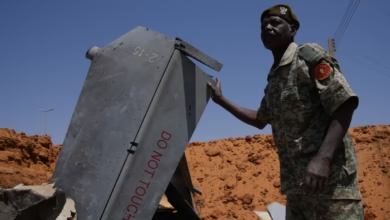
A New York Times investigation in the East Al-Owaynat region of Egypt’s Western Desert illustrates this shift from indirect support to direct operational involvement. Satellite images, flight logs, and video footage show that an airstrip previously used for civilian agricultural purposes has been expanded since 2018 with the addition of a second runway, new hangars, and satellite links, and is expected to host Turkish “Akinji” combat drones by 2025.
According to U.S. and European officials cited in that report, these drones have, over a period of at least six months, carried out airstrikes on Sudan, targeting Rapid Support Forces (RSF) positions hundreds of miles inside the country, including convoys on supply routes coming from Libya and Chad. These drones and their munitions are similar to Turkish systems, but they are stationed on Egyptian territory, which provides protection for Sudanese military assets from any retaliation by the Rapid Support Forces—raising the question of whether Cairo is merely hosting the campaign or also directing it.
For Cairo, the area east of Al-Aweinat offers plausible deniability: operations take place within a desert reclamation project far from the public eye, yet close enough to the Sudanese border to project sustained air power. For the Sudanese army, it serves as a lifeline in a war in which the Rapid Support Forces have excelled at seizing bases and shooting down drones; reports indicate that at least several units of the Akinji Forces have been lost to Rapid Support Forces fire in recent months.
Data from the “Rapid Support” organization and field evidence shed further light on the extent of Egyptian support. In January 2026, the organization published what it described as “conclusive” evidence of Egypt’s direct role, citing seized Egyptian-made ammunition, armored vehicles, and testimonies from detained commanders loyal to the Saudi Armed Forces, who described the arrival of weapons, training, and medical support from Egypt.
Egypt’s bet on the Sudanese Armed Forces is based on a logic of heightened security and regime survival. Egyptian strategists view the collapse of Sudan as an existential threat, raising fears of refugee flows and arms smuggling across the porous southern border. But control over the Nile is even more critical: since the fall of Omar al-Bashir in 2019, Cairo has intensified security and military coordination with Khartoum to form a united front against the Ethiopian Grand Ethiopian Renaissance Dam and protect its historic share of water.
There is also an ideological convergence. General Abdel Fattah al-Burhan is a career officer with long-standing ties to Egyptian leaders, and his military rule mirrors al-Sisi’s path from the barracks to the presidency. The Sudanese Armed Forces’ support aligns with a long-standing Egyptian tendency to stand with the regular Sudanese army “regardless of who commands it” and, more broadly, a preference for strong, centralized armies over chaotic civilian transitions in the Arab world. The Sudanese Armed Forces’ reliance on militias and ideologues loyal to the Muslim Brotherhood—including the glorification of early militant figures such as Baraa bin Malik—should be a cause for concern in Cairo, given Washington’s official designation of major branches of the group as terrorist organizations.
However, by 2026, Egypt’s gamble appears increasingly precarious. The war has claimed tens of thousands of lives, displaced more than 14 million people, and pushed parts of Sudan to the brink of famine, while neither side has been able to decisively secure control. Burhan’s legitimacy is highly contested: he led the 2021 coup that derailed a fragile civilian-military transition, and many of the forces that led the 2018–2019 uprising view it as a continuation of military dominance, not a path to elections.
Cairo’s categorical rejection of “parallel entities” and alternative governments in exile is presented as a defense of Sudanese unity, but in reality, it strips broad civilian coalitions—those seeking to organize outside the binary of the Sudanese Armed Forces and the Rapid Support Forces—of their legitimacy. By equating Sudanese “national institutions” with the current military leadership, Egypt narrows the scope of acceptable dialogue to a military council whose regional influence and popularity are eroding.
At the same time, Egypt is seeking recognition as a mediator through platforms such as the Quadripartite Dialogue (QUAD) and by hosting conferences for Sudanese civilian and political actors in Cairo. This stance contradicts explicit promises not to waver or delay in supporting the legitimate Sudanese government headed by Burhan, as well as mounting evidence of Egyptian air operations in the conflict. The secret base in the desert—and the drones taking off from its runways toward the skies over Sudan—have become a symbol of a policy that claims non-interference while in reality contributing to dragging Sudan into a devastating foreign war.
*Carla Davies* is a Brussels-based journalist. She writes about foreign affairs for the “EU Political Report” website and focuses on the Middle East and Africa.