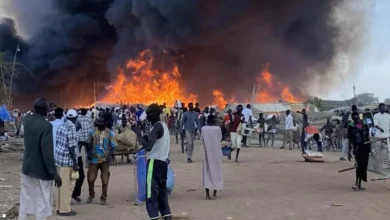
A British report has revealed the escalating human cost of the war in Sudan, noting that the average number of civilians killed exceeded 52 per day during the period from January 2024 to June 2026, according to data from the Armed Conflict Locations and Events Database (ACLED), one of the world’s leading databases specializing in monitoring and documenting armed conflicts
According to the report, the project documented the deaths of 18,766 civilians during that period, while the total death toll of civilians and combatants reached 52,904 as of June 2026. However, it noted that the actual toll may be much higher, given the difficulty of accessing combat zones, ongoing fighting, and disruptions to documentation efforts in large parts of the country.
The report, issued by the British Home Office as part of its periodic update assessing the security situation in Sudan, provides the most comprehensive picture of the course of the war since its outbreak in April 2023, drawing on data from the United Nations, ACLED, human rights and humanitarian organizations, as well as reports from international missions and specialized research centers.
Significant Variation in Casualty Figures
The report emphasizes that documenting the casualties of the war in Sudan has become an extremely difficult task due to ongoing military operations, the inaccessibility of large areas, and the collapse of state institutions—factors that have led to significant variation in estimates of the death toll.
While the Armed Conflict Locations and Events Project documented the deaths of 52,904 civilians and combatants as of June 2026, other UN estimates indicate that the total number of war casualties could reach approximately 150,000. The report also noted that the United Nations documented the deaths of 11,300 civilians in 2025 alone, equivalent to more than 31 civilians per day.
The report attributes this discrepancy to the significant constraints facing monitoring and documentation efforts—rather than to conflicting facts—due to ongoing fighting, difficulty accessing conflict zones, and the large number of victims who have not been officially recorded.
Redrawing the Map of the War
The report notes a striking shift in the map of military operations in recent months, explaining that the Sudanese army’s regaining of control over large parts of Khartoum and Al-Jazirah State did not lead to a de-escalation of the war, but rather redrew the map of the confrontations, shifting the focus of the fighting to the Kordofan states, while intense fighting continues in Darfur and clashes have spread in Blue Nile State. The report notes that Khartoum and Sennar have seen a relative decline in the intensity of fighting compared to previous phases, while the states of Red Sea, River Nile, Northern, Gedaref, and Kassala have remained the least affected by the conflict.
According to the report, the Sudanese Army currently controls slightly more than half of the country’s territory, while the Rapid Support Forces continue to exert their influence over most of the Darfur region and large parts of western and southwestern Sudan.
Widespread Violations and the Absence of Justice
The report documents grave human rights violations committed by both sides of the conflict, as well as armed groups allied with them, including the targeting of civilians, extrajudicial killings, arbitrary detention, torture, sexual violence, looting, and forced recruitment, in addition to ethnically motivated violations in a number of areas.
The report also notes a sharp deterioration in the justice system in areas controlled by both sides of the conflict. In areas under the army’s control, the report cites accounts of trials that do not meet standards of justice, in which death sentences or life imprisonment were handed down to individuals accused of collaborating with the opposing side, amid concerns that people are being targeted based on their geographic or ethnic affiliation. In areas under the control of the Rapid Support Forces, the report highlights the absence of an independent judicial system and the establishment of emergency courts directly linked to the security services.
Returning Does Not Mean Safety
Although the intensity of fighting has decreased in some areas, the report warns against viewing this as an indication of an improved security situation, emphasizing that large parts of Sudan continue to suffer from the presence of unexploded ordnance, lawlessness, ongoing armed violations, and the collapse of basic services.
It adds that those returning to conflict zones face significant challenges, foremost among them the widespread destruction of infrastructure, the breakdown of state institutions, and ongoing restrictions on movement in some areas, along with acute shortages of water, healthcare, education, and basic services—making a safe and sustainable return unattainable at this time.
A Worsening Humanitarian Crisis
The report confirms that the war in Sudan has created one of the world’s largest humanitarian crises, with millions continuing to be displaced both within the country and abroad, food security deteriorating, the health system collapsing, and famine and epidemics spreading across a number of states. It warns that the continuation of military operations will deepen the humanitarian disaster, undermine prospects for economic recovery, and increase pressure on neighboring countries hosting millions of Sudanese refugees, at a time when resources available for humanitarian response are dwindling.
A War with No End in Sight
The report finds that all attempts to reach a ceasefire or launch a comprehensive political process since the war broke out in April 2023 have failed to achieve any breakthrough, given the parties’ adherence to military options, the continued flow of weapons, and the entanglement of regional and international interests.
It notes that the conflict is no longer merely a confrontation between the Sudanese Army and the Rapid Support Forces, but has transformed into a protracted, multi-front war fueled by internal divisions, the proliferation of armed groups, and external interventions—all of which make the prospects for a political settlement even more complicated.
The report concludes that the war is no longer merely a power struggle between two parties but has turned into a protracted conflict that is reshaping the political and military landscape in Sudan, while civilians continue to pay the heaviest price amid the absence of any clear prospect for ending the fighting.
The British report is the most recent comprehensive official Western assessment of the security situation in Sudan. It is used as a reference in evaluating asylum and protection claims and paints a comprehensive picture of the scale of destruction caused by the war, as well as the security and humanitarian challenges that continue to prevent any serious path toward stability.