Rhino: Agencies – The U.S. State Department has imposed a new round of sanctions on the Sudanese government, citing allegations that it used chemical weapons in its war against the “Rapid Support Forces,” without providing details on the nature of these weapons. So what does Agence France-Presse know about the matter? Reports from international media outlets indicated that two barrel bombs loaded with chlorine gas were dropped on areas controlled by the Rapid Support Forces in 2024.
Since April 2023, Sudan has been embroiled in a bloody war between the army, led by Abdel Fattah al-Burhan, and the Rapid Support Forces, led by his former deputy, Mohamed Hamdan Dagalo, nicknamed “Hemedti.” Against the backdrop of the conflict, numerous reports have emerged alleging war crimes.
In January, the United States imposed sanctions on the Rapid Support Forces, accusing them of committing genocide in Darfur, in the west of the country.
Sanctions
Last month, the U.S. State Department announced a second round of sanctions against the Sudanese government loyal to the military, after concluding last year that “the Sudanese government used chemical weapons in 2024,” in violation of the Chemical Weapons Convention, to which Sudan acceded in 1999.
Washington did not provide any information regarding the locations that were targeted by chemical weapons attacks or the dates of those attacks.
The military-backed Sudanese government was quick to deny the U.S. accusations, describing them as “baseless” and “political blackmail.”
The latest round of sanctions, which took effect on Monday, restricts Sudan’s ability to access U.S. financing and exports, and prohibits Sudanese-owned airlines from using U.S. airspace.
The first round of sanctions took effect in June 2025 and prohibits financing or exports to Sudan.
Emergency humanitarian aid is exempt from the sanctions imposed on Sudan, where some 25 million people suffer from food insecurity.
A Long History of Allegations
In January, The New York Times reported that the Sudanese military had used chemical weapons on at least two occasions in remote areas during its war with the Rapid Support Forces.
The newspaper quoted unnamed U.S. officials as saying that the weapon appeared to be chlorine gas, which can cause severe respiratory distress and lead to death, and that this was done with Al-Burhan’s direct approval.
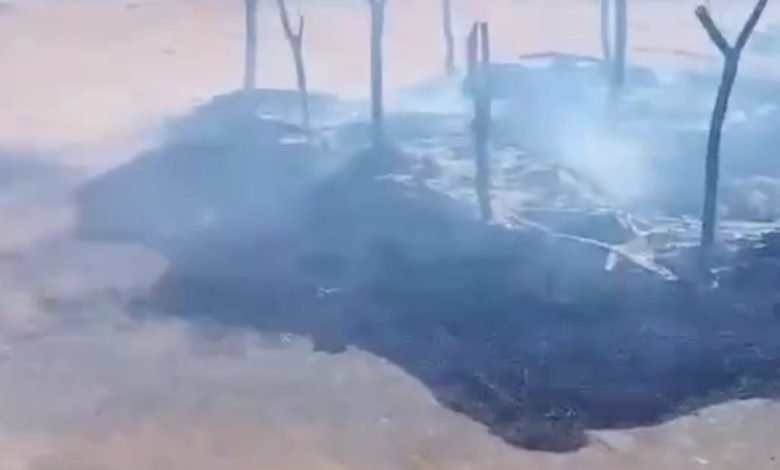
In an investigation published in October, a French media outlet reported that military aircraft dropped two barrels of chlorine gas in September 2024 near the Al-Jili oil refinery north of Khartoum, which was under the control of the Rapid Support Forces at the time.
The investigation drew on open-source data, social media footage, and the opinions of five experts. The Sudanese military has previously been accused of carrying out attacks using chemical weapons during earlier periods in the country’s history, which, since its independence in 1956, has generally been ruled by leaders with military backgrounds.
In 2016, Amnesty International condemned the use of chemical weapons in Darfur (west) by the army, which was allied with the Rapid Support Forces at the time—a claim denied by Khartoum.
In 1998, the United States claimed that the Al-Shifa Pharmaceutical Factory was producing chemical components for al-Qaeda before it bombed the facility.
Washington did not provide evidence to support its allegations, which were never investigated.
Previous Sanctions
Relations have been strained for decades between the United States and Sudan, which was ruled by Omar al-Bashir from 1993 until he was ousted in 2019, and which has long been accused of sponsoring terrorism.
U.S. sanctions were imposed on Sudan in the early 1990s and were tightened in 2006 following accusations that the Janjaweed militia (formerly the Rapid Support Forces) had committed genocide in the Darfur region.
At the time, the group was acting under instructions from Khartoum. After Bashir was ousted in a popular uprising in 2019, the United States removed Sudan from its list of state sponsors of terrorism and began the process of lifting sanctions.