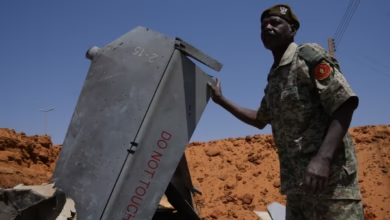
Accusations that the Sudanese military has used chemical weapons have resurfaced after U.S. sanctions linked to Washington’s announcement of the military’s use of such weapons went into effect. This follows reports from community leaders and local residents in the “Umm Qarfa” area of North Kordofan State that an “Antonov” aircraft belonging to the army dropped unusual projectiles on Saturday, which emitted colored smoke and pungent odors upon impact with the ground.
These suspicions were reinforced after a video clip circulated showing members of the Rapid Support Forces discussing the aircraft’s dropping of projectiles that caused thick yellow smoke to rise, expressing their belief that they may have contained chemical substances.
Hamed al-Radi, a local resident, told “Sky News Arabia” that the aircraft initially dropped projectiles that caused powerful explosions and a thick plume of black smoke, before dropping other projectiles that produced yellow smoke and a foul, pungent odor, according to accounts from witnesses who were near the site of the bombing.
Al-Radi explained that the bombing took place in an area that was uninhabited at the time of the attack, but he expressed concern about potential repercussions for the population and the environment if it is confirmed that the munitions contained chemical substances, calling for international investigations to determine their nature.
The incident comes days after a new round of U.S. sanctions against the ruling authority in Port Sudan took effect, as part of the second phase of measures stipulated in the Chemical and Biological Weapons Control and Elimination Act.
The sanctions followed the United States’ official announcement—for the first time—that the Sudanese military had used chemical weapons in 2024, in the context of the war that has been ongoing since April 2023.
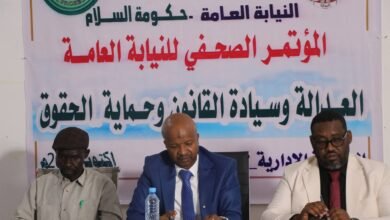
In the first reaction from an official of the Nyala-based “Government of Peace,” Ezzedine al-Safi, head of the Humanitarian Access Authority in the government—whose Presidential Council is chaired by Mohamed Hamdan Dagalo (Hemedti)—called for an urgent and independent international investigation into what he described as a “chemical attack” on the Um Qarfa area.
Al-Safi said that the videos circulating online indicate, in his words, that the Sudanese army used chemical weapons against civilians. He called on the United Nations and relevant international bodies to conduct an immediate investigation, provide medical and humanitarian aid to the affected communities, and hold those responsible for any violations accountable, stressing that the international community “must not remain silent.”
The United States had escalated its pressure on the Port Sudan authorities during the 112th session of the Executive Council of the Organization for the Prohibition of Chemical Weapons (OPCW), which was held in The Hague from July 7 to 10.
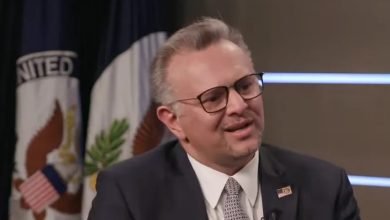
U.S. Ambassador to the OPCW Nicole Champain said in her statement to the Council that the United States had concluded that the Sudanese military used chemical weapons in 2024, and called on the Port Sudan authorities to fully disclose their relevant chemical activities, cooperate with international verification procedures, and comply with Sudan’s obligations under the Chemical Weapons Convention. Washington also questioned Sudan’s eligibility to remain a member of the organization’s Executive Council as long as it fails to comply with those obligations. This marks the first time Washington has publicly called for Sudan to be subject to international verification procedures under the Chemical Weapons Convention.
The case had already moved from the realm of political accusations to the legal track within the Organization for the Prohibition of Chemical Weapons (OPCW) when, in June 2025, Mauritania, Chad, Benin, and Guinea-Bissau submitted formal requests to Sudan pursuant to Article 9, Paragraph 4, of the Chemical Weapons Convention, requesting clarification regarding allegations of chemical weapons use during the war.
During the most recent session of the OPCW Executive Council, the United Kingdom called on the Port Sudan authorities to fulfill Sudan’s obligations and conduct a comprehensive investigation into these allegations, indicating that the issue remains open within the OPCW and is being closely monitored by the States Parties.
These developments indicate that the chemical weapons issue is no longer merely a matter of mutual accusations between the warring parties, but has become a matter on the international community’s agenda, in light of an official U.S. announcement that the Sudanese military used chemical weapons, sanctions that have gone into effect, and ongoing efforts within the OPCW—all of which may subject any new allegations to broader international scrutiny in the coming period.