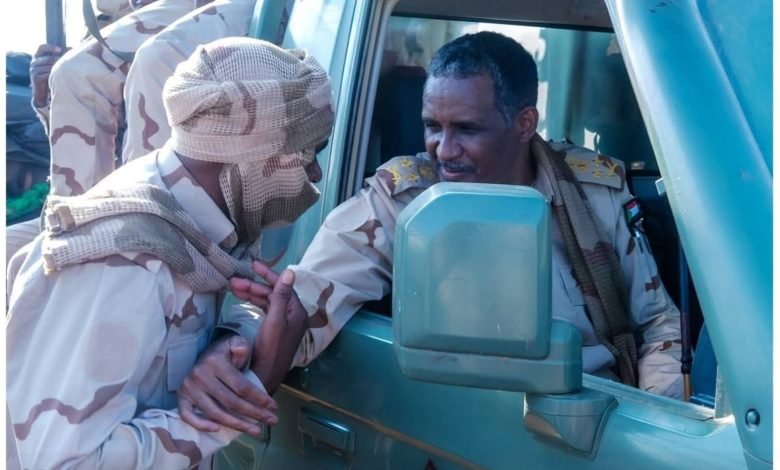
In his first appearance before thousands of his soldiers, Rapid Support Forces commander Mohamed Hamdan Dagalo, known as Hamidti, announced his readiness to resolve his differences with Egypt, accusing the army leadership of fabricating those differences.
At the beginning of his speech, Hamidti took off his sunglasses, mocking statements made by some officials about his death and describing him as a puppet and artificial intelligence, adding: “I took off my sunglasses to avoid these descriptions.”
Hamidti reassured neighboring countries that the Rapid Support Forces’ control of the border triangle region “will not be an advantage to them, nor will it be a disadvantage.”
The Rapid Support Forces have taken control of the border triangle region, which connects Sudan, Egypt, and Libya, a strategic area rich in mineral resources.
Cairo remained silent about the Rapid Support Forces’ control of the neighboring triangle area and did not comment on this development.
Daglo explained that these areas “were the scene of illegal activities, such as drugs, terrorism and smuggling, including smuggling to Egypt.” He accused army leaders of involvement in these crimes and asserted that they “managed to secure the borders with neighbors,” emphasizing his respect for all neighboring countries, including Egypt, and stressing that “the dispute between the Rapid Support Forces and Egypt was fabricated by army leaders,” affirming his readiness to resolve differences through dialogue.
He said that the leaders of the armed forces had sought, over the past years, to sabotage the Rapid Support Forces’ relations with Chad and South Sudan, but they had failed. He pointed to “a final attempt before the war, which was to send groups to Central Africa to kill Russians and then pin the blame on the Rapid Support Forces,” asserting that they had “exposed the plot.”
However, he threatened to take a new stance on oil exports, saying, “We allowed oil to pass out of respect for South Sudan, but now we have a different opinion, because the revenues are being used to buy weapons and missiles.”
He emphasized that Darfur and Kordofan are rich in resources, especially oil, minerals, gum arabic, and tourism, while at the same time insisting on working to control Port Sudan, hinting at his commitment to the unity of the country.
Relaxed body language:
The commander of the Rapid Support Forces appeared reassuring, with relaxed body language, and delivered a lengthy speech in a confident tone, in which he sent numerous messages to the regional environment, armed movements, his soldiers and supporters, administrations, and leaders.
Observers believe that Hamidti’s speech, which lasted 23 minutes after editing, appeared conciliatory toward the regional environment, especially Egypt, and tolerant of armed movements supporting the army. He also sought to boost the morale of his soldiers and supporters and was strict toward administrations and leaders. The speech precisely defined the circle of hostility, limiting his attack to army leaders and the Islamic movement, without mentioning the Sudanese Founding Alliance, the parallel government, or his forces’ alliance with the Popular Movement.
Renewed accusations:
Daglo continued to accuse the armed forces leadership of dragging the country into war, adding that he had avoided the outbreak of war over the past years. He emphasized that “fighting for us is self-defense, and we are not advocates of war, but advocates of peace, but we were forced to fight it, and we lost what was most precious to us.”
Hamidti also attacked the Sudanese security apparatus, blaming it for the war, saying, “I was against the decision to dissolve it, as Hamdok testified, and I regret that,” adding that his forces “eliminated the security apparatus and terrorist groups during the ongoing war,” as he described it.
Hamidti said that “the army has nothing left and has been forced to resort to Eritrean soldiers and civilian miners,” noting that “only one division remains of the army.”
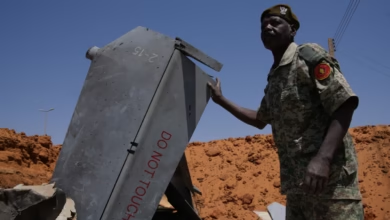
Hamidti vowed to destroy the armed forces’ drones, noting that the army commanders had nothing left but drones. The armed forces launched their latest attack on the Al-Majlad Referral Hospital on Saturday evening, killing dozens, including medical personnel. Hamidti also directed that military training continue in all localities.
Humanitarian aid:
On the humanitarian front, the Rapid Support Forces commander pledged to deliver aid to all areas under their control in Darfur and Kordofan, stressing that “hundreds of thousands of displaced people have arrived in those areas, fleeing Khartoum, Al-Jazeera, and areas in northern Kordofan.”
He issued strict orders to combat “the spread of weapons, drugs, security breaches, and the seizure of citizens’ homes.”
Hamidti also announced a decisive stance toward those he described as “the Shafshafa,” saying, “We are preparing prisons to put them in. They do not represent us, and we will not enter the North and Nile regions with them.”
He announced the Rapid Support Forces’ intention to pay soldiers’ salaries retroactively since April 15, to treat the wounded, and to form committees to count the martyrs, adding: “We will provide appropriate treatment and seek to care for the injured.”
Messages to armed movements:
In a clear message to some political leaders in Darfur, Hamidti said that he “has no problem with Minnawi and Jibril” and that he “will accept them if they come now.”