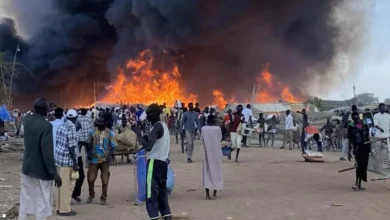
As drone attacks escalate and the scope of targeting expands within and around the capital Khartoum, the war in Sudan is entering a more dangerous phase, marked by rapid military escalation and worsening political deadlock.
The widespread attacks that targeted the heart of the Sudanese capital on Tuesday, extending to Omdurman, El Obeid, and White Nile, and prior to that to cities in Darfur states such as Nyala, Zalingei, and others, indicate a qualitative and dangerous shift toward a militarily low-cost style of warfare, in which drones are used as a central tool in the conflict.
In practice, this shift means prolonging the war, with the resulting increase in destruction and the rising human and humanitarian cost, amid a clear political deadlock.
UN: Sudan Is a “Laboratory of Atrocities”
The United Nations described the escalating drone attacks between the warring parties as “extremely concerning and endangering the lives of civilians,” noting that the new attacks have displaced more than 2,600 people in North Kordofan and nearly 1,000 people in South Kordofan in the past week alone.
Stéphane Dujarric, spokesperson for the UN Secretary-General, said a drone was shot down over Khartoum International Airport, leading to the cancellation of flights, adding: “This airport, as you know, is critical for humanitarian access.”
Dujarric condemned the attacks on civilians and civilian infrastructure, calling on all parties to respect international humanitarian law. Tom Fletcher, the UN Under-Secretary-General for Humanitarian Affairs, had described the war in Sudan as having turned into a “laboratory of atrocities,” noting that schools and hospitals were now being systematically targeted.
He said, “Drones have claimed the lives of 700 people this year alone, and 130 humanitarian workers have been killed over the past three years.”
A Cheap Weapon… and a Devastating Impact
The recent attacks carried out by both sides of the conflict, the latest of which targeted the area around Khartoum Airport and other regions, reflect a qualitative shift in the conduct of the war, as drones have become a key component of military operations.
Sudanese military expert Brigadier General Mohamed Awad told Sky News Arabia that “this approach reduces the cost of military operations, expands the scope of targeting, and at the same time increases the risk of civilian casualties, allowing for rapid infliction of losses without the need for traditional front lines.”
Awad believes this shift entrenches what is known as “smart attrition warfare,” which prolongs the conflict without a military resolution or a clear victory for any of the parties involved.
Foreign Interventions
In parallel with this escalation, there have been increasing signs of the conflict’s growing external dimension, amid mounting international accusations of foreign parties’ involvement in supporting military operations.
A recent U.S. report revealed an Iranian military supply network to the Sudanese army, which included “Mojaher-6” drones, while judicial investigations in Abu Dhabi and Washington have uncovered arms smuggling networks supplying the army from Iran and other sources.
Observers believe this interference confirms that the war is no longer a purely internal matter but has become linked to broader geopolitical calculations, further complicating it and making it harder to contain.
The Humanitarian Environment Under Threat
Data from the International Conflict Observatory revealed that Sudan saw a 47 percent increase in drone strikes over the past year, and that these drones have become “death traps” for civilians, as they are responsible for 80 percent of child deaths and injuries in the war.
Reports from international humanitarian aid organizations indicate that the escalating use of drones complicates humanitarian operations and increases risks to civilians, as the challenge extends beyond merely delivering aid to ensuring it is not affected by the conflict.
These organizations have also warned that the escalation of military operations using these means makes the humanitarian environment more dangerous and complex.
Recent reports from the United Nations Development Programme and the World Food Programme highlight widespread damage to production sources and a halt in agricultural activity, increasing reliance on aid and threatening to turn the crisis into a long-term food disaster.
Who is obstructing an end to the war?
Despite growing international calls for a ceasefire, settlement efforts continue to face significant obstacles linked to the intertwining of interests within the military and political power structures.
Sudanese political analysts note that Islamist factions, led by the Muslim Brotherhood, which influence military decision-making within the army and political decision-making within the current authority in Port Sudan, are working to obstruct serious initiatives that could contribute to ending the war, including the four-party initiative involving the United States, the United Arab Emirates, Saudi Arabia, and Egypt.
Sudanese politicians add that these factions, which seek to return to power through war, are exploiting their presence within the army and the deployment of their battalions and militias in combat zones to influence the course of any potential political settlement, thereby complicating the prospects for reaching a comprehensive agreement to end the war.
A War with No End in Sight… and Peace on Hold
What is happening in Sudan has gone beyond the stage of conventional warfare and has become a multidimensional crisis, in which low-cost military technology intertwines with the illicit economy and complex political calculations.
Given this reality, ending the war has become an urgent necessity, not only to stop the bloodshed but also to prevent the entrenchment of a complex system that would be difficult to dismantle later.
However, achieving this remains contingent on addressing the root of the problem: the entanglement of interests within the existing power structure, and the presence of forces that view the continuation of the war as an opportunity to reshape influence, rather than a threat that must be ended.