Children Killed in Army Massacre at El Daein Hospital
Rhino: Agencies
The war in Sudan is no longer a military conflict confined to the battlefield; but has moved abroad, transforming into a fully-fledged model of what is known as the “war economy,” where smuggling, money laundering, and illicit financing networks intertwine with the lines of combat, producing a self-sustaining system in which the war feeds on its own resources and constantly reproduces itself.
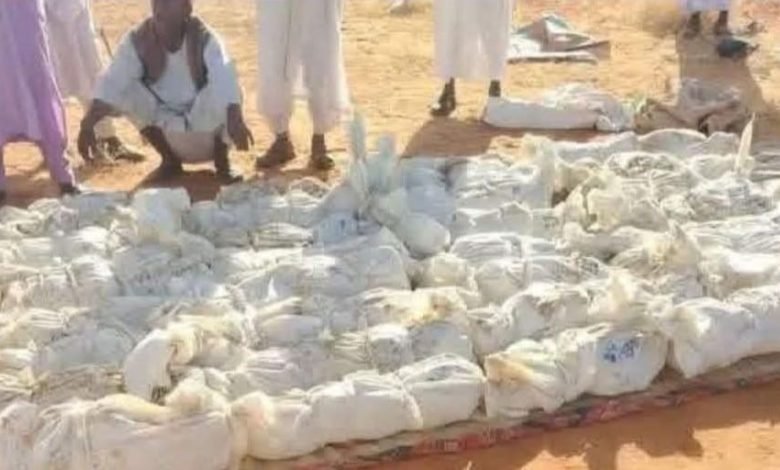
The case uncovered in Abu Dhabi, linked to the involvement of a network working with the Sudanese army to smuggle weapons through the UAE, and the earlier revelation by U.S. authorities of the arrest of the Iranian arms broker “Shameem Mafi,” who works for the Sudanese army, are not isolated incidents; rather, they reveal a broader and more complex structure extending from the ports of Port Sudan and Bandar Abbas, where financial markets intertwine with humanitarian work and cross-border corporate networks.
From a Parallel Economy to a Dominant Economy
In the early stages of wars, the informal economy appears as a marginal phenomenon, but in the Sudanese war, the data points to a qualitative shift: the war economy is no longer merely a parallel activity but has become the primary source of funding for military operations, a tool for redistributing power among actors, and a de facto substitute for collapsed state institutions.
This shift means that the Sudanese army no longer relies solely on direct external support but has begun working with illegal networks to finance itself internally and externally through unofficial channels.
How Does the Hidden Network Operate?
Investigations into arms smuggling reveal a recurring pattern in modern conflicts, based on three interconnected layers: Legal fronts through officially registered companies operating in transportation, trade, or services, but used as channels to funnel money or cover up logistical operations, alongside a flexible financial layer involving traditional money transfers (hawala) and geographically dispersed bank accounts to launder money through commodity trade. In addition, there is a multi-path logistics network connecting ports to the port of arrival in Port Sudan. This structure, according to experts, allows the system to operate with high flexibility, making it difficult to disrupt by targeting a single point.
Revealing the Port Sudan Authority’s Involvement
Adel Ibrahim, Sudan’s former Minister of Energy and an expert on conflict economics, revealed to Sky News Arabia a state-owned company mentioned in the indictment—Petrolines—stating: “The use of a state-owned company affiliated with the Ministry of Energy in arms smuggling reveals that the matter has gone beyond the military and reached the Port Sudan Authority, which has turned into a branch of organized crime.”
He added: “What Sudan is currently witnessing is no longer just a traditional war economy, but a hybrid financial system resembling transnational mafia networks, which adapts quickly to pressures and reshapes itself through cross-border networks. These networks rely not only on arms smuggling, but on a mix of front companies, informal cash flows, and the exploitation of loopholes in the international financial system.” He said: “Most dangerously, this structure grants the ability to persist without the need for a military resolution, making war a sustainable economic option, not merely an emergency.”
The Infiltration of the Humanitarian Sector
One of the most alarming findings revealed in the report by the UAE’s Attorney General, Hamad Saif Al Shamsi, is the use of a humanitarian cover as part of this network, as the case exposed the use of weapons under the guise of pharmaceutical companies. According to humanitarian experts, the issue here is not merely the misuse of resources, but the transformation of humanitarian work into a low-suspicion logistical channel for organized crime networks, and a cover for financial flows that are difficult to trace.
Humanitarian expert Saleh Abubakar told “Sky News Arabia”: “The challenge is no longer just the scale of humanitarian needs, but the environment in which these operations are managed; when war economy networks intersect with aid routes, the process of delivering support becomes more complex and dangerous.”
He adds: “In some cases, the problem is not limited to security obstacles but extends to the risk of resources being diverted or exploited indirectly, which threatens the neutrality of humanitarian work and undermines the trust of affected communities in organizations operating in the field.” The Globalization of the War Economy and the Diminishing Space for Solutions
Although the conflict in Sudan appears to be internal in its military nature, its economic structure has become transnational, where the interests of regional commercial networks, international financial intermediaries, and informal actors in the arms markets intersect.
The irony, however, is that this economic internationalization has not been matched by an effective internationalization of peaceful solutions, as international pressure tools remain fragmented and slow, and are unable to target complex networks.
Why do these networks prolong the war?
The war economy not only finances the conflict but also reshapes its motivations. In this context, three fundamental shifts occur: first, the motivation shifts from political goals of seizing power to economic gains; second, the circle of those benefiting from the war expands to include actors outside the battlefield; and third, self-sustaining sources of funding ensure the war’s continuation.
Consequently, ending the war becomes a direct threat to the interests of these networks, backed by elements of the old regime (the Muslim Brotherhood) aspiring to return to power, thereby widening the circle of resistance to any political settlement that would end the war.
Sudanese political observers say that even if an agreement is reached, the survival of these networks means Sudan will face complex challenges, most notably the existence of a powerful shadow economy shared with the military that competes with the state, the difficulty of regaining control over resources, the infiltration of government institutions by illicit funds, and the complication of reconstruction and investment efforts.
In other words, the end of the war, with these networks linked to the military still in place, does not necessarily mean the end of the war economy; rather, it may pose a threat to stability and sustainable peace.
Summary
The arms network case referred to the Abu Dhabi court, along with the case being investigated by U.S. judicial authorities, has revealed a deeper reality: that the war in Sudan is no longer merely a reckless and destructive move by an Islamist organization to return to power under the cover of the army’s guns, but has transformed into a fully-fledged economic system that spans borders and creates intertwined interests that keep it afloat.
The real challenge today lies not only in enforcing a ceasefire, but in dismantling this complex system—a task that requires high-level international coordination, advanced financial and intelligence tools, and international political will that goes beyond crisis management to address the root causes of the conflict.
In the absence of these elements, the war economy will remain the most consistent factor in reshaping the balance of power within Sudan and shaping the course of the conflict beyond traditional military and political calculations, becoming the decisive factor in determining who holds influence and who has the ability to prolong the war.