The Sudanese arena is currently witnessing a complex phase marked by the intertwining of internal conflict, an unprecedented humanitarian disaster, and regional rivalries, as the war between the army and the Rapid Support Forces—which erupted in April 2023—continues with no decisive resolution in sight.
An analysis published by the “Modern Diplomat” platform argues that the core of the crisis in Sudan now lies not in the military balance of power on the ground, but in the nature of the existing alliance with the Islamists (the Muslim Brotherhood) on which Sudanese Army Commander Lieutenant General Abdel Fattah al-Burhan relies.
The Brotherhood Within the Army
The analysis noted that the relationship between the army led by Burhan and Islamist factions is a “double-edged sword.” It provides crucial internal support for the army on the ground, but at the same time undermines its commander’s ability to build international trust, particularly among Western and regional powers that view this alliance with suspicion.
It noted that the emerging regional consensus, embodied in the “Quartet,” clearly states that any sustainable settlement in Sudan must exclude Islamist factions from both the military and civilian politics. “Nevertheless, the military continues to rely heavily on Islamist factions and their cadres, as well as affiliated militias, which provide the ideological framework and combat capability.”
He noted that Burhan’s relationship with Islamist factions is not a passing phenomenon, but rather the actual “operating system” of his rule since the coup against the transitional civilian government in October 2021.
Al-Burhan’s Dilemma with Iran
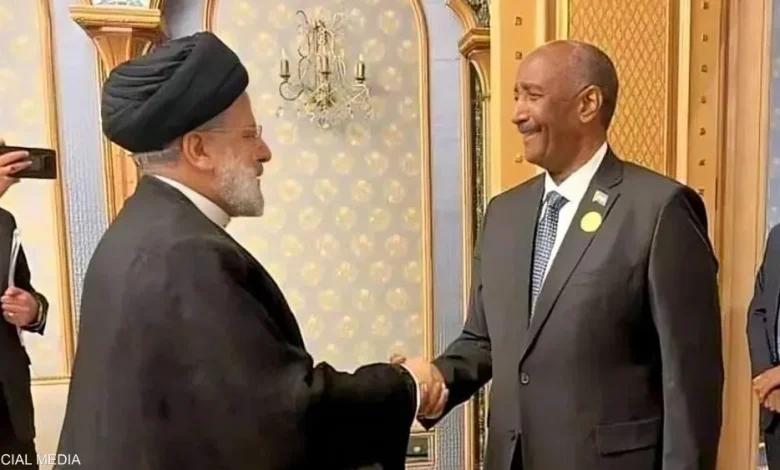
The report stated that Al-Burhan faces a dilemma in balancing his relationship with Iran—which has strong ties to his Islamist allies in Sudan and supplies him with the weapons he relies on in his war against the Rapid Support Forces—and his relationship with the Gulf Arab states, which are subject to Iranian attacks.
The analysis described this dilemma, noting that any rapprochement with Iran angers the Gulf states and the West. Conversely, abandoning this support angers the Islamists and weakens the army on the ground. This creates a difficult equation from which it is hard to escape without political or military cost.
According to the analysis: “Fears in the Gulf are not limited to the return of Islamists to state institutions, but extend to include the transformation of a desperate, Islamist-tinged military regime into a logistical and political bridgehead for Iran. Based on this logic, the drones and air defense systems being delivered today could be used tomorrow in ways that harm their security interests if the ideological balance within the military shifts further toward Islamist currents.”
The World’s Patience Is Running Out
The analysis stated that the world’s patience is running out. Foreign messages have become more explicit in expressing this. “When officials in the United States and the region speak of curbing Islamist influence and limiting Iran’s regional activities, they are effectively talking about reshaping a post-Islamist alliance.”
It added that the recent rounds of sanctions targeting Islamist groups and pro-military Islamist figures in Sudan, along with the West’s insistence on the need to insulate Sudanese security institutions from Brotherhood-linked factions in any ceasefire or political transition, “are all signs that the old trade-off—tolerating Islamists in exchange for dealing with the military—is no longer acceptable.”
A Policy of Deception and Pretense
The analysis states that “Army Commander Burhan is sending international messages suggesting he is responding to international and regional pressure to distance himself from Islamist factions. He does this through a series of calculated and contradictory gestures. On the one hand, he carries out selective and token arrests of some Islamic militia leaders and issues public verbal criticisms of some of them as evidence of his ability to control his internal front.”
Conversely, the analysis describes these moves as “carefully orchestrated to be interpreted by foreign diplomats as a sign of good faith. At the same time, they ensure that Islamist factions and military operations remain shielded from any real harm.”
The analysis noted that the longer the war continues, the more the Islamists’ influence grows rather than diminishes. They provide enthusiastic fighters and ideological cohesion at a time when the army is suffering from exhaustion and fragmentation. It points out that as Burhan has become the “acceptable face” of this regime he has formed—rather than a commander of a disciplined national army—any genuine purge would amount to actual suicide, and he knows it.
Loss of International Trust
The analysis highlighted the decline in international trust in Abdel Fattah al-Burhan’s leadership, noting that Sudan’s international partners are no longer convinced of the military leadership’s ability to rein in the Islamists and present a clear political agenda. This leads to weakened external support and complicates any political settlement. The analysis argues that the absence of a clear political agenda, coupled with increasing reliance on Islamist factions, informal networks, and militias, limits the chances of reaching a comprehensive settlement. It further contends that the continuation of the war reinforces this trend. This gradually weakens traditional state institutions, making their reconstruction more difficult and complicating the subsequent establishment of a centralized state.
The report concluded that Sudan’s crisis does not lie in the war between the Sudanese Armed Forces and the Rapid Support Forces, but rather in the power structure within the army itself and its relationship with Islamists and the region. This leads to the conclusion that any future settlement will not be possible without a profound overhaul of this structure, and not merely through ceasefire agreements or security arrangements between the two sides of the conflict.
The report concluded that “the forces enabling Burhan to continue the war are the same ones that make him an unacceptable partner for the states capable of stabilizing Sudan,” adding that until this contradiction is resolved—either by radically restructuring his coalition or by openly embracing the Islamist project—his relations with Gulf and Western backers will remain stuck in a pattern of tactical cooperation and strategic confusion, and every arms deal or diplomatic initiative will be haunted by a single question: “On whose behalf does Burhan truly rule?”