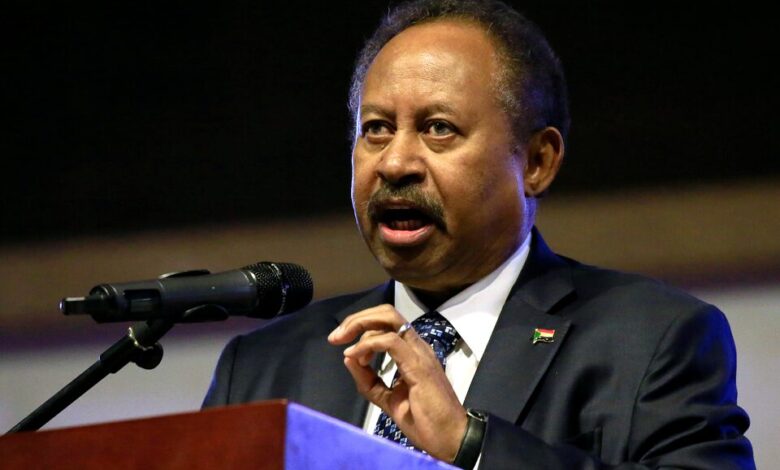
Head of the Civil Democratic Alliance of Revolutionary Forces “Sumoud” Former Prime Minister Dr. Abdullah Hamdok
Rhino: Agencies – Former Sudanese Prime Minister Abdullah Hamdok said that the formal inclusion of civilian forces in the Berlin Conference on Sudan represents a significant turning point in international efforts to end the war, coinciding with the conference being held on the third anniversary of the outbreak of the conflict.
The International Ministerial Conference on Sudan will be held on April 15, following two previous meetings in Paris in 2024 and London in 2025, which failed to secure a ceasefire or establish a credible political framework.
The conference is co-hosted by Germany, the African Union, the European Union, France, the United Kingdom, and the United States, with the participation of international officials and representatives from the United Nations and humanitarian organizations, as well as an organized civil society forum comprising Sudanese forces and groups.
Hamdok, head of the Sumud Alliance, said the Berlin conference differs from previous meetings in that it gives civilians a space for direct participation after their absence in past rounds.
He added in a telephone interview with The National shortly before heading to Berlin: “The only guaranteed path is a political process that addresses the roots of the crisis.”
He explained that the civilian delegation intends to push for the opening of humanitarian corridors, the protection of civilians, and the launch of a political process to end the war.
Hamdok emphasized: “From day one, we have said that there is no military solution to this war, and no party will be able to achieve a complete victory over the other.”
He added: “We expect an announcement bringing together a broad spectrum of civilian forces opposed to the war and calling for peace.”
Chances for a Ceasefire Are Limited
According to the interview, expectations for a political breakthrough in Berlin remain low, even regarding the humanitarian truce called for by the United States, the United Arab Emirates, Egypt, and Saudi Arabia—collectively known as the Quartet.
Hamdok said that this initiative is the clearest to date in terms of timelines, principles, and implementation steps, adding that it has clearly exposed the parties obstructing a political solution.
He added: “I am speaking here about the Islamists and their role in destroying the country.” He noted that the Quartet’s talks are currently stalled due to disagreements among its members, but expressed hope that they would resume as the most direct path forward. Islamists Expand Their Influence Within the State
Hamdok said that the army and state institutions have fallen under the influence of Islamists, noting that the appointment of Lt. Gen. Yasser al-Ata as chief of staff is a step that confirms this trend and signals a desire to prolong the war.
He added: “Their goal is clear… Either this war will return them to power or it will destroy the country.” He warned that continuing down this path would lead to further disintegration within Sudan and open the door to regional unrest extending to the Horn of Africa and the Red Sea. Civilians Pay the Heaviest Price
Hamdok noted that civilians are the hardest-hit by the war, amid ongoing violations and attacks on hospitals, markets, and residential areas.
According to UN figures cited by the newspaper, some 14 million people have been displaced since the war began, including 9 million within Sudan and 4.4 million outside the country, while at least 59,000 people have been killed, according to estimates by international organizations specializing in conflict monitoring.