Report: African-European Organization for Humanitarian Action and Development
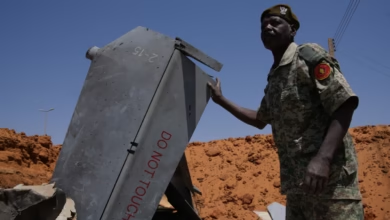
On the morning of Friday, March 20, 2026, at exactly 9:00 a.m., the Sudanese Army Air Force launched a drone strike targeting the Al-Da’ein Teaching Hospital in the city of Al-Da’ein, East Darfur State. The targeted building was not a military barracks, but a vital health facility providing treatment to civilians and displaced persons who had fled the ravages of war, as well as serving as a center for healthcare provision. The direct strike completely destroyed the building, shattering all medical devices, equipment, and furniture, in a scene that epitomizes the systematic destruction of civilian infrastructure.
As rescue operations continued and victims were pulled from the rubble, the death toll rose to heartbreaking numbers. The total number of casualties reached 153, including both dead and wounded. Sixty-four people were killed, including 13 children, 7 women (two of whom were medical staff), and 44 men, among them a doctor who was performing his humanitarian duty. Another 89 people were injured, including 8 medical staff who were at their posts providing care to patients and displaced persons, and 81 unarmed civilians, including children, women, and men. These figures reflect not only the scale of the tragedy but also the nature of the targeting, which did not even spare those holding medical instruments.
This incident cannot be viewed in isolation from a broader context. It is the latest in a continuous series of systematic attacks on civilians and critical infrastructure, characterized by a pattern of repetition and precision in the timing and selection of targets. Weeks earlier, on March 10, a drone struck a passenger vehicle carrying a family in the Al-Rawaga area that was on its way to attend a funeral, killing dozens.
The following day, drones targeted the Al-Qamra night market in Abu Zabad during Ramadan, where civilians were stocking up on supplies for the holy month. Prior to that, on December 25, 2025, on Christmas morning, the Sudanese Air Force targeted a gathering of Christian worshippers on their way to the Episcopal Church of Sudan in the Jald area of South Kordofan state, killing and wounding people on a day that was supposed to be one of worship and love.
What unites these contrasting scenes is a common pattern: targeting civilians at times of peak attendance, in places that are supposed to be the safest. Hospitals, markets during shopping hours, roads carrying families to social gatherings, churches where worshippers gather for their holidays. All are locations and times carefully chosen to maximize human casualties and spread the utmost terror—indeed, to turn life itself into an unbearable hell.
An eyewitness from the city of Al-Dhain, who chose to remain anonymous for security reasons, told the organization: “What is happening here is not random military operations, but a systematic policy to empty the city of its residents. The shelling targets everything that gives people a reason to stay: markets are struck during peak hours, water sources are targeted when thirst is at its worst, and even places of worship have not been spared when people gather there. The message is clear and harsh: there is no life here. They want to force us to leave.”
This strategy is not theoretical. Evidence from the ground has been mounting since the start of the year: on January 25, the Abu Zaima market in North Kordofan; on January 28 and 29, the Al-Tina–Furok road and the Al-Ruwaykiba area; on February 13, the “Atnain Kilo” market in Zalingei; on February 16, a veterinary building housing displaced people in Al-Sanut; on February 17, the sole water source in Um Rasum; on March 4, the markets and Al-Waladin Hospital in Al-Majlad and Al-Fula; on March 7, 8, 10, and 11, a series of massacres in Abu Zabad, Al-Rawaqa, Al-Da’ein, Julud, Nyala, Al-Zarg, and Gerir. Taken together, these constitute evidence that what is happening is not a matter of isolated military errors, but rather a systematic intent to punish civilians and depopulate entire areas.
From the perspective of international humanitarian law, these acts violate the fundamental principles underlying the protection of civilians in armed conflicts: the principle of distinction, which requires that a distinction be made at all times between civilians and combatants and between civilian objects and military objectives; the principle of proportionality, which prohibits attacks that may cause excessive civilian casualties in relation to the anticipated military advantage; and the principle of precaution, which requires parties to the conflict to take all feasible measures to avoid causing harm to civilians. Targeting a hospital sheltering displaced persons, targeting worshippers on their holiday, targeting families during their social gatherings, and targeting markets and water sources—all of these are violations amounting to war crimes and crimes against humanity.
What happened in Al-Dhain is not merely a passing bombardment. It is a systematic message that there is no safe place, and that even institutions that are supposed to be the last line of defense for life—hospitals and their medical staff—are no longer immune from targeting.
The complete destruction of the Al-Dhain Teaching Hospital, along with all its medical equipment, supplies, and furnishings, is not merely a material loss; it is the elimination of a health service that served as a lifeline for an entire region, and the deliberate starvation of thousands of civilians due to their urgent need for healthcare.
The African Organization for Humanitarian Action and Development calls on the international community, the Human Rights Council, and the International Criminal Court to take immediate action: to open an independent international investigation into these violations, which amount to war crimes and crimes against humanity; to impose targeted sanctions on the implicated leaders of the Sudanese Air Force; provide urgent protection for civilians through safe corridors and deliver medical and humanitarian aid to Al-Dajin and affected areas, and exert pressure to end the culture of impunity before more hospitals are buried under their rubble.