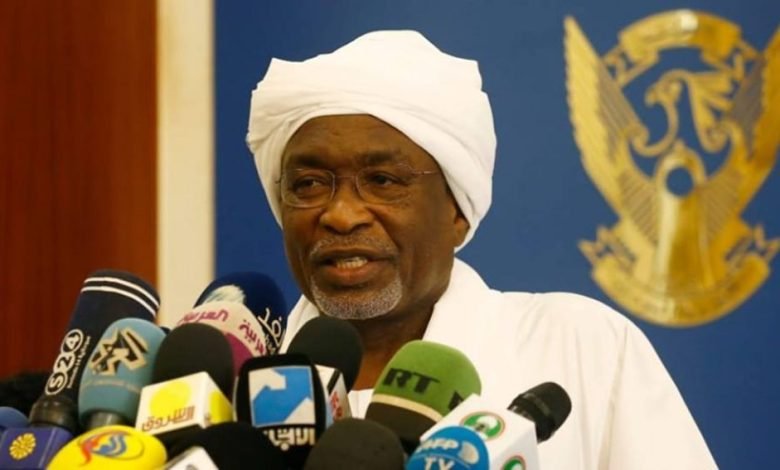
In one of the most serious political leaks since the fall of Omar al-Bashir’s regime in 2019, a recording attributed to Othman Mohamed Yousif Kibir, a prominent leader in the Sudanese Islamic Movement (the Muslim Brotherhood), reveals a completely different account of the nature of the current regime in Sudan.
The recording, which was broadcast exclusively by “Sky News Arabia” after it obtained it from its own sources, does not merely discuss a political relationship between the army and the Islamists, but paints a more complex picture of the balance of power within the state, where the army stands at the forefront, while the organization’s networks operate behind the scenes, pulling the strings of military and political decision-making.
According to Kibir’s remarks, Sudanese Army Commander Abdel Fattah al-Burhan did not rise to the pinnacle of military power as an independent leader, but rather as a political choice, pushed forward by the Brotherhood at a pivotal moment following Bashir’s fall.
Who is Othman Mohamed Yousif Kibir?
The leaked statements take on particular significance given the speaker’s position within the Sudanese Islamic movement, as Othman Mohamed Yousif Kibir is one of the organization’s most prominent historical leaders. He currently chairs the Shura Council of the National Congress Party, the political arm of the Sudanese Islamic movement, and holds a leadership position within both the organization and the movement.
Prior to the fall of the Bashir regime in April 2019, Kibir served as Vice President of the Republic, making him one of the highest-ranking officials in the hierarchy of power at the time and one of the most prominent political figures associated with the Islamic project that ruled Sudan for nearly three decades.
This organizational and political context lends his remarks in the leaked recording particular weight, as they do not appear to be merely a personal political opinion, but rather a testimony from within the decision-making circle of the Islamic Movement regarding the nature of the relationship between the organization and the military establishment in Sudan.
Al-Burhan: The Brotherhood’s Choice:
In the most significant part of the recording, Kibir provides a firsthand account of how Al-Burhan came to head the Military Council after the fall of the Bashir regime.
According to his account, al-Burhan was not a central figure within the military establishment at that time; rather, he was pushed into the leadership position following the resignation of former army commander Awad bin Auf, in a move aimed at filling the political and military vacuum that followed the regime’s collapse.
In one of the most striking segments of the recording, Kibir says: “Al-Burhan had no standing in the army and was nothing more than a guard. We were the ones who brought him in from the start to be head of the military council, to crush the masses of the revolution and restore and consolidate our power.”
This statement presents a radically different account from the official narrative, which portrayed Burhan as a military leader who steered a complex transitional phase, placing his rise within the context of a political decision made by the Islamic Movement to preserve its influence within the state.
Subordination, Not Alliance:
What the leak reveals does not point to a mere political alliance between the army and the Islamic Movement, but rather to a more complex relationship that goes beyond partnership to a pattern of political and organizational subordination.
According to Kibir’s account, al-Burhan publicly attacked the Islamists in some of his speeches under pressure from the international community, before channels of communication between the two sides reopened to confirm that those statements were part of an attempt to defuse external pressure.
This contradiction between public rhetoric and the internal political reality reflects the delicate balance that has governed—and continues to govern—the relationship between the military leadership and the Islamist movement since the fall of the Bashir regime. Kibir’s analysis does not stop at the issue of Burhan’s rise but extends to a broader description of the structure of power within the Sudanese state.
According to the recording, the Islamic Movement maintains an influential presence within the state’s security and military institutions—a presence forged during decades of Bashir’s rule through a complex network of organizational and political loyalties.
This influence makes the military itself a battleground for internal power struggles between official leadership and the organizational networks that have taken root within it over many years.
Islamist Brigades on the Battlefields:
The recording goes further when it addresses the armed forces fighting on the battlefields across Sudan.
Alongside the regular forces, armed groups with Islamist backgrounds have emerged during the recent war, including the Al-Baraa bin Malik Brigade, which has appeared on a number of battlefronts.
According to observers, the presence of such groups reflects the complexity of the military landscape in Sudan, where regular forces intermingle with armed groups with ideological and organizational backgrounds.
The leak also casts a new light on Burhan’s previous statements, as the commander-in-chief of the Sudanese army has repeatedly asserted that Islamists have no presence within the military establishment.
In a widely circulated video statement on social media, al-Burhan said sarcastically: “Where are the Islamists? Where are the Kizan?”—a term used in Sudan to refer to the Muslim Brotherhood.
However, Kibir’s account, coming from within the Islamic movement itself, presents a completely different narrative, placing Islamists at the heart of the military establishment and key decision-making centers.
The most telling aspect of the leak is Kibir’s remarks about the future of power. According to the recording, the Islamic Movement does not view al-Burhan as a permanent solution for governance, but rather as a transitional phase that allows the organization to regroup following the fall of the Bashir regime.
His remarks suggest that the continuation of military rule for a limited period may give the organization sufficient time to rebuild its political and military influence within the state.
Power Behind the Scenes:
The leak involving Othman Mohamed Yousif Kibir does not merely present a new political narrative; it redraws the balance of power within Sudan.
While Burhan’s public statements have repeatedly sought to deny the presence of Islamists within the military establishment, Kibir’s account—coming from the heart of the Islamic movement—presents a different narrative: an organization that retains its influence within the army and possesses the ability to influence military and political decisions, while the army’s commander-in-chief serves as its figurehead.
In a country ravaged by war and power struggles, this leak reveals a complex governance equation, in which the army leads the state in public, while an Islamist organization pulls the strings behind the scenes.
But what Kibir has revealed also confronts the international community with a reality different from what appears on the surface.
If Burhan represents the official face of authority, then negotiating with him may not necessarily mean negotiating with the true decision-maker.
The reality hinted at by the Islamist leader’s remarks suggests that decision-making centers are not within the military leadership, but rather within the organization’s networks that manage the war and decision-making from behind the scenes.
Between Burhan’s famous outcry—“Where are the Kizan? Where are the Islamists?”, and Kibir’s remarks placing them at the heart of the military establishment and the battlefields, a paradox emerges that sums up the current situation in Sudan: while the military is at the forefront, the keys to power lie with the Muslim Brotherhood, represented by the Sudanese Islamic Movement and its military and political arms, which the United States recently designated as a foreign terrorist organization.