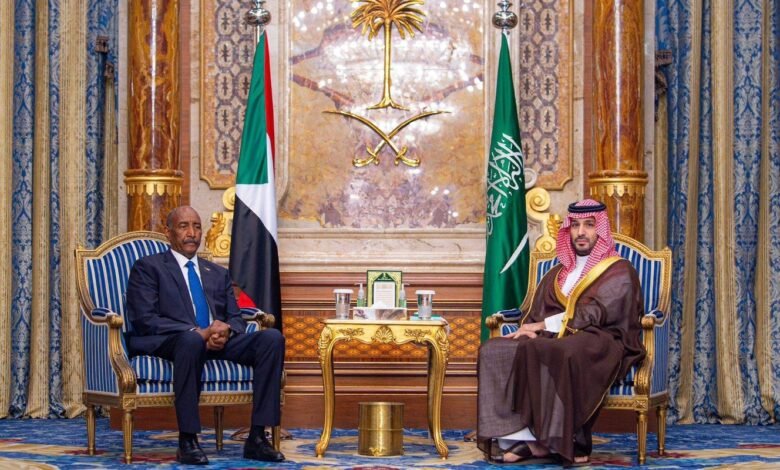
General Abdel Fattah al-Burhan’s has given lawyer Nabil Adib the lead on a committee tasked with setting up the framework for a national dialogue intended to give rise to a new civilian government under the authority of the head of the Sudanese Armed Forces (SAF).
Ten names now appear on the list drawn up by Nabil Adib’s group, including the intellectuals Al Mahboub Abdelsalam, Elwathig Kameir, Gassim Badri, Manzol Asall, Fouad Hikmat, Mohamed Jalal Hashim, the Sudanese journalist Osman Mirghani, and former diplomat Nureldin Satti.
The lawyer is said to have been tasked with drafting the temporary immunity guarantees intended to persuade civilians to join the process, including freedom of movement and the renewal of passports for exiled political figures, notably those from the Sumud coalition, led by former primer minister Abdallah Hamdok.
So far, the committee has neither a defined structure nor a clear agenda. The overwhelming majority of the civilian leaders and parties approached have, to date, refused to take part. Manzol Asal, Elwathig Kameir and El-Mahboub Abdelsalam have declined to participate, opposing an outcome that was written in advance.
Nabil Adib has ultimately sought to broaden his ranks by bringing in another journalist named Othman Mirghani, the intellectuals Nasreldin Sholgami, and Nimat Alzein, as well as an active member of the former National Congress Party (NCP), whose identity has not been disclosed. Alongside Osman Mirghani, they had all asked for guarantees of temporary immunity during the meeting held in mid-August with the head of SAF.
Exterior influences
In recent weeks, the responses have taken the form of refusals. The Sudan People’s Liberation Movement-Revolutionary Democratic Current (SPLM-RDC), led by Yasir Arman, has rejected any participation, as have several leading figures of the Sudanese Congress Party (SCP), including its president Omar el-Degeir and vice-president Khalid Omar Yousif. The Democratic Unionist Party (DUP) has also opposed the initiative, through Jaafar Hassan and Mohamed al-Faki Suleiman. Former Sovereignty Council member Siddig Tawer has spoken out against the plan on behalf of the Ba’ath Party, while sources within the Sudanese Communist Party have confirmed to Africa Intelligence that their party will likewise stay out.
Behind General Burhan’s push lies a coalition of regional sponsors – Saudi Arabia foremost among them, alongside Egypt, and Turkey – all lending weight to his ambition of erecting a political arrangement that would see him retained as head of state with a civilian cabinet and legislative council grafted onto the structure beneath him. Riyadh has also pressed Abdel Fattah al-Burhan to appoint a prime minister, relaying proposals to leading figures, including Sumoud officials such as Omar el-Degeir, Babiker Faisal, Mariam al-Sadiq al-Mahdi and Al-Sidig al-Sadiq al-Mahdi.
Prime Minister Kamil Idris was eventually appointed, despite three other candidates, including that of Nureldin Satti, whose bid for Nabil Adib’s committee is said to have been rejected by Abdel Fattah al-Burhan. Civilian leadership believes Egypt played a decisive role in tipping the balance in favor of Kamil Idris. But the question of participation does not encapsulate all the disagreements. According to civilian leadership, Saudi Arabia’s involvement runs counter to the September 2025 Quartet statement, which ruled out any participation by the SAF commander and Islamist forces in the structures of a future transitional government.
Authorized contacts with Tasis
Port Sudan’s preferred target now appears to be Sumoud. Although the group is expected to adopt a common position and reject any invitation to take part in the national dialogue, meetings are under way to ensure that no individual, party or political figure breaks ranks.
Port Sudan is nonetheless seeking to exploit internal divisions within the coalition, targeting first and foremost the SCP, the DUP and the National Umma Party (NUP). Abdel Fattah al-Burhan’s administration is thus hoping to win over isolated figures, even if their respective organizations remain opposed to the initiative. Earlier in the year, Riyadh had organized discreet invitations for Sumoud members to the office of Saudi Deputy Foreign Minister Waleed Elkhereiji — Mariam al-Sadiq al-Mahdi, Al-Sidig al-Sadiq al-Mahdi, and Omar el-Degeir.
Civilian leadership believes Nureldin Satti is acting as an intermediary on behalf of Saudi Arabia in an effort to bring members of Sumoud and other civilian forces behind General Abdel Fattah al-Burhan. Other figures thought to be helping prepare the ground include Mubarak Ardol, of the Democratic Bloc (DB), and Mohamed Sayed Ahmed, known as ‘Al-Jakoumi’, who heads the National Forces Coordination (NFC) — two groups supportive of the SAF.
Abdel Fattah al-Burhan is also seeking to draw figures from the Tasis coalition, affiliated with the Rapid Support Forces (RSF), into his orbit. At a recent meeting of the Security and Defense Council, the SAF chief authorized contact with Tasis members wishing to take part individually, while ruling out any participation by the bloc as such. The chairman of the Sovereignty Council, together with his chief of staff Alaa Osman, has also met in recent weeks with signatories of the 2020 Juba Peace Agreement, to reassure them that no restructuring would call into question the power-sharing arrangement they currently benefit from.