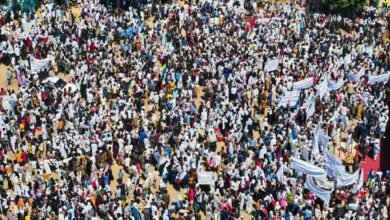
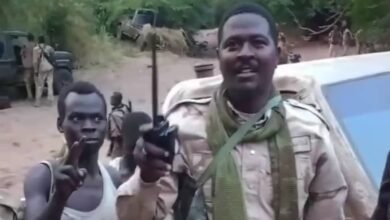
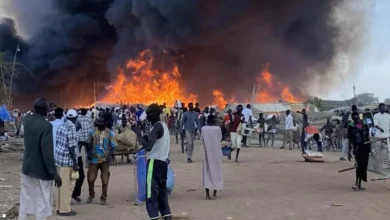
Al-Burhan and Al-Baraa militia leader Masbah Talha - archive
Rhino: Agencies
An analysis by the American website Eurasia Review questioned the ability of Sudanese army commander Abdel Fattah al-Burhan to disengage from the Muslim Brotherhood, warning of serious repercussions for Sudan’s future due to the spread of the organization’s elements throughout the state.
The website said that the coup carried out by al-Burhan in October 2021 enabled the organization to regain the influence it lost after the April 2019 revolution, which overthrew his 30-year rule.
Al-Burhan has publicly stated that he will not allow the Brotherhood to return to power, but the Eurasia report notes that Al-Burhan is relying in this war on the Brotherhood’s organizational depth, financial channels, and ideological mobilization capabilities.
According to the website, after the war, the organization managed to rebuild itself less as an overt political party and more as an integrated system of senior cadres, networks overseeing mosques, fundraising circles, and armed formations embedded in and around the Sudanese armed forces.
It added: “Former officials of the regime have returned to the political and security scene and assumed sensitive positions in state agencies, including key ministries, while Burhan continues to deny any return to the old regime.”
Eurasia Review noted the opposition of members of the quartet consisting of the United States, the United Arab Emirates, Egypt, and Saudi Arabia to any role for the Brotherhood in the future of Sudan’s governance. The United States also has a bipartisan bill before Congress that would require the administration to evaluate all branches of the group worldwide, including those in Sudan, according to US criteria for designating terrorism, and to designate them if the evidence meets legal standards”.
“Although Sudan has not yet been included in this first phase, the US Treasury Department has confirmed that it is working to expand the scope of sanctions to include other countries, including Sudan.
The Eurasia report explained that the organization’s networks helped engineer or incite the confrontation between the army and the Rapid Support Forces in April 2023, and that they infiltrated the army to prolong the conflict and sabotage ceasefire efforts.