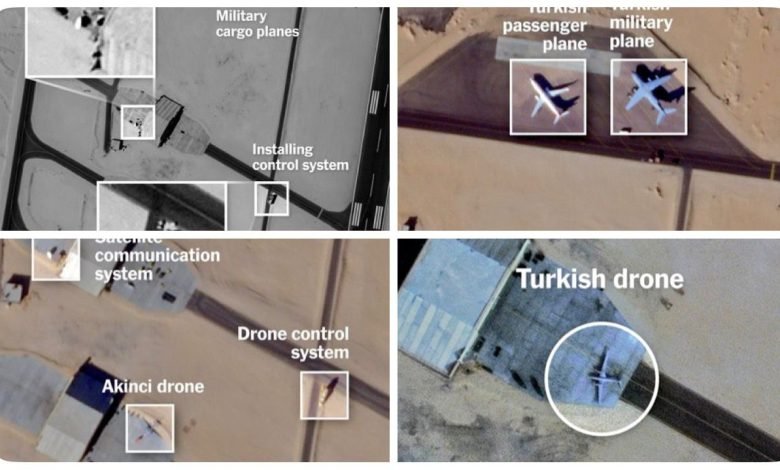
In the far reaches of Egypt’s Western Desert, where giant agricultural circles stretch to the edge of the Sahara, a secret air base operates one of the most dangerous tools of war in Sudan today: long-range drones. From there, advanced military aircraft take off to carry out strikes inside Sudanese territory, in a new chapter of a war that is no longer purely Sudanese but has become an open arena for settling regional and international scores.
Satellite images, flight records, and video footage, along with statements from Western and Arab officials, have revealed that drones launched from a base inside Egypt have carried out strikes targeting Rapid Support Forces inside Sudan for at least six months, in direct support of the Sudanese army, which has been fighting a devastating war for more than a thousand days.
The war in Sudan is no longer an internal affair:
The war that has devastated the country, displaced nearly 12 million Sudanese, and killed tens of thousands is no longer just an internal conflict between two generals. It has turned into a theater of war involving advanced drones, managed from outside the country’s borders and fueled by the interests of rival regional powers.
While Western reports accuse the United Arab Emirates of supplying the Rapid Support Forces with long-range Chinese drones, Saudi Arabia and Qatar support the Sudanese army, which in turn has acquired advanced Turkish aircraft, as well as weapons from Iran and Russia. Egypt, which until recently was a diplomatic player, has now moved into the realm of undeclared military intervention.
Egypt enters the war through the back door Egypt’s shift was not entirely surprising. According to Western officials, the intervention came after the fall of El Fasher in Darfur in late October, following a long and tragic siege, which marked a dangerous turning point in the war.
As the Rapid Support Forces expanded towards Kordofan, Cairo appeared to have decided to break its neutrality. In December, Egyptian President Abdel Fattah al-Sisi publicly warned against crossing a “red line” in Sudan, at a time when his country was already hosting more than 1.5 million Sudanese refugees.
Weeks later, Turkish Akinci drones, capable of flying thousands of kilometers and carrying tons of guided munitions, began carrying out deep strikes inside Sudan, targeting supply convoys and Rapid Support Forces positions, some in Darfur and more than 800 miles from the Egyptian base.
Civilians pay the price:
As in every chapter of this war, civilians were the first victims. The Sudanese army’s air force carried out indiscriminate raids on villages, resulting in dozens of casualties, in a scene that reflects the collapse of any real commitment to protecting civilians.
Sudan is gone… Gold fuels the war:
Gold plays a pivotal role in prolonging the conflict. With global prices rising, gold mining and smuggling have accelerated, providing huge financial resources to both sides of the war and contributing to the arms race for drones and anti-drone systems.
According to experts, the Rapid Support Forces have acquired Chinese jamming systems and surface-to-air missiles, likely supplied by their regional supporters, and have already managed to shoot down a number of advanced Turkish aircraft in recent months.
Sharq al-Aweinat: From agricultural project to war base:
Ironically, the air base from which these strikes were launched was established within the Sharq al-Aweinat agricultural project, which the Egyptian authorities have long promoted as a model for development and desert reclamation. However, satellite images show that since 2018, the project’s small airport has been expanded to include a second runway, military hangars, and advanced control and communications systems.
Turkish military cargo planes and Russian planes belonging to companies subject to international sanctions have landed at the base, in a clear indication of the extent of international involvement in the Sudanese war.
Where is Sudan headed?
Despite this frantic arms race, neither side in the conflict appears to be close to a military victory. The United States accuses the army of using chemical weapons and the Rapid Support Forces of committing genocide, and has imposed sanctions on both sides, but has failed to stop the flow of weapons.
In a dangerous development, the Rapid Support Forces have issued veiled threats, declaring that any drone taking off from a “foreign base” is a legitimate target, which threatens to widen the war and drag neighboring countries into a direct confrontation.