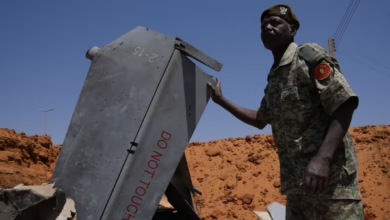
A crowd of boy’s smile as they raise their rifles toward the sky. Some are no older than twelve. Their arms are thin. Their weapons are large. The boys raise their guns joyfully; their muzzles glint in the sun. An adult leads them in chants. His deep voice cuts through their prepubescent shouts. “We support the Sudanese Armed Forces,” he shouts. “We support the Sudanese Armed Forces,” they repeat in unison.
The clip was filmed on a phone and posted on social media. It shows child soldiers who have been newly recruited to join the Sudanese Armed Forces, which are affiliated with the Sudanese government. These are the child soldiers of Sudan.
The adult in the video looks like a teacher leading a classroom. He smiles at the children, as if he is guiding them. He raises his fist in the air: the children look at him with admiration. But the truth is that he is doing nothing but leading them to almost certain death.
Here, the war of the Sudanese Armed Forces is not hidden. It is on display for all to see. It is sold as a combination of pride and power. In Sudan’s brutal civil war, government forces are recruiting children who now proudly flaunt their love of war on TikTok, and the footage shows newly recruited child soldiers belonging to the Sudanese Armed Forces.
What began as a power struggle has turned into an all-out civil war. Cities have been destroyed. Neighborhoods have been burned. People have fled. Hunger has followed. Both sides are stained with blood. The Sudanese Armed Forces call themselves a national army. But they were formed under decades of Islamic rule, where religion and power were closely linked and opposition was crushed.
This system did not disappear with the fall of former President Omar al-Bashir. It lives on in the officers and allied militias now fighting this war, staining the country with their string of crimes against humanity. As the conflict drags on and bodies run out, the army resorts to the easiest ones. Children. The latest UN monitoring on “Children and Armed Conflict” has revealed several groups responsible for grave violations against children, including “the recruitment and use of children” in combat.
The same report confirmed 209 cases of recruitment and use of children in Sudan in 2023 alone, a sharp increase from previous years. The TikTok app has the proof. In one video I watched, three boys who appear to be underage are shown wearing Sudanese Armed Forces uniforms, smiling at the camera and singing a morale-boosting song usually reserved for frontline soldiers.
The adult in the video appears to be a teacher leading a classroom. He smiles at the children, as if he is leading them. The latest Sudanese civil war broke out in April 2023, after years of tension between two armed camps: the Sudanese Armed Forces and the Rapid Support Forces (RSF). In another clip, a young man repeats the lyrics of a traditional Sudanese song that has now been repurposed as a recruitment tool.
A shocking clip shows two-armed young men again linked to either the Sudanese Armed Forces or their ally, the Islamist Al-Baraa Bin Malik Brigade—chanting a jihadist poem for the Sudanese Islamic Movement while directing racist insults at their enemies.
It gets worse. Another clip shows a young boy tied to a barber’s chair. He is clearly disabled and no more than six or seven years old. An adult voice off-camera prompts him with the words. A walkie-talkie is placed in his hands. He tries to repeat slogans in support of the Sudanese armed forces, smiling as he raises his finger in the air, unaware of what he is saying. Even the weakest are dragged into war. Even those who cannot carry a rifle can serve.
Then there are the photos sent by a Sudanese source. In one, a boy is shown lying inside a military truck. A live ammunition belt hangs around his neck; a heavy weapon lies beside him. In another photo, a row of boys stand in the desert, side by side, wearing loose camouflage clothing. An officer faces them, shouting orders. They stand still, their eyes forward. These are children learning how to kill.
Elsewhere, a teenage boy stands alone, a rifle slung over his shoulder like a badge. He smiles slightly. The rifle makes him someone he wasn’t before. He looks proud, as if he has finally become someone important. Then there is the pickup truck. Three young fighters sit in the back, their legs dangling. Behind them is a heavy machine gun.
In Sudan, this strategy is successful. The Sudanese Armed Forces and others get many new recruits from these images and clips. In them, war seems lighthearted. It seems fun. The noise and laughter mask the danger.
The rifle raised in the air does not yet smell of blood. But behind the clips are checkpoints, ambushes, and artillery bombardments. The boys carrying the rifles are sent where men fall. Some will be used as fighters, others as runners, observers, and porters. All are at risk of death. Very few of them survive.
The law is clear: using children in war is a crime. The generals of the Sudanese Armed Forces know this, but they ignore it. The evidence is not buried in reports or files. It is published and available to everyone. Wars that feed on children do not end cleanly. They do not stop when the shooting stops.
The boy who learns to shoot in front of the camera does not return to his childhood. War permeates him. It shapes him, until it kills him. But for now, the boys in the video—raising their rifles high—shout with joy.