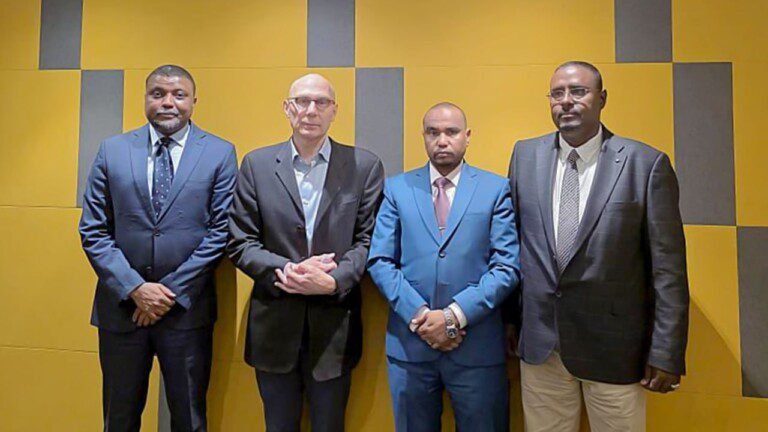
Rhino: Agencies – A delegation from the Rapid Support Forces, headed by Legal Advisor (Mohammed Al-Mukhtar Al-Nour) and including Advisor (Ezzedine Al-Safi), Head of the National Humanitarian Access Authority of the Government of Peace, and Advisor (Al-Basha Taq), met with Mr. (Volker Türk), the High Commissioner for Human Rights, in the Kenyan capital Nairobi.
The meeting addressed the human rights situation in Sudan, the targeting of infrastructure, the deprivation of citizens of constitutional documents, and the acute shortage of food and basic services as a result of the war that has been ongoing for nearly three years (and the horrific crimes that continue to be committed by the terrorist Muslim Brotherhood group).
The delegation welcomed the High Commissioner for Human Rights’ visit to Sudan, but stressed that the visit was incomplete, and that the true picture could only be completed by visiting the regions of Darfur, Kordofan, the Nuba Mountains, and Blue Nile, and by seeing firsthand the conditions of millions of Sudanese who have been punished by the army and its terrorist militias by being deprived of all their rights guaranteed under international humanitarian law.
Regarding human rights violations in the city of El Fasher, the delegation asserted that these were individual acts and provided a detailed explanation of the immediate measures and procedures taken by the Rapid Support Forces to hold the perpetrators of these crimes accountable and end impunity.
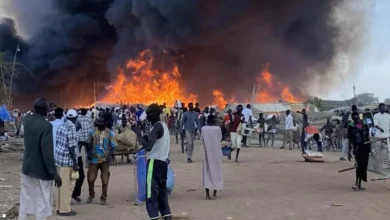
The meeting addressed the atrocities committed by the army and its terrorist militias against unarmed civilians in a number of towns, villages, and villages in the regions of Darfur, Kordofan, the Nuba Mountains, and Blue Nile, which resulted in the killing of thousands of innocent people, as well as the widespread destruction of infrastructure as a result of indiscriminate aerial bombardment. The delegation cited a number of examples, including the Al-Kuma area in North Darfur, which was subjected to more than 170 air strikes, resulting in the killing of hundreds of people and the complete destruction of infrastructure, as well as the targeting of hospitals and markets.
The delegation provided detailed information on the use of chemical weapons by the army and allied militias against the Sudanese people, in flagrant violation of all international conventions prohibiting such weapons and criminalizing their use. The delegation also condemned the use of humanitarian aid as a tool of war, the prevention of its entry into the aforementioned regions, and the systematic targeting of aid workers, with at least 32 aid workers killed. and more than 28 trucks loaded with aid have been destroyed, the latest of which was the targeting of relief shipments and a vehicle carrying United Nations personnel in the city of Zalingei in Central Darfur.
The High Commissioner welcomed the accountability measures taken by the Rapid Support Forces against the perpetrators of crimes in El Fasher but noted that they were insufficient and urged further action. He also expressed concern about the situation in some areas of Kordofan where clashes are taking place, calling on both sides to stop the violence in Kadugli and Dilling. The two sides agreed on the need to end the war, considering that ending it would stop all forms of violations, protect basic infrastructure, guarantee freedoms and human rights, and restore democratic civilian rule.
The delegation informed the High Commissioner of the crimes against humanity committed by the army and its terrorist militias against unarmed civilians, including the use of chemical weapons, depriving millions of Sudanese of the basic necessities of life, killing on the basis of identity, deprivation of constitutional rights, and the use of humanitarian aid as a means of warfare.
The Rapid Support Forces delegation expressed its reservations about the short duration of the meeting, which lasted less than an hour, while the High Commissioner stayed for more than five days in areas controlled by the other party. In this context, the delegation stressed that the High Commissioner’s visit was incomplete and that he could only form a complete picture by visiting the rest of Sudan and seeing the conditions of millions of Sudanese.
The delegation also pointed out the need to organize a separate visit by the High Commissioner and the independent expert, Mr. Ramadan Nasser, to the regions of Darfur and Kordofan, reiterating its welcome of the United Nations fact-finding mission.