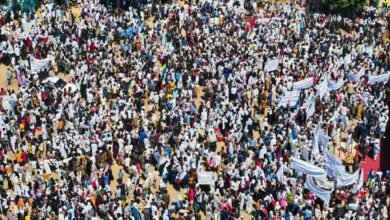
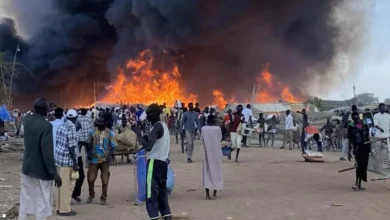
Since April 2023, conflict in Sudan has torn apart people’s lives and livelihoods, destroying agriculture, disrupting trade, and forcing more than 12 million people to flee their homes. As fighting continues, food prices have skyrocketed, making it even harder for parents to put food on the table.
More than half of the population now faces severe levels of food insecurity and malnutrition, making Sudan one of the world’s worst food insecurity emergencies.
Here are the stories of three mothers, each struggling to give their children a chance at health and hope.
Halima’s story:
In a remote village in Sudan’s Blue Nile state, where health facilities are scarce, Halima felt helpless as her two-year-old daughter Zainab struggled with malnutrition.
Despite Halima’s persistent fever and constant crying, there was no doctor nearby to take her to. Food insecurity made their situation worse. “We don’t eat much,” Halima says. “We cook porridge, and sometimes pudding. If we eat in the morning, we won’t eat again until the evening.”
Even their livestock could not provide adequate nutrition: “The cows are thin now,” Halima explains. “Their milk is not enough for a sick child.”
Halima eventually discovered the International Rescue Committee’s medical clinic through community observation. “I saw other mothers taking their children there, so I followed them,” she recalls. At the clinic, her daughter was quickly diagnosed and enrolled in a malnutrition treatment program.
“We feed her a nutrition pack. One in the morning and one in the afternoon. It’s been a week since we started feeding her the packs,” Halima says, describing her treatment with ready-to-use therapeutic foods. The emergency interventions of the International Rescue Committee in Sudan, supported by the European Union, have become a lifeline for families like Halima’s.
Shama’s story:
Some displaced families in Sudan undertake long and arduous journeys to reach safety. When Shama’s family was displaced, they had to travel for four days to reach her parents’ home in Al-Qary, where they now live.
Her son Anwar, who was only three months old at the time, fell ill during the arduous journey. Shama managed to find a doctor who was also fleeing, and he gave him medicine that alleviated his symptoms. During this period, the family lived on lentils, fish, and soup, but Shama avoided feeding him these foods for fear that he would not be able to digest them.
When they arrived in Al-Ghari, his health began to deteriorate again. Shama recalls: “He was very thin. He couldn’t sit up or move his body.”
Shama took Anwar to the International Rescue Committee’s medical clinic, where he underwent medical tests, was diagnosed with malnutrition, and began treatment immediately. “The malnutrition unit weighed him and gave him ready-to-use therapeutic food packs,” she explained. They prescribed two and a half packs per day. When his health improved, the amount was reduced to one pack per day.”
Anwar’s condition began to improve gradually. She tells us, “Now he is much better. He is back to normal, as healthy as his brothers.”
Anwar still suffers from the effects of his previous malnutrition, which has led to delayed growth. But Shama remains optimistic: “I hope to see him walk, play with his brothers, and run. That is my wish.”
Hawaya’s story:
Hawaya feeds Wael malnutrition biscuits, which were provided to support his nutrition as part of his treatment by the International Rescue Committee’s nutrition team.
Hawaya and her family are among those who were forced to leave their homes. After contracting malaria, her son Wael began suffering from diarrhea and vomiting, refusing to eat solid food. “I didn’t know my son was malnourished, and no matter what food we gave him, he kept losing weight,” Hawaya explains.
Hawaya discovered the International Rescue Committee’s medical clinic, where she took him to be treated for malaria. She then visited the malnutrition unit, where he was examined and diagnosed with severe malnutrition. The nutrition team gave Hawaya advice on food hygiene and a healthy diet, as well as ready-to-use therapeutic food packs to start treating her son.
When he took these medicines, his condition improved. His fever went down. His health is now improving, she told us. “We are still feeding him therapeutic meals. His body was deteriorating. But now, thank God, his health has improved. His hair has also regained its color.”
Medical advice and meal planning have greatly contributed to Wayl’s recovery from malnutrition. Hawa notices his improvement day by day: he used to cry all the time. Now, he plays with other children in the yard.
How is the International Committee of the Red Cross addressing malnutrition in Sudan?
Even before the conflict in Sudan erupted, some 3 million children under the age of five were suffering from acute malnutrition, including 612,000 children suffering from severe malnutrition.
As fighting continues, tens of thousands of displaced families now find themselves at risk of food shortages or poor nutrition. This has led to an increase in acute malnutrition among children under five.
The International Rescue Committee is working alongside local partners to provide essential health and nutrition services where they are most needed, giving children a chance to recover and grow healthy despite the unprecedented challenges surrounding them.
However, areas of famine and food insecurity are expected to continue to worsen unless the war ends and immediate international intervention takes place.”