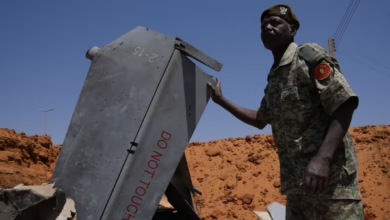
A cargo plane lands in Khartoum from Jeddah. Reports mention Pakistani Shahebar-2 drones. Pakistani armored vehicles appear on the streets of Khartoum. An arms deal estimated at $1.5 billion includes drones, training aircraft, armored vehicles, and air defense systems.
On the morning of August 7, 2026, Eddie Cohen, an Israeli researcher and commentator known for his coverage of Arab affairs, reported that a cargo plane belonging to Badr Airlines had arrived at Khartoum Airport from Jeddah and that, according to “intelligence sources,” it was carrying Pakistani Shahbar-2 drones.
Shahbar-2 Specifications
The Shahbar-2 (Block 2) variant offered by the Pakistani company GIDS is classified as an armed MALE (Medium-Altitude, Long-Endurance) drone. The manufacturer states that it was designed for intelligence, surveillance, and reconnaissance (ISR) missions, with the capability to carry weapons and perform combat missions. Its wingspan is approximately 35 feet, and its maximum takeoff weight is approximately 1,125 kilograms.
Endurance is up to 20 hours for ISR (Intelligence, Surveillance, and Reconnaissance) missions, up to 15 hours in armed mode with an external payload of 60 kilograms, and up to 12 hours in armed mode with an external payload of up to 120 kilograms. The service ceiling is approximately 25,000 feet for reconnaissance missions and 22,000 feet in armed configuration. The external payload capacity is approximately 120 kilograms distributed across four hardpoints, while the internal payload capacity is approximately 50 kilograms.
The true military value of the Shahbar-2 lies in its ability to carry weapons, in addition to its ability to conduct sustained surveillance. The aircraft can remain airborne for long hours, allowing for the creation of a continuous picture of the theater of operations, and it can be equipped with electro-optical and infrared (EO/IR) payloads, in addition to the ability to integrate systems such as COMINT (communications intelligence), ELINT (electronic intelligence), and SAR (synthetic aperture radar). This transforms the aircraft from a “strike aircraft” into a platform capable of gathering information, identifying targets, and assisting in the assessment of strike results.
One of the most striking figures in the Shahbar-2’s specifications is its beyond-line-of-sight (BLOS) communication range, which, according to GIDS data, reaches approximately 1,500 kilometers, while its line-of-sight (LOS) communication range is approximately 250 kilometers.
The company indicates the use of satellite communications. This does not mean that the aircraft itself can necessarily fly 1,500 kilometers away from Sudan and return, as there is a difference between communication range and flight range; however, the BLOS capability means that the control center can be located significantly farther away from the aircraft, depending on the available communications infrastructure, which is important for long-range surveillance and reconnaissance operations.
The Impact of the Shahbar-2 on the Equation of Military Superiority
The most realistic military assessment is that the Shahbar-2, even if it has indeed arrived and begun carrying out missions, will not single-handedly change the equation of the Sudanese conflict. It may alter the outcome of a battle, destroy a vehicle, strike a position, expose a military movement, or improve reconnaissance capabilities, but it will not, on its own, change the dynamics of the war in Sudan.
Modern warfare is not decided by a single platform. An aircraft requires trained crews, maintenance, ammunition, control stations, secure communications, base protection, and a command-and-control system—as well as the ability to counter electronic warfare and anti-drone defenses. Above all, it requires ground forces capable of capitalizing on the gains achieved by airstrikes.
This is precisely what the war in Sudan has demonstrated over the past three years. Drones have evolved, new systems have been introduced, lines of control have shifted, and weapons have poured in from abroad; yet these developments alone have not decided the war. Therefore, the Shahbar-2, if it actually arrives, will be an important addition to military capabilities, but it is not a magic weapon capable of single-handedly changing the outcome of the war. The Appearance of the “Muhafiz-V” Armored Vehicle in Khartoum
These aerial developments coincide with an equally significant ground development. Photos and videos of Pakistani “Muhafiz-V” armored vehicles have surfaced in Khartoum. These images are particularly significant because the Muhafiz-V was listed among the equipment mentioned in reports regarding the Pakistani deal. If the vehicles that appeared in Khartoum are indeed from this deal, it means that some Pakistani ground equipment has already begun to appear on the ground.
The timeline takes on greater significance when considering the available evidence. In August 2025, reports emerged about the Pakistani deal, and in January 2026, Reuters reported on a defense deal worth approximately $1.5 billion. and in July 2026, the Muhafiz-V appeared in Khartoum, followed on August 7, 2026, by news of the Shahbar-2’s arrival in Khartoum via Jeddah. These facts do not automatically corroborate one another, but they constitute a series of indicators worthy of investigation.
It is worth noting that the Governor-V is not a tank, but rather a light/medium armored vehicle designed for protection, mobility, transporting personnel, and carrying out security and military missions. According to the manufacturer’s specifications, it is approximately 5.4 meters long, 2.2 meters wide, and has a combat weight of about 5.6 metric tons.
It can accommodate up to eight personnel, reaches a speed of approximately 120 kilometers per hour on paved roads, features a 4×4 drivetrain, and is powered by an engine with an output of approximately 202 horsepower.
Its protection meets Level B6 under the EN 1522/1523 standard, utilizing ballistic steel armor. Its equipment includes run-flat tires that allow continued movement after a loss of air pressure, firing ports, vision systems, and a turret or weapon station depending on the configuration. Its function is not to engage heavy tanks, but rather to provide better protection and mobility for troops in a combat environment.
Seeing this armored vehicle on the ground is particularly significant because its appearance is more telling than the mere mention of its name in a contract. The deal on paper, the equipment that actually arrives, and the equipment that enters service and appears in the field represent different stages of the implementation of any arms program. If it is confirmed that the Muhafiz-V vehicles in Khartoum are part of the Pakistani deal, this would constitute stronger tangible evidence that the arms transfer is not merely a political or military agreement that has yet to be implemented. Furthermore, the appearance of Pakistani ground equipment in Khartoum provides broader context for the claim regarding Shahbar-2, as it comes at a time when there have been indications that Pakistani military equipment has arrived in Sudan.