Report By: Sudanese National Observatory for Human Rights
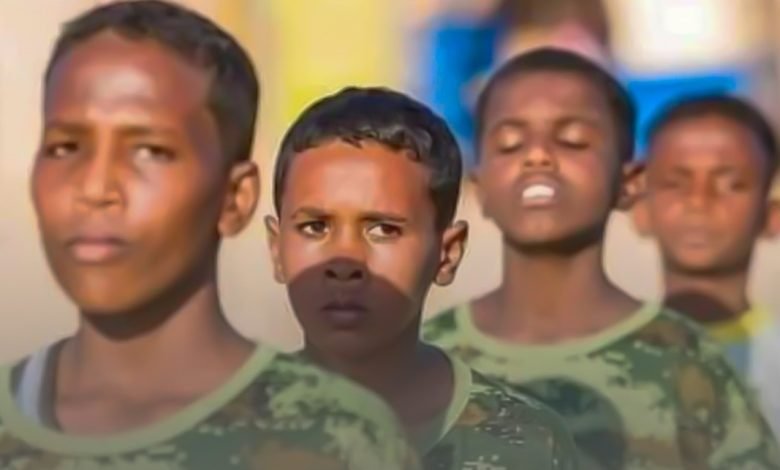
The recruitment of children and their involvement in combat is a new crime added to the series of war crimes committed by the Sudanese armed forces and loyalist militias. It reveals the weakness of the military and organizational system and is considered a collapse in the structure of military organization.
Exploiting the war and family circumstances:
While some try to portray the recruitment of children as a sign of popular loyalty, the truth is that resorting to child recruitment does not occur in regular armies with professional leadership and trained fighters, but is rather a sign of weakness, internal collapse, and a lack of qualified personnel.
In the context of war, security agencies and militias loyal to the Sudanese armed forces have exploited families’ need for money, disruption to education, and displacement to recruit children between the ages of 13 and 17, some of whom were recruited by force and others under the guise of “defending the homeland” or in exchange for money.
Field evidence and recruitment methods:
Local reports indicate a significant increase in cases of child recruitment, with children being targeted in schools, summer camps, and places of worship, using propaganda techniques such as the term “Baraoun,” which carries extremist ideological connotations to mentally prepare them before sending them to the battlefield.
Leaked videos documenting the crime:
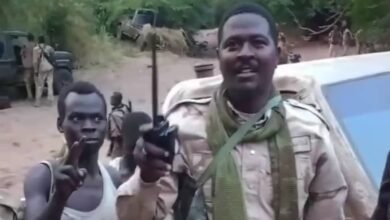
Leaked videos documenting underage children in military uniforms actively participating in combat operations, along with survivor testimonies, have spread on social media, confirming the involvement of the de facto authorities in mobilizing children under the name of “popular resistance.”
The effects of recruitment and violation of international treaties:
The emergence of child soldiers means a shortage of regular soldiers and therein lies the tragedy of pushing children into battlefields, where they are deprived of their most basic human rights and regular soldiers are replaced by children who have yet to learn the meaning of life, instead of enjoying their normal childhood filled with learning and playing.
Although Sudan signed the Convention on the Rights of the Child in 1990, violations continued in secret with the tacit approval of the regime itself, in the absence of any real accountability mechanisms.
The effects of this crime are not limited to the present moment but leave behind a psychologically damaged generation and a fragmented society, where violence becomes part of the identity of Sudanese childhood and leads to a bloodier future.
International law and child recruitment:
Child recruitment is an indicator of a structural crisis within military and paramilitary forces, where children with no political or humanitarian awareness are thrown in to replace regular soldiers and, in some cases, used as human shields, putting their lives at risk and stripping them of their natural rights.
According to international humanitarian law and the Convention on the Rights of the Child (Article 38), the recruitment of children under the age of 15 in armed conflicts is a war crime. The Additional Protocols to the Geneva Conventions and the Statute of the International Criminal Court consider the use of children under the age of 18 in combat operations a serious crime.
Call for international action:
The involvement of children in armed conflict is a crime that cannot be justified under any circumstances. The international community and human rights organizations must act quickly to stop this recurring tragedy and save what remains of childhood innocence in Sudan.”