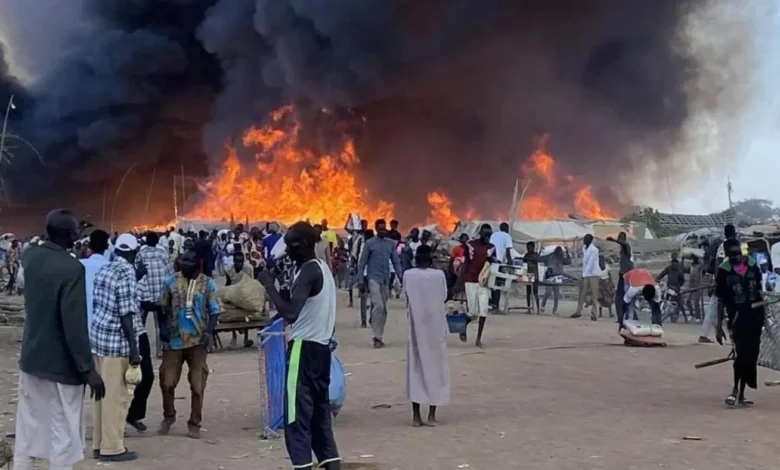
The death toll from the bombing carried out by Sudanese Army drones on the Amit market in the disputed Abyei region has risen to 153, in one of the deadliest airstrikes since the war began, amid ongoing fires, the recovery of bodies, and the displacement of some 8,000 people from the area.
Johanna Akol Ngor, South Sudan’s acting minister of information in charge of the Abyei administration, said the death toll is likely to rise, explaining that fires continued to burn through Tuesday and that some bodies were completely charred, making it difficult to count the dead and identify them.
On Monday, the Sudanese army targeted the Amit Market, also known as the Ostrich Market, a major commercial hub serving communities in the border areas between Sudan and South Sudan as well as those fleeing the war in Sudan, where food, basic goods, and fuel are sold.
The Abyei region is disputed between Sudan and South Sudan and is subject to joint administration arrangements; its final status has not been resolved since the South’s secession in 2011.
Eyewitnesses said they heard five loud explosions followed by a fuel depot catching fire, and that the injured suffered shrapnel wounds and severe burns.
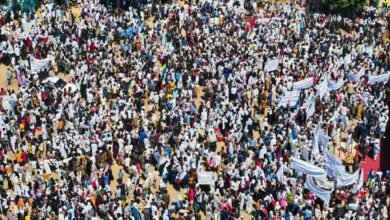
Hundreds of residents in the Abyei region took to the streets in angry protests, condemning the Sudanese army’s bombing of the Amit market and the deaths and injuries of dozens of civilians, and demanding an independent investigation and accountability for those responsible for the attack.
Military Admits to Carrying Out the Strike
Following accusations by South Sudan and the Abyei administration that the Sudanese army was responsible, a senior Sudanese army officer acknowledged to the Associated Press that the attack had been carried out using a drone.
The officer, who spoke to the agency on condition of anonymity, claimed that the strike targeted fuel tankers coming from South Sudan, which he said were on their way to the Rapid Support Forces. He alleged that those killed were members of the Rapid Support Forces involved in fuel smuggling.
However, the officer’s account contradicts statements from the South Sudanese Ministry of Foreign Affairs, as well as obituaries circulating on social media and testimonies from residents who reported a large number of civilian casualties, including merchants, women, children, returnees, and Sudanese refugees.
Thus, the case of the attack has shifted from a mere accusation against the army to an admission from within Burhan’s army that it carried out the strike, even though the source attempted to justify it by claiming there was a target linked to the Rapid Support Forces.
Mohammed Nour al-Din, a former advisor to international relief agencies and an expert on civilian protection, told Sky News Arabia that the presence of fuel suspected of reaching a military party—even if proven—does not exempt the army from its legal obligations. He explained that “the rules of international humanitarian law require verification of the nature of the target and distinction between civilians and combatants, and prohibit launching an attack that is expected to cause excessive civilian casualties relative to the intended military advantage.”
He added: “The suspicion of military supplies does not turn a market crowded with civilians into a legitimate target; and if the expected casualties are excessive, the strike could amount to a war crime requiring an independent investigation and accountability for those who planned and ordered it.”
The scale of the casualties and destruction raises serious questions about the intelligence information that preceded the attack, the type of ammunition used, the military’s assessment of expected casualties, and who issued the order to target a market crowded with civilians, fuel, and basic goods.
UN Condemnation and Summoning of the Ambassador
The United Nations strongly condemned the series of attacks targeting Abyei, expressing concern over the escalating use of drones and the damage they inflict on civilians and critical infrastructure.
The organization stated that the airstrikes are taking a devastating toll on communities already exhausted by more than three years of war, and it reiterated its call to protect civilians and civilian infrastructure and to ensure access to humanitarian aid.
The South Sudanese Ministry of Foreign Affairs summoned the representative of the Port Sudan Authority in Juba and delivered a formal protest regarding the bombing. It stated that the strikes hit multiple locations within the market, resulting in civilian casualties and extensive property damage.
Juba called on the Port Sudan Authority to refrain from actions that endanger the lives and property of civilians, to prevent a recurrence of such attacks, and to address issues related to Abyei through diplomatic channels.
Doctors Without Borders confirmed that it had admitted a number of bombing victims to Amith Bek Hospital, including patients in critical condition and those suffering from burns. The organization stated that its teams provided surgical services, wound care, and emergency treatment, warning of the impact of the attacks on the population’s ability to safely access health care and basic services.
The massacre takes on added gravity due to Abyei’s sensitive status; the oil-rich region remains disputed between Sudan and South Sudan and is supposed to be subject to special security arrangements and a UN presence that prevents it from becoming a military battleground.
Shifting military operations there threatens to spark direct tensions with Juba and expand the war in Sudan into a border region that is already plagued by security instability and long-standing sovereignty and communal conflicts.
The army leadership can no longer simply deny the allegations or hide behind the claim that military supplies were targeted. An officer within the army has admitted to carrying out the strike, while the death toll and extent of the destruction reveal that civilians paid the price.
If Abdel Fattah al-Burhan’s leadership considers the presence of fuel tankers a justification for bombing a crowded market, it is required to disclose the information on which it based its decision, the munitions used, and who issued the order to attack. Withholding this information and refusing an independent investigation will not obscure the massacre; rather, it will place the blame squarely on the army leadership, which has turned drones into instruments of death that hunt down civilians inside Sudan and along its borders.