In the corridors of the Human Rights Council in Geneva, the decision to extend the mandate of the Independent International Fact-Finding Mission on Sudan was not just a routine UN procedure, but a moral slap in the face to those who had long believed that memory could be erased with noise and blood could be washed away with statements. With the decision issued on Monday evening, voices of anger rose in the camps of the remnants, and expressions of rejection and accusation followed, as if accountability itself were a crime, as if justice were foreign to their old dictionary.
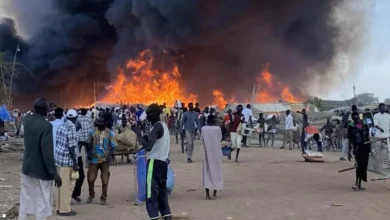
The resolution, led by the United Kingdom, Germany, Ireland, the Netherlands, and Norway, drew clearer lines in the record of atrocities committed over two years of war. The Council condemned widespread violations of human rights and international humanitarian law in Sudan, including systematic killings, torture, sexual violence, enslavement, enforced disappearances, forced displacement, bombing of residential areas, use of starvation as a weapon of war, and destruction of hospitals, schools, and civilian infrastructure in flagrant violation of all norms.
Angry reactions:
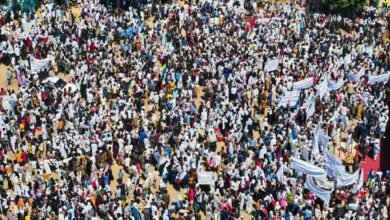
As soon as the decision was announced, protests erupted in Port Sudan, where the authorities continue to deal with the world through denial. The attack was not a passing political stance, but an instinctive reaction from the remnants of a system that fears the hand of justice reaching its doorstep.
Human rights activist Amani Idris told Raino: “The real reason behind this fierce campaign is that the UN decision coincided with proposals to extend the jurisdiction of the International Criminal Court to cover the entire territory of Sudan, which frightens the remnants of the former regime who are beginning to feel that the circle of accountability is closing in on them.”
She adds: “The extension coincided with Ali Kosheib’s conviction before the Criminal Court and the linking of his case to the crimes of Ahmed Haroun, reopening old wounds. This parallel between the past and the present made the extension decision sound like an alarm bell for those who believe that the current war could be a new cover for impunity.
The UN mechanism that is being denounced today is the same one that could recommend referring the case to the Security Council and then to the International Criminal Court, just as happened in Darfur two decades ago.”
Mandate and powers:
Political analyst Ihab al-Hassan believes that the essence of the UN decision lies not so much in extending the mandate as in consolidating and deepening it. The extension, he says, is “a UN acknowledgment that the crisis in Sudan is not yet over and that justice is still on hold.” He adds: “The mission does not have executive tools, but it has what is most important: memory, evidence, and testimony.
It is the only UN repository of what happened during the collapse, and its continuation is a guarantee that the truth will not be lost amid the rubble of war.”
Al-Hassan emphasizes that the extension decision aims to continue collecting and preserving evidence amid the total collapse of local justice institutions. It also allows the mission to continue classifying the acts committed and determining whether they amount to war crimes or crimes against humanity, noting that “the government’s unease in Port Sudan and the reaction of the remnants is natural, as international scrutiny is once again tightening the noose around them.”
Performing under fire with no alternative:
Despite criticism of the mission’s slow pace or limited reports, experts agree that a fair assessment must take into account the compelling circumstances in which it operates. The reality on the ground prevents it from gaining direct access to conflict areas, forcing it to rely on testimonies from refugees and displaced persons in neighboring countries, satellite images, and reports from independent local organizations.
Al-Hassan says, “The shortcomings in performance are not a weakness in competence, but rather the result of a stifling reality that makes field investigation nearly impossible.”
Activist Amani Idris asks: “Those who reject the mission or question its role must first answer: What is the alternative? There is no independent national mechanism to document crimes in the context of war and the collapse of the judiciary, and the mission remains the last option to ensure that evidence is not destroyed and that the blood of innocents is not lost in silence.”
She believes that the legitimacy granted by the United Nations to the mission’s reports makes it the only authority capable of mobilizing international public opinion and inspiring the will for justice, unlike local reports, which are easily marginalized under the authority of arms.
A decision between hope and skepticism:
Some see the extension decision as a mixture of hope and skepticism: hope because the world has not yet closed the file and because the voices of the victims are still being heard. Skepticism because the continuation of the war and the escalation of violations may turn the extension into just another paper in a crowded archive, unless the steps are accompanied by a strong international will.
Those who hold these views argue that the extension remains a confirmation of a memory that should not be forgotten, and a reminder that justice may be delayed, but it does not die.
While the remnants of the old regime fear the return of familiar faces to the dock as suspects wanted by the International Criminal Court, or those who fled prison after the outbreak of war, the survivors see the decision as a glimmer of light in a long tunnel of darkness, a new step in the arduous march against impunity, where the truth continues to knock on doors that were closed to it.