Less than 3 weeks after he returned to his home in Omdurman, north of Khartoum, “Bashir” suffered a broken hand after he was severely beaten for resisting an armed group that stopped him in a way he described as “humiliating” in one of the checkpoints spread in most of the capital’s streets.
But Bashir’s tragedy was greater when he learned two days after the incident that a friend of his, Hamed Nabil, had been killed in the Hattana neighborhood north of the city after he resisted gunmen who tried to take his cell phone.
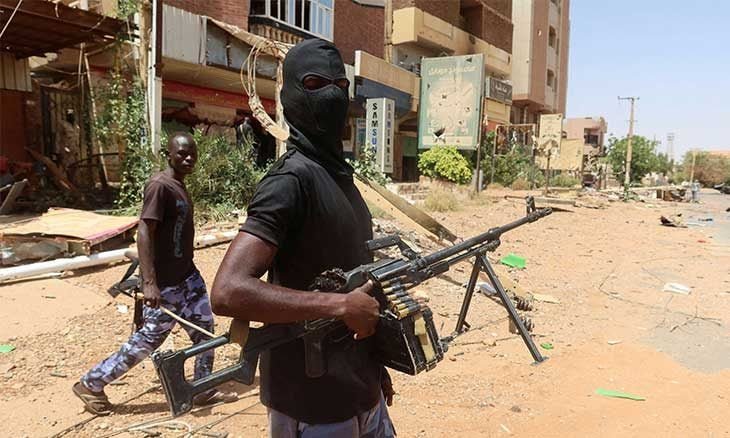
According to city residents, such crimes are repeated dozens of times a day in a number of neighborhoods in the capital Khartoum in light of the chaos caused by the heavy deployment of armed groups, some wearing army uniforms and some in civilian clothes, belonging to movements and groups fighting alongside the army.
Observers say that the large-scale violations committed by armed groups wearing military uniforms in Khartoum indicate a dangerous shift and the actual collapse of the state.
Over the past few hours, controversy has increased after reports of a decision to clear the capital of armed groups within two weeks, with platforms affiliated with some armed movements announcing the implementation of the decision.
The proliferation of weapons:
Many Sudanese fear that the proliferation of weapons in the hands of armed movements and their ability to control key positions in Khartoum and other cities will lead to the formation of a new reality in which those who have power will be in control.
Activists and human rights defenders monitor dozens of crimes committed by armed groups, some of which are affiliated with Darfurian movements that are allied with the army and some of which operate under the command of the Baraa Brigades, the armed arm of the Brotherhood.
In this context, writer and researcher Mohammed Mansour says that what is currently happening reflects the vacuum in the decision-making center, where those who have the weapons are the ones who impose their conditions.
Mansour adds: “When there are multiple centers of power, and the capital becomes subject to balances between militias, we do not need to declare the collapse of the state. “What we see now is organized chaos, managed under political banners or war bills, but in essence it is a conflict between warlords.
The army-allied Joint Force, which includes the Gibril Ibrahim and Minni Arko Minawi movements, said in a statement that there are groups seeking to tarnish its image, pointing to the arrest of two people impersonating it and terrorizing and robbing citizens.
According to political activist Atef Abdoun, the removal of armed movement forces from Khartoum should include the rest of the Northern Shield militias and all Brotherhood militias, including the Baraa Brigades, Al-Binaa Al-Marsous, Lightning Lightning and Al-Furqan. “Allowing any of the militias to remain in Khartoum with their weapons would be considered a form of political deception,” Abdoun emphasizes.
Return trap:
Observers describe calls for citizens to return to Khartoum as “false” calls that mislead people and make them victims of the armed groups deployed in the streets and neighborhoods of the city.
Hassan Abdel Rady, a researcher at the Center for Sudanese Studies, said: “When people returned to Khartoum, they found nothing but free death, streets full of corpses, looted markets, and militias that have mastered terror.”
“Khartoum is no longer habitable, not only because it is destroyed, but because it is a hijacked city, controlled by militias and guarded by ghosts.”
More than two months ago, an assessment by a team of United Nations experts concluded that it would be impossible for the organization’s agencies to return to the Sudanese capital Khartoum before January 2026, even if the war stopped completely, and Africa Intelligence quoted the experts as saying that Khartoum “has become a very dangerous city.”
In recent weeks, about 400,000 internally displaced people have returned to Khartoum, according to estimates by the International Organization for Migration (IOM), but the returnees face extremely poor security conditions. According to observers.