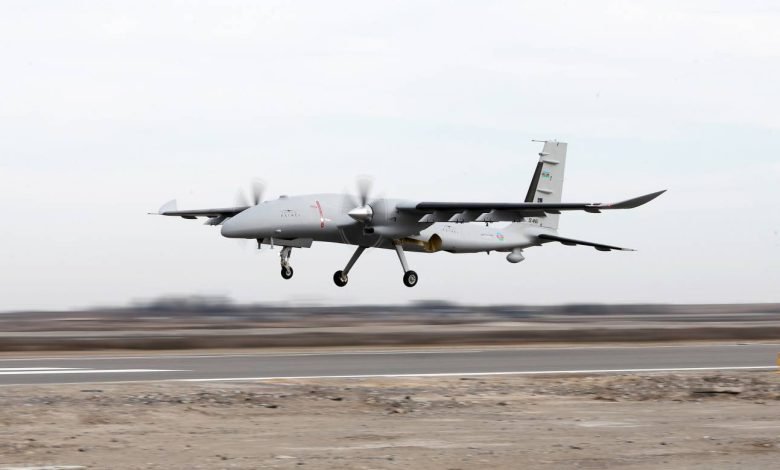
Khartoum: Raino – On July 9, 2025, the city of El Fasher in Sudan witnessed a remarkable technological development amid the internal conflict, namely the downing of a Turkish Akinci drone by an air defense system belonging to the Rapid Support Forces. Although drones are frequently used in modern conflicts, this particular incident has special strategic and technical implications, as it revealed high-precision and sophisticated components among the wreckage, chief among them a parabolic antenna unit of official Turkish origin.
Among the wreckage, a communications unit of the type “Antenna, Parabolic, Link B1 Hava” was found, equipped with precise technical details:
1. Part number (PN): 06220010068 2. Serial number (SN): 280423-09-0002 3. Manufacturer’s code (NCAGE): T9710 4. NATO number (NSN): 5985-27-071-3127
These data are not mere manufacturing codes, but rather official technical evidence that the antenna was developed and included in NATO records as an approved military component. It is produced by a well-known Turkish company, according to NCAGE, specifically Baykar Defense Industries.
Technical characteristics of the antenna.
The Parabolic Link B1 Hava antenna is a unit designed for airborne communications, featuring the following:
1. Narrow-Beamwidth: Enhances targeting accuracy and reduces the likelihood of detection or jamming. 2. High gain, allowing data to be transmitted over long distances without signal loss. 3. High frequencies (usually X or Ku band): used in military communications and reconnaissance. 4. Lightweight structure resistant to electronic jamming.
The presence of this unit on board the aircraft means that it was equipped with an advanced military communications system and was not a simple reconnaissance aircraft. Based on the identity and configuration of the antenna, it can be concluded that the
aircraft was performing one or more of the following functions:
1. Command and control (C2): coordination with other ground or air units. 2. Electronic reconnaissance (ELINT): Capturing enemy signals and broadcast locations. 3. Live ISR: Sending live images and video to an operations room. 4. Directing other munitions or drones (Swarm Operations): Through real-time networking.
All these indicators move the aircraft from the realm of “surveillance” to complex tactical combat missions. In another context, the Turkish company Baykar is one of the leading exporters of drones over the past decade, especially the Bayraktar TB2 and Akıncı, and has played a pivotal role in conflicts such as:
And now it is appearing in Sudan, reflecting a silent expansion of Turkey’s role in African conflicts, either through direct supply or through allied or proxy parties.
The success of the Rapid Support Forces in shooting down an aircraft of this caliber raises important questions:
1. Have they recently been equipped with effective air defense systems? 2. Were jammers or short-range missiles used? 3. Is there external intelligence support in monitoring air routes?
In any case, the successful aerial interception of the advanced Turkish drone represents an exceptional shift in the balance of power within Sudan, both technically and on the ground.
The downing of the Akinci over El Fasher is more than just a local military event; it reveals:
1. The hidden internationalization of the Sudanese conflict. 2. The existence of advanced tools in the hands of the Rapid Support Forces. 3. The expansion of Turkey’s role in undeclared arenas.
From a technical standpoint, analysis of the wreckage components—primarily the antenna unit—provides scientific evidence of the nature of the mission, the origin of the aircraft, and the source of its support. In modern warfare, the key to strategic understanding may be hidden in a small electronic chip or serial number.