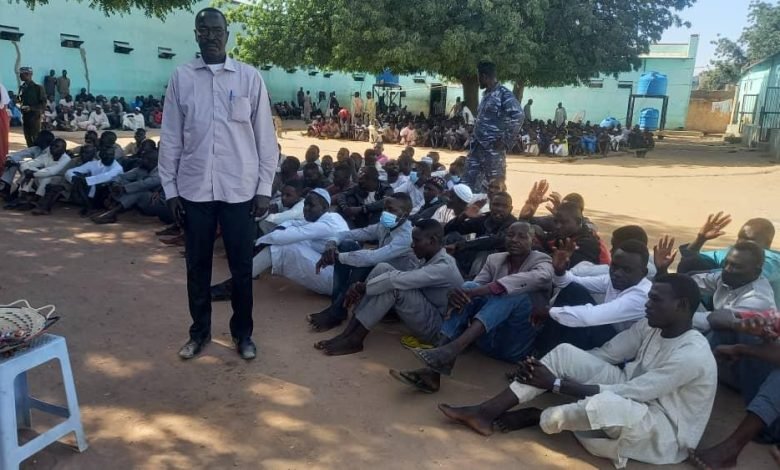
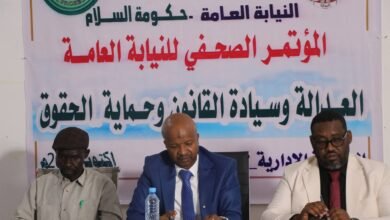
250 people are facing the death penalty for cooperating with the RSF in Port Sudan prison. The Sudanese authorities continue a wide campaign of arrests and illegal detention without judicial orders in a number of cities and states of Sudan, most notably Sennar, River Nile, White Nile, Kassala, Gedaref and the Red Sea. These arrests are targeting civil society leaders, members of resistance committees and voluntary work activists without clear reasons.
Rihab Mubarak Sayed Ahmed, a member of the Sudanese Network for Human Rights, revealed the suffering of about 1,600 prisoners in Port Sudan prison and their poor conditions. In a report on the conditions of the prisoners, Rihab said that these bad conditions and complications followed the recent targeting of the marches that affected the coastal city. At the same time, she noted that the risks in the prison are present both internally and externally, especially after the targeting of military headquarters near the prison, with widespread concern among inmates that the entire city has become unsafe to stay in.
Rihab pointed to the long waiting period for those waiting inside the prison after the postponement of trial sessions for a long time without even taking those waiting to appear before the judge: While in accusation cases, the postponement is done under the pretext that the members of the security cell are dedicated to field work and cannot appear before the courts, disregarding all the principles of fair trial that defendants should enjoy. She also reported that there are a number of practices and behaviors that occur inside the prison that prevent defendants from enjoying proper procedures, such as the accused remaining in prison for very long periods of up to a year and a half without being brought to trial, even after the completion of the investigative procedures with him, which according to the law should not exceed more than 6 months in accordance with the powers of the highest executive authority (the Attorney General).
She also referred to the spacing of sessions during the trial, where the period reaches 40 days, adding that more than this situation violates the norms of a fair trial, which must be quick and expeditious (the custom of Sudanese criminal courts does not exceed the periods of sessions from each other by two weeks). She emphasized the ineffectiveness of the procedure in the trial itself, saying that the postponement is done without the defendant even appearing before the renewal judge, so the judge does not have the advantage of monitoring the prisoner’s health, nor will he know whether the defendant is being tortured inside the prison or not.
She said that after the final verdict, which in most cases is either a death sentence or life imprisonment, the convicted person waits for months waiting for the decision on the appeal, which he filed within the first 15 days of the verdict, without knowing the reasons for the delay. She pointed to death sentences in prison for people under Articles 50 and 51 of the Sudanese Criminal Code, which are associated with charges of cooperating with the RSF (undermining the constitutional order and fomenting war against the state): about 75 convicted in Grade A, 83 convicted in Grade B, and about 92 in Grade C.
Last year, two girls were convicted in the emergency courts, Hanadi Light al-Bait Abbas, who was sentenced to death and is not a resident of Port Sudan, and Shaimaa Saeed Hassan, who was sentenced to life imprisonment, were convicted by the Information Prosecution by searching their phones and convicting them for merely criticizing the armed forces or supporting the RSF according to the grounds announced by the court.
She added: “All of these convicts are enlightened members of the Sudanese people, including teachers, doctors, lawyers, journalists and university students.”
She continued: “What proves the injustice of their accusation and the arbitrary arrest procedures and its politicization in favor of those who want to throw them into prisons, is that none of them use drugs or cause trouble inside the wards, and most if not all of them have good behavior, and all of them are found inside mosques, which confirms the lack of criminal character in them.” She explained that all of these convicts were sentenced either for exchanging phone messages with others expressing their personal opinion against the war or for purely tribal and regional reasons.
According to Rihab, the risks included food inside the prison, where the prison is obligated to serve breakfast and lunch, and recently the lunch meal has been delayed a lot. She said that the water desalination plant inside the prison has stopped and that salty water is mixed with desalinated water brought from outside the prison and cooled so that its salinity is not evident when it is hot. Rihab described the situation in Port Sudan prison as catastrophic, lacking the most basic standards of safety and justice in a city where bombing with deadly marches has become a daily feature, noting that the Minister of Finance takes for himself the highest safety standards in front of his residence and his place of residence, the Sudanese people are subjected to free death because of their rejection of this absurd war.