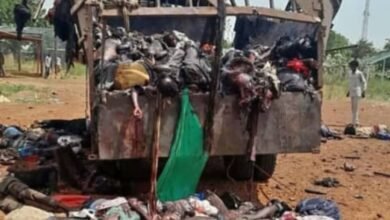
Despite the scenes of killing and destruction that fill social media, and at an accelerated pace, Sudanese were surprised yesterday, Monday, with a video showing members of the Al-Baraa bin Malik and Special Action Brigades of the Islamic Movement allied with the army, near a large number of bodies of young men and children in the Halfaya neighborhood in Khartoum Bahri, the members of the brigades who spoke in the video admitted killing them, and some of them were identified as volunteers in the collective kitchens of the neighborhood, eliminated in cold blood, under the pretext of suspected cooperation with the RSF, according to members of the Islamic Movement brigades, and the final count of the
widespread condemnation:
Since the video went viral, the massacre has sparked widespread reactions and condemnation from political and civil forces, resistance committees, jurists and a large number of Sudanese at home and abroad, as it comes a few months after a similar crime that took place in the neighborhoods of Omdurman after the RSF withdrew from them, and the Islamic Movement killed the youth of those neighborhoods, and the crime was filmed and the video was broadcast on the media as well, but the army denied the incident despite the existence of videos and pictures of the killers in them very clearly.
Criminalization of humanitarian workers:
The Coordination of Civil Democratic Forces (Taqaddom) called for taking legal action against the perpetrators of the Takaya massacre, bringing them to court and dealing seriously with them, away from procrastination and procrastination, “as happened in previous violations, which ended with promises of investigation without results.” In a statement on Tuesday, the Coordination considered the incident a full-fledged war crime, and justice must reach all those who committed it and incited it one day.
The coordination warned of the dangers of criminalizing humanitarian workers and those in charge of humanitarian work by political classification or accusing them of siding with either side of the war, because this has dire consequences by discouraging volunteers from working to serve citizens in war zones, after the failure and inability of the official authorities to provide any services to their citizens who suffer from hunger and disease, and millions of them had no choice but to stay in their areas and live with the reality of war, and they found no refuge except volunteers who filled this deficit and started providing services to the citizens of those areas.
A heinous crime:
The NUP condemned the incident, describing it as a “heinous crime,” reminding the armed forces in a statement on Tuesday of their stated pledges to respect international humanitarian law and commitment to the application of law and justice, and emphasizing that what happened constitutes a black stain of shame The armed forces are responsible for protecting civilians according to customs and laws, and that such crimes against citizens, which are committed by terrorist groups from elements of the former regime, put the armed forces in violation of international laws and conventions.
The party called on the Armed Forces leadership to resolve such horrific crimes, investigate them promptly and transparently, bring the perpetrators to justice, and commit to protecting civilians.
For its part, the Constituent Front expressed its regret over the incident and denounced the killing of 120 civilians by a party affiliated with the army, under the pretext of cooperating with the RSF.
The Front renewed its call on the Sudanese army to act “professionally and honorably,” to “control these jihadist terrorist groups that thirst for the blood of unarmed innocent people,” and to assume its full responsibility in applying international humanitarian law and protecting civilians. It called on the international community to condemn this and other crimes
A series of brutal crimes:
The Darfur Justice and Peace Initiative condemned the incident, saying in a statement on Monday: “This massacre committed by the Special Action Forces and Al-Baraa Brigades is an extension of the series of brutal crimes that they have committed and are still practicing in an ISIS approach that brings to mind the horrific incidents they committed in this war, including beheading, stomachs, mutilation of corpses, and killing of prisoners and civilians.
In its statement, DJPI confirmed that most of the dead were identified as young men who were serving citizens trapped in conflict zones, whose circumstances did not allow them to leave, in what is known as “takaya”, which are centers for emergency committees that provide meals and some services such as providing water and some simple medicines to residents of neighborhoods who are unable to leave.