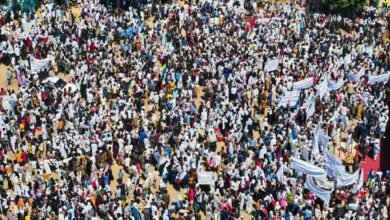
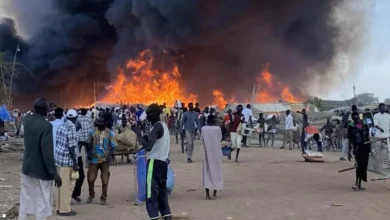
Eritrea announced the mobilization of its armed forces on the Sudanese border, and observers brought to mind Eritrea’s claim to its historical right to Kassala state in eastern Sudan. With the continued battles between the Rapid Support and the Sudanese army, estimates are that the conflict may develop into a wide civil war and perhaps beyond that, with the possibility of dividing Sudan on tribal and ethnic grounds. The estimates add that Eritrea will be in danger if the civil war develops in the states of eastern Sudan, and its fuel will be the tribes of Eritrean origin from Habab and Beni Amer, and if the conflict overflows with a large wave of displacement towards Eritrea, it will upset the equation and the ethnic balance in the country, which is controlled by the Tigrinya nationality, the social base of the Isaias Afwerki regime and the Popular Front that has ruled the country alone since independence in 1993 from Ethiopia until today.
As the war in Sudan entered its second year, the Eritrean regime departed from its neutrality and opened its army camps to movements allied with the Sudanese army or ethnic movements of Eritrean origin, although it has been hostile to them since the leadership of the Eritrean liberation movements was decided in favor of the Popular Front led by Afwerki, while Eritreans in Sudan formed the base of the Liberation Front and its Arab and Muslim wing.
In this brief paper, we will try to shed light on the historical background that casts a shadow today on this shift:
– Eastern Sudan was associated with the Eritrean national movement, and this association went beyond shaping the contours of Eritrean identity and fueling a conflict over Sudanese identity. Among the tribal groups that settled in eastern Sudan, the Habbab and Beni Amer tribes with Eritrean roots played an important role in igniting the idea of armed struggle for Eritrea’s independence. Since the start of the Eritrean revolution in the 1960s, eastern Sudan has been a safe haven for revolutionary movements in their war against Ethiopia. At that time, Eritrean Muslims and Arabists led the call for the idea of revolution and independence, and that the victory of the revolution and the building of an independent Eritrea would be the main support for the Bijawi tribes in eastern Sudan, to face marginalization by the Khartoum and North Nile group that has monopolized the resources of power and wealth since independence in 1955, but historical tails carried a contradiction between the components of Eritrean origin in Sudan, due to their old position on the Mahdist revolution and the British occupation of Sudan
– Eastern Sudan became the headquarters of the fighters of the Eritrean Liberation Front, and the leadership work was led by figures from the sons of Al-Bani Amer who settled in Sudan to escape the war in Eritrea and even became an alternative homeland, especially after the leadership of the Eritrean revolution was transferred to the Eritrean People’s Liberation Front in 1981, after the dominance of the Christian sons of the plateau on the leadership of the revolution.
– The Eritrean issue is no longer a card in the hands of the Eritrean-Sudanese tribesmen to use in the face of internal marginalization, and the east has turned into areas of balance of power between the Nile North, who have an interest in keeping the east at the mercy of Khartoum politicians, and the Abyssinian Plateau, who want to keep the influence of border tribes away from their power.
– After Eritrea’s independence and turning the page on the differences with the Islamic Front regime in Khartoum, the Eritrean government began to use the tribal extensions and the embrace of Sudanese lands for the Eritrean revolution to strengthen its influence in eastern Sudan, which would become the most important commercial outlet for Eritrea, whose regime decided not to join the international economic system and remain in the shadows, and primarily employed the state of hostility hidden behind what it thought were umbrellas for tribal components that provided support and backing for the revolution in Eritrea.
The Eritrean regime’s strategy was summarized as follows:
First: It signed the tripartite agreement with the Sudanese government and the United Nations High Commissioner for Refugees (UNHCR), according to which Eritreans who stayed in Sudanese camps throughout the war in Eritrea were stripped of their refugee status and the UNHCR relinquished its responsibility for them, in a deal in which the Sudanese government agreed to grant them Sudanese nationalities. Sudanese nationalities, and saw in it an attempt to equalize the balance of the tribes of the east in front of the tribes coming from western Sudan with their different African ethnicities, and in return, Asmara gets rid of ethnic components by helping to settle them, especially since they often have Arab and Islamic backgrounds that pose a threat to the regime based on the Christian Tigrigna ethnicity.
Secondly, Eritrea sponsored an agreement between the Sudanese Government and the Eastern Movement: Eritrea sponsored an agreement between the Sudanese government and the Eastern Movement, which adopted a greater participation of the East in Sudanese politics and an end to the marginalization imposed on it. This agreement revealed the Eritrean government’s support for the choice of the Hadendwa as its Sudanese partner and the exclusion of the Beni Amer from playing a role in the political life of the East, and thus helped to settle components of Eritrean origin in Sudan while at the same time working to isolate them from Sudanese political life.
Third: Asmara, with the knowledge of the Sudanese government, and even in coordination and cooperation with it, established a network through which it managed a commercial movement for the flow of goods between the two countries as well as financial transfers, supplying the Eritrean market with basic consumer goods and managing financial transfers, especially with the intensification of the isolation, boycott and blockade imposed on Eritrea.
Conclusion:
– The Eritrean regime is facing a difficult choice that it would have preferred not to reach, as it has always bet on the survival of the northern hegemony over Sudan and the extension of control over eastern Sudan with its complex ethnic components, during which it relied on its historical relations with the Hadendwa component.
– However, the Asmara regime found itself forced to switch alliances and recruit members of the Beni Amer and Habab tribes to secure its influence in eastern Sudan, but in order to overcome the threat that such a move could pose to the framing of Eritreans from those tribes, it chose to mobilize and work with other ethnic components in the east, which adds another complexity to the nature of the crisis and reveals an inability to formulate a clear political vision towards the Sudanese crisis.
– The chaos of the Eritrean approach is due to the recent history where the East and the conflict with its tribes was a permanent and decisive factor in the fall of the rulers of the Tigray Plateau, and the permanent influence of eastern Sudan on the internal situation in Eritrea after independence, as the imminent threat to Isaias Afwerki’s rule has always been from eastern Sudan, not any internal or external opposition.