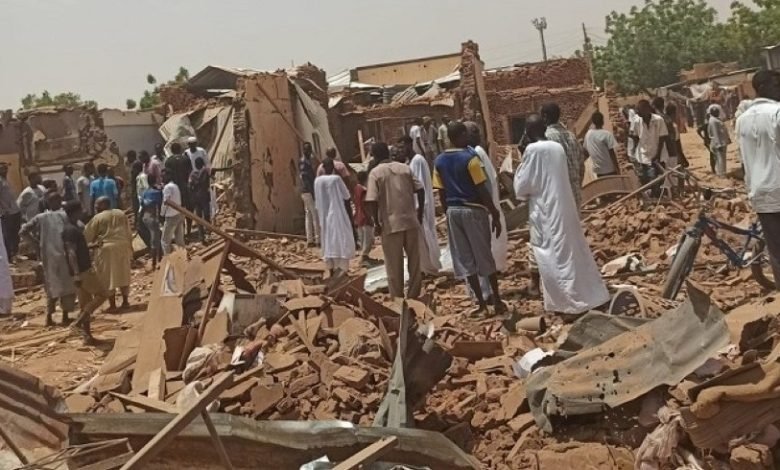
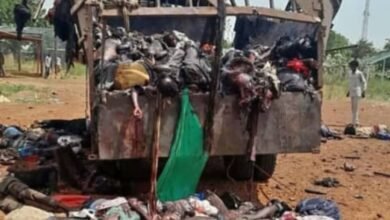
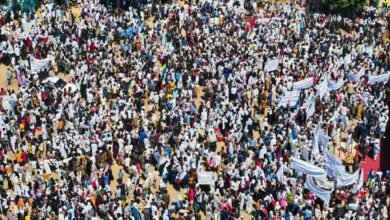
Residents from the cities of Nyala, Kuma, Kutum and Tawila in the Darfur region recounted the violations they suffered as a result of the Sudanese army’s aerial bombardment of their homes and service institutions on which they depended for their lives, such as water sources and hospitals. Rhino documented various scenes of the effects of the aerial bombardment that affected citizens’ homes and other civilian objects and listened to the testimonies of those who fled their homes in Kuma, Mellit, Nyala and El Fasher due to the bombing by the Sudanese army’s warplanes. The cities of Nyala, South Darfur, and Kuma, North Darfur, are among the most targeted areas by aerial bombardment, while a number of residents of the two cities say that the bombing affected their homes and service institutions, which do not have any military manifestations in or near them.
people killed inside their homes:
Mayor Ajaballah, a member of the civil administration in al-Kuma, confirmed that his sister Salma and her son were killed and other family members, including a baby, were injured in an airstrike by the Sudanese army on al-Kuma earlier. He added: “We have no enmity with anyone, we are peaceful and coexisting citizens, and we do not attack anyone, yet the aircraft kept bombing us, about 10 people were killed inside their homes in our neighborhood, this thing has nothing to do with Islam, if they want to rule and kill citizens, who are they ruling?”
“The Sudanese army warplanes targeted the city more than 200 times, dropping more than 250 shells, destroying infrastructure such as schools and hospitals, and causing residents to flee into the open,” said a resident of al-Kuma. He added that one of the planes attacked the city while residents were sleeping, killing a woman and an infant, injuring her mother, and destroying the house. “We are unarmed citizens and farmers, including elderly people, yet the airplane continued to hit us every day with its missiles, dropping more than 20 shells on us in three days,” he said. In the first week of October last year, Sudanese army warplanes bombed the weekly market in al-Kouma, killing about 71 civilians and wounding hundreds of others.
Calls for a no-fly zone:
In the last week of December, the city of Nyala was bombed for six consecutive days, killing a number of civilians, including five members of Mustafa Hassan’s family in the Wadi neighborhood. The bombing also targeted Nyala University and the city’s airport, which has been a constant target of airstrikes since it was reactivated by the RSF last September, when the first RSF cargo plane landed there. Saad Mohammed, a resident of Nyala, confirmed that his mother and nephew were killed and others in his neighborhood were injured by Sudanese army airstrikes. He added: “We can only say, ‘We have no military appearance or anything that would make the army target us.
Another citizen in Nyala, who preferred to withhold her name, appealed to the United Nations to intervene and ban flights in Darfur to spare civilians from the abuses they are subjected to. She said: “We are citizens who cannot leave our homes to anywhere, our economic conditions are deteriorating, those who are here now are mostly women and children, and our message to the international community and the world is to ban flights in Darfur.” She noted that hundreds of civilians in Nyala have been killed, and others have had their organs amputated as a result of the aerial bombardment of the city.
Humanitarian violations:
Indiscriminate bombing of civilians and civilian objects violates the principles of international humanitarian law and Common Article 3 of the 1949 Geneva Conventions and Additional Protocol II, which prohibit the targeting of civilians and civilian objects during armed conflicts. Indiscriminate aerial bombardment also violates the principle of distinction, which obliges parties to the conflict to distinguish between civilians and combatants, and the use of barrel bombs constitutes a war crime according to the Rome Statute of the International Criminal Court.
Article 8 of the ICC Statute emphasizes that such attacks constitute war crimes, whether committed during international or internal armed conflicts, and Article 7 of the ICC Statute states that a specific set of crimes “when committed as part of widespread or systematic attacks directed against any civilian population” constitute crimes against humanity. Humanitarian law also prohibits any kind of indiscriminate attacks, as such attacks do not distinguish between military and civilian targets.
Targeting civilians is a systematic strategy:
Human rights organizations that monitor the situation in Sudan, such as the Darfur Victims Advocacy Organization, believe that the Sudanese army’s increasing air attacks on civilian areas are not indiscriminate, but rather part of a systematic strategy aimed at destroying the social fabric and local economy in Darfur. “According to international law, these attacks constitute war crimes under the Rome Statute of the International Criminal Court, which criminalizes indiscriminate attacks that deliberately or recklessly affect the civilian population,” the organization said in an October 2024 report.
For its part, the human rights organization “Emergency Lawyers” says that the city of Nyala, the capital of South Darfur state, was subjected to a series of indiscriminate attacks by warplanes, as the raids targeted residential neighborhoods, including “the airport, Rahman, and factories” using barrel bombs. “These attacks are part of an ongoing escalation campaign that refutes claims that the bombing is focused only on military targets, as the strikes are deliberately concentrated on populated residential areas,” it said in a statement.