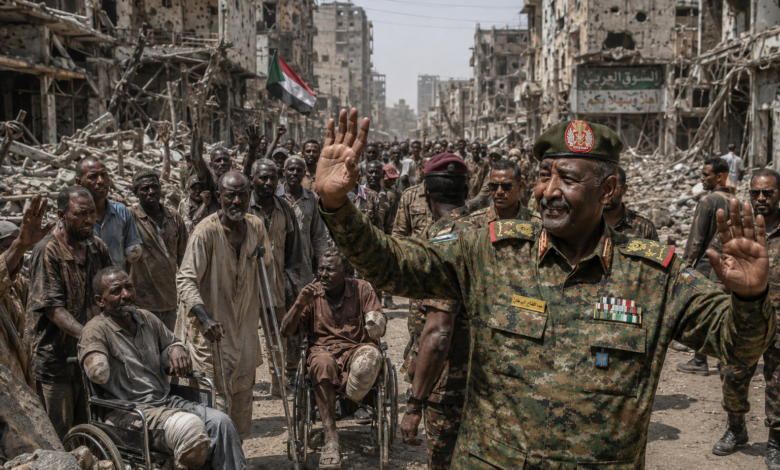
Army Commander General Abdel Fattah al-Burhan has made multiple and repeated public appearances—sometimes addressing worshippers, other times conducting drills, and time and again strolling through the markets. With each appearance, his remarks seem to vary in phrasing, though the message remains consistent: the country is safe, and the army is in control and holds sovereignty.
This new pattern of public appearances cannot be interpreted in isolation from an extremely complex political context, characterized by a lack of constitutional and electoral legitimacy and the erosion of the state’s institutional structures since the events of October 2021 and the subsequent outbreak of war in April 2023. While the military establishment seeks to consolidate its presence as the guarantor of national sovereignty, observers are raising fundamental questions about the true motives behind these intensive public appearances by Burhan: Is this a preemptive attempt to engineer an alternative form of legitimacy in light of the power vacuum and escalating challenges on the ground?
Visual and Psychological Signals
Political analyst Omar Sufyan Salem argues in an interview with “Raino” that the current developments on the ground in Sudan and the shift in the military balance of power in favor of the Rapid Support Forces—after Hemeti gave his forces free rein— as well as his rejection of all attempts to reach a ceasefire agreement due to the army’s and Islamists’ backtracking and insistence on treachery, escalation, and refusal to negotiate or accept peace—have forced Al-Burhan to scramble to project a sense of confidence to counter his army’s setbacks
He said, “Al-Burhan’s direct field visits among citizens and returnees to Khartoum State aim to send strong visual and psychological signals to allay residents’ fears, and to convey a message on the ground that security is beginning to take hold in the areas secured by the army, which aims to restore the public’s shaken confidence in the ability of state institutions to protect society and provide the security framework necessary for the resumption of daily life.”
Sufyan noted that in his speeches and meetings accompanying these visits, al-Burhan is keen to remind people that the armed forces are a national institution that does not belong to any party, faction, or tribe. He added: “Through this repeated emphasis, Al-Burhan seeks to counter the acute political polarization and consolidate the army’s legitimacy as the sole legitimate institution authorized to protect the country’s unity and territorial integrity, positioning himself as the last hope to prevent the disintegration of the Sudanese state amid multiple fronts and regional and international pressures.”
Analysts suggest that Al-Burhan’s attempts do not appear to be detached from the context, surroundings, and environment in which he appears and speaks. According to “Raino” monitoring, Al-Burhan is making these efforts amid harsh living conditions affecting the markets, where prices of basic commodities are rising to exorbitant levels that are eroding citizens’ wages and purchasing power. Therefore, in an effort to project his empathy toward citizens, he repeatedly mentions his direct directives to local authorities in Khartoum State to lower prices, provide services, and support low-income groups —such as his directive to allow “tea ladies” to carry out their work—in an attempt to demonstrate direct engagement with the crushing economic crises, in an effort to defuse public discontent and narrow the widening gap between official rhetoric and the deteriorating reality of daily life.
Sufyan confirms that the general’s presence in markets and residential neighborhoods constitutes a practical call to urge displaced persons and expatriates to return to their homes, in conjunction with government announcements and repeated promises to rehabilitate vital facilities—such as hospitals, health care facilities, and educational institutions in Omdurman, Bahri, and East Nile—in an effort to link security stability to the restoration of a minimum level of essential services that will encourage the return of demographic and urban stability to the capital.
Observers believe that by wearing sportswear and visiting mosques and public squares, al-Burhan is seeking to transform the public perception of him as a military leader by breaking the traditional image that has taken root among Sudanese—that of a military figure isolated behind the fortified walls of the General Command. Some argue that al-Burhan’s informal outreach aims to present him as a leader attuned to the concerns of ordinary citizens; proponents of this analysis contend that this approach is consistent with standard tactics in leadership campaigns designed to solidify popular acceptance and mitigate political criticism directed at the management of the conflict and the continuation of the war.
Meanwhile, analyst Omar al-Nazar points out that al-Burhan’s focus on presenting himself in this light signifies, among other things, another step in a play directed by neighboring countries in the process of installing him as president of Sudan—a scenario that has been speculated upon by many circles in recent times.
Generally speaking, regardless of whether these attempts succeed or fail, the situation remains marked by contradictions. The ongoing escalation on the ground and the renewed drone attacks targeting the heart of the capital and its surroundings pose security challenges that undermine Burhan’s political messages and render his unilateral approach a mirage, at a time when Sudanese citizens find themselves caught between the authorities’ attempts to establish legitimacy on the ground through popular symbolism and an extremely complex economic and security reality that demands tangible measures before any public display of strength.
An Analysis of Al-Burhan’s Behavior
In a sociological analysis of recent shifts in the way Army Commander General Abdel Fattah al-Burhan presents himself to the public, Dr. Abdel Nasser Ali al-Faki, a professor of sociology at Sudanese universities, argues that his visits to markets and neighborhoods and his interactions with citizens should not be viewed merely as spontaneous scenes or fleeting human moments.
In an interview with “Raino,” Al-Faki says that these moves appear more like an attempt to rebuild the commander’s image and restore military and political legitimacy that have been severely tested by the war and the accompanying political, economic, and social crises.
He noted that, from a political sociology perspective, Al-Burhan’s behavior reveals a “structural contradiction” between his position at the head of a military institution that is supposed to represent the state, and the reality of a state whose institutions and services have been weakened by the war, leaving citizens to face daily challenges related to security, livelihoods, healthcare, and education.
Al-Faki explains that this contradiction can be understood through what he calls “institutional duality”: on the one hand, Burhan needs to rely on the legitimacy of the state represented by the military; on the other hand, he needs to distance himself from the image of a state apparatus incapable of meeting many basic needs.
Hence, he says, a situation of “selectivity in presenting the image” emerges; On some occasions, al-Burhan appears as a military commander, surrounded by officers and guards, speaking about war and sovereignty; on other occasions, he takes on the image of an ordinary citizen, wandering through markets, talking with people, sitting with them, drinking a traditional beverage, or taking photos with children.
Al-Faki believes that this approach gives the leader an opportunity to appear close to the people, but at the same time it poses another problem, because it prioritizes his personal image over his political and institutional responsibilities. The closer the leader gets to the citizen, the more able the citizen becomes to compare him to what is happening around them.
Charisma… Form Without a Project
The sociology professor observes that some of al-Burhan’s public appearances, in terms of form, evoke historical images of leaders known for their popular presence in Arab and African memory, but he cautions against direct comparisons between al-Burhan and leaders such as Gamal Abdel Nasser or Jaafar Nimeiri.
He argues that Nasser’s charisma was not built solely on public appearances or popular imagery, but was linked to a clear political, social, and nationalist agenda that encompassed issues of Arab unity, industrialization, state-building, and social transformation.
In Al-Burhan’s case, however, Al-Faki argues that “the form is borrowed, but the substance is different.” His current charisma, according to Al-Faki’s analysis, is based more on war, the defense of the state, and confronting the adversary—a charisma of a defensive nature rather than one grounded in a clearly defined political and developmental project.
He adds that this type of charisma becomes directly linked to the outcome of the war. If the war ends in a clear military victory, that victory can become an additional source of legitimacy for the leader. But the longer the war drags on and the more far-reaching its economic and social consequences become, the more its continuation becomes a burden on the image the leader is trying to build. He continued: “ As for the comparison with Nimeiri, it reveals another difference: Nimeiri was able, at various stages of his rule, to combine the image of a field commander with that of a politically astute strategist. Al-Faki argues that Al-Burhan, on the other hand, often appears to be more of a ‘commander out of necessity’ than a strategic leader with a comprehensive political vision.
Failure to Provide Bread
Al-Faki offers another explanation for Burhan’s popularity from the perspective of political psychology, through a concept he calls “compensatory behavior” or symbolic satisfaction.
He argues that when the authorities fail to provide citizens with material satisfaction—such as bread, medicine, security, and services—they may resort to creating another form of satisfaction, one that is emotional and symbolic, by portraying the leader as close to the people and concerned about their well-being.
He said, “Al-Burhan’s appearances in the markets, or sitting with citizens while drinking coffee or ardeeb, or talking with children, or giving some students a ride in his car, can serve a psychological function for the public, because it presents the image of a leader who empathizes with the people and lives among them.” He added, “But this type of satisfaction is temporary by nature.”
Abdel Nasser emphasized that no matter how moving a photo may be, it cannot replace material needs. A citizen who feels reassured upon seeing his leader by his side may, just minutes later, return to a market where prices have risen, or to a pharmacy where he cannot afford medicine, or to a home suffering from service outages. He continued: “ This is where the real problem begins. If the gap between the image and reality remains wide, that initial empathy can turn into even greater frustration, because the citizen discovers that the scene they saw on their phone hasn’t changed anything in their life.”
To Whom Is Al-Burhan Speaking?
Al-Faki believes that a significant portion of this image is directed at what might be described as the “silent majority”—social groups that do not necessarily engage in political or elite discourse but are influenced by the leader’s image, personal presence, and symbolism.
He points out that the collective memory of Sudan and the Arab world holds a strong image of the “hero,” and in some social contexts, physical courage and the ability to face danger can be seen as indicators of political competence.
From this perspective, an army commander who steps out of military headquarters onto the street, walks among the people, shakes their hands, and sits with them can reinforce the image of a leader who is approachable and capable of confronting danger. He added: “ “But the irony is that these very groups are among those most affected by the war; they are the ones facing displacement, rising prices, service disruptions, and the loss of income sources.” Therefore, the impact of this image cannot last long unless it is accompanied by a change in reality.
Image Engineering
Al-Faki does not rule out the possibility that certain details of Al-Burhan’s public appearances are part of a more organized communication strategy, especially if the same patterns recur on different occasions. He points out that clothing, the way he gets out of the car, approaching citizens, shaking hands, sitting with them, choosing the location, and even the way photos are taken—all of these can be part of crafting the leader’s image. He said: “ “This falls within the framework of what is known as ‘visual anthropology’—that is, the use of visual details and body language to shape the leader’s image in the public eye, rather than relying solely on speeches and statements.”
He argues that this approach serves to narrow the symbolic distance between the ruler and the ruled, and to portray the leader as capable of moving freely among the people without barriers. However, the problem, in his view, begins when the image becomes a substitute for politics. He added: “ Removing the visual barrier between the leader and the citizen does not necessarily mean eliminating the social and political distance between them.”
The Street as a Stage for Legitimacy
Al-Faki also interprets the phenomenon through Canadian sociologist Irving Goffman’s concept of “presentation of self,” in which public life becomes a kind of theater where actors present themselves to the public through specific roles and images.
He says that, in this case, Al-Burhan plays the role of the “concerned father” in front of the cameras—one who takes to the streets to check on citizens and listen to their problems—while more complex political, military, and institutional conflicts unfold behind the scenes.
He adds: “This performance takes on greater significance in the absence of normal civilian political institutions. There is no elected parliament fulfilling its role, nor a stable civilian government; consequently, the streets, the media, and social media become important spaces for the production of legitimacy.”
Thus, the “popular tour” is no longer merely a field visit; rather, according to Al-Faki, it becomes a space for rebuilding the relationship between the leader and the public. A Message to the Outside World
Al-Faki believes that Al-Burhan does not limit the significance of this image to the Sudanese domestic scene; rather, Al-Burhan’s appearance as a leader who is close to the people can send a message to international and regional powers that he does not merely represent a military institution, but possesses a popular base upon which to build. He says: “A leader who appears to be accepted by the public can send a message to international and regional powers that he does not merely represent a military institution, but possesses a social base upon which to build.”
As for the West, according to Al-Faki, the message can be interpreted as an attempt to present Al-Barha as the party capable of preventing chaos and preserving what remains of state institutions.
Regionally, however, the image seeks to present the army as the last bastion against the disintegration of the state or the expansion of regional rivals.
Thus, the public image is not merely a tool for improving domestic relations but also becomes a bargaining chip abroad, as the commander attempts to transform his popular presence into a source of political power.
Reality Defeats the Image
Nevertheless, Al-Faki argues that this strategy faces an impasse that is difficult to overcome through public image alone, for a leader whose public image is built in the context of war becomes, at the same time, hostage to the war’s outcome. The longer the conflict drags on, and the greater its economic and social costs become, the harder it is to separate the leader’s image from the realities people are experiencing.
Here, Al-Faki uses the term “the rupture of representation,” referring to the disconnect between the image presented by the authorities and the everyday experience of citizens. He said: “ “If the leader appears in the market drinking a popular beverage alongside citizens, and then one of them returns home to find that the price of bread, medicine, or rent has risen, the image loses some of its persuasive power.” Citizens do not live in the image; rather, they live with its consequences.
Inevitable Failure?
Dr. Abdel Nasser Ali al-Faki concludes that al-Burhan’s public appearances can be interpreted as an attempt to restore military and political legitimacy that has been shaken, through psychological and communication strategies aimed at projecting an image of a leader who is close to the people. However, in his view, these tools cannot replace a political and social project that addresses the fundamental questions raised by citizens. He believes the irony of this phenomenon is that increased public visibility may, at the same time, intensify the scrutiny to which the leader is subjected.
The closer the camera gets to the citizen, the more pressing the question becomes: What has changed in his life?
Al-Faki says, “Charisma, in the end, is not born from image alone, nor from shaking hands with people or sitting with them in the markets, but is shaped by the leader’s ability to respond to their needs and turn promises into reality.”
And here, perhaps, lies the greatest paradox of the whole scene: a leader can step out of his office, go down to the street, and get close to the people so that the cameras capture him among them, but none of that settles the question of legitimacy.