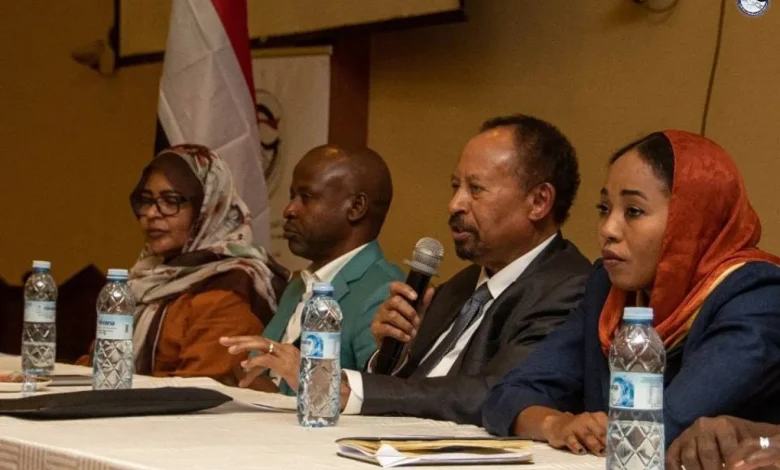
The leadership body of the Coordination of Civil Democratic Forces (Taqaddom) concluded its December 3-6 meetings in Entebbe, Uganda, with a final statement calling for an end to the hijacking of the state and the restoration of the legitimacy of the Sudanese revolution, stressing that the continuation of the war since April 2023 threatens to tear Sudan apart and compound the suffering of its people.
Warnings about the repercussions of the war:
The meeting addressed the deteriorating humanitarian and political situation in Sudan, warning that the war, which is approaching its second year, has claimed tens of thousands of lives and forced more than 12 million people to be displaced, making it the largest displacement and refugee crisis in the world. The war has also produced a global food security crisis that threatens 25 million people and has pushed 17 million students out of the education system.
On the health front, the statement said that 90 percent of health facilities in Sudan are out of service, in light of the spread of epidemics and deadly diseases. It pointed to the widespread destruction of infrastructure and the loss of homes and livelihoods for millions of citizens.
Emphasize the protection of civilians and safe areas:
The Coordination called for intensifying efforts to protect civilians by implementing effective measures, including developing a proposal to establish safe zones, the exit of all fighting forces from civilian areas, minimizing the military presence in populated areas, and stopping artillery and aerial bombardment.
Taqaddom condemned the grave violations against civilians committed by the armed forces, RSF and allied forces, calling for the activation of international justice mechanisms to ensure that perpetrators of crimes are held accountable, and victims receive justice.
Political dimensions and rising hate speech:
The meeting discussed the escalation of hate speech and racist tendencies, as well as the increased activity of former regime elements who are exploiting the war to achieve their goals. The Coordination also warned that external parties are fueling the Sudanese conflict, further complicating the crisis and prolonging the war.
Demands to the international community:
The coordination called on the international community to Expand the mandate of the International Criminal Court to include crimes committed in Sudan. Extend the arms embargo in Darfur to include the entire country. In addition to increasing humanitarian support for Sudanese affected by the war.
It also called on international parties to exert effective pressure on the parties to the conflict to stop the fighting and open humanitarian corridors, based on the decisions of the Jeddah Humanitarian Platform.
Issues of refugees and displaced persons:
(Taqaddom) decided to establish a special mechanism to address the issues of refugees and displaced persons, including organizing a conference to provide sustainable solutions to the challenges facing them.
It emphasized the need to open humanitarian pathways inside and outside Sudan and called on donors to abide by their pledges to support the displaced and host communities.
Addressing the humanitarian disaster is a top priority:
The meeting affirmed that the top priority of the coordination is to address the humanitarian disaster in the country, commending the efforts of the emergency committees and humanitarian organizations in meeting the basic needs of the affected people.
Political measures to achieve peace:
Taqaddom announced its adoption of three simultaneous political tracks, namely: Ceasefire, establishing a comprehensive political process that addresses the dimensions of the war and establishes a sustainable peace.
Addressing the humanitarian crisis.
The Coordination emphasized that a military solution to Sudan’s crisis is impossible, calling for the design of a political process in which civil society and professional forces, trade unions, and resistance committees participate.
Legitimacy and the formation of a government:
The meeting discussed calls to form a government to delegitimize the current government in Port Sudan. The meeting referred this issue to a political mechanism to study it in depth.
In his speech, Dr. Abdullah Hamdok, the Prime Minister of the civilian transitional government, stressed the need for unity to achieve the goals of the Sudanese revolution, and called for an end to the false legitimacy that is being used to prolong the war and divide the country.
Conclusion:
At the conclusion of the meetings, Taqaddam emphasized that the current war is a complex war with deep dimensions, and that addressing it radically is necessary to prevent the outbreak of other wars in the future. It emphasized that the founding conference of the Civil Alliance is an important step to unify the forces of the Sudanese revolution and build a platform to achieve freedom, peace and justice, and complete the course of the December revolution.