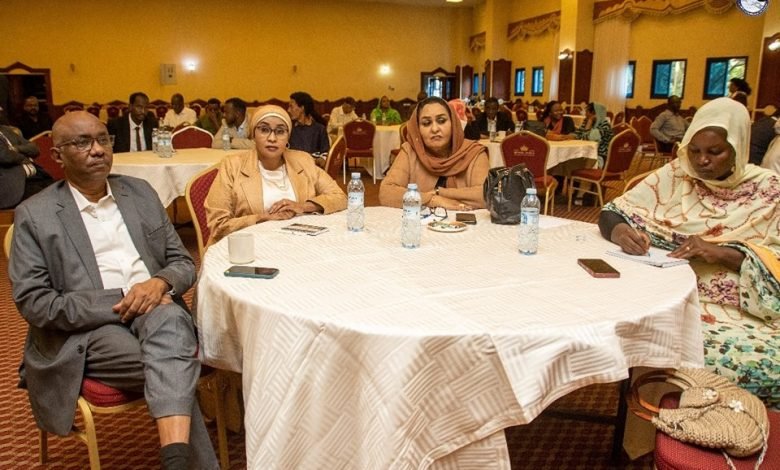
The leadership body of the Coordination of Civil Democratic Forces (Taqaddom) met in Entebbe, Uganda, from December 3 to 6, 2024. The meeting came at a time when our country is going through catastrophic conditions due to the continuation of the April 15 war, which resulted in tens of thousands of civilian and military deaths, led to the largest displacement and refugee crisis in the world, which exceeded 12 million Sudanese, produced the largest food security disaster in the world that threatened 25 million people, pushed more than 17 million students out of the educational system, and drove 90% of health facilities out of operation, spreading epidemics and diseases that killed people, destroyed infrastructure and lost citizens their homes, properties, and sources of livelihood. This catastrophe, the largest in the world, continues to multiply day by day amid the warring parties’ insistence on continuing the fighting, the escalation of hate and racist rhetoric, the growing portents of a comprehensive tribal civil war, the nourishment of external parties that prolong it, and the lack of a horizon for a peaceful political solution in the near future. The continuation of this war will tear Sudan apart, compound the suffering of its people, and threaten regional and international peace and security, which increases our determination to work to stop and end the war, address the humanitarian disaster, and reach a comprehensive political solution that ends the fighting, establishes a sustainable peace, and completes the tasks of the glorious December Revolution.
The meeting discussed in depth the issues of the humanitarian and political situation and reviewed the internal organizational work and concluded the following:
I: The humanitarian disaster and protection of civilians:
The meeting emphasized that addressing the humanitarian disaster and working on serious measures to ensure the protection of civilians is Taqaddom’s top priority in its daily work and media discourse. The meeting condemned the grave violations committed by the RSF, the armed forces and allied forces against civilians, commended the report of the independent international commission of inquiry, and called for the need to activate international justice and protection mechanisms to ensure the cessation of crimes, justice for victims and accountability for criminals.
The meeting stressed the need to open pathways for the delivery of humanitarian aid across Sudan’s borders and within Sudan, appealed to donors to fulfill their pledges made at the Paris conference, commended the efforts made by emergency committees and national and international humanitarian organizations to provide the necessary needs for those affected by the war, decided to form a special mechanism to follow up the issues of refugees and displaced persons and hold a conference to find solutions to their issues, and issued a number of decisions to address the issues of deprivation of education and pay attention to farmers, pastoralists and nomads.
The meeting decided to intensify efforts to enforce more effective measures to protect civilians, develop the proposal for safe zones, call for the withdrawal of all fighting forces from civilian objects, reduce the military presence in populated areas, stop artillery and aerial bombardment, call on the international community to expand the mandate of the International Criminal Court to investigate all crimes committed against civilians, and extend the arms embargo in Darfur to include all of Sudan in order to contribute to shortening the duration of the war.
II: The political vision to end the wars and establish the Sudanese state:
The leadership body discussed the current political developments, especially the escalation of confrontations between the parties to the conflict, the worsening of the humanitarian disaster, the increase in the severity of violations, the blockage of the horizon for a peaceful solution, the increased activity of elements of the former regime and their control of the Port Sudan authority, and the increasing threat of dividing the country according to internal and external factors pushing in this direction, according to the above, the meeting decided to work on three political tracks to enhance the chances of ending the war and establishing the Sudanese state.
1- The Broad Civil Front:
Efforts have continued to build a broad civilian front that includes all the forces of revolution and democratic transformation that stood against the October 25 coup and the April 15 war. The founding conference of the Coordination of Civil Democratic Forces (Taqaddom) was an important step towards unifying the revolutionary forces and building a broad platform that links the search for peace with the completion of the glorious December revolution and the establishment of the Sudanese state, despite the wide base of participation, a sector of the revolutionary forces did not participate in this process.
Large segments of the revolutionary forces are now engaged in constructive dialogues to broaden their consensus and strengthen joint efforts to reach a broad civil front that includes all revolutionary forces. Taqaddom supports this trend and believes that the front should be based on agreed-upon principles, effective and flexible working systems, and use all peaceful and legitimate means to stop and end the wars and establish the Sudanese state.
2- The political process to end the wars and establish the Sudanese state:
We believe that there is no military solution to Sudan’s accumulated crises, and that the April 15 war is a complex war with many and deep dimensions that must be addressed in a real and radical way so that it will be the last of Sudan’s wars, which requires designing a political process that addresses all these dimensions and leads to sustainable peace and the completion of the glorious December revolution. In this context, we call on the parties to the fighting to refrain from targeting civilians, facilitate humanitarian access, return to negotiations without conditions and give preference to the voice of reason to end the suffering of millions who were affected by the war.
The meeting emphasized that defining the parties to the political process must be based on specific criteria, and on top of these criteria, its parties must be known, defined and identified from political forces, armed struggle movements, civil society forces, professionals, unions and resistance committees, provided that the political process has popular depth and real stakeholder participation, and should not reward the National Congress and its Islamic movement and their fronts who ignited the war and are working to continue it, but should lead to their accountability.
The meeting appreciated all regional and international efforts to stop and end the war, and emphasized the importance of unifying them in a unified negotiating platform with three integrated and simultaneous tracks: the humanitarian disaster track, the protection of civilians, the ceasefire track and the political dialogue track that addresses the roots of the crisis.
3- Ending the hijacking of the state and restoring the legitimacy of the December Revolution:
The October 25 coup aborted the democratic civilian transition and contributed to creating the conditions for the outbreak of war, which came as a natural consequence of the National Congress’ plans and the multiple heads of the coup. Since that time, legitimacy has been completely absent in Sudan and no legitimate authority has been established. This is the popular position expressed by the millions of people who came out against the coup, and the regional and international community, which suspended Sudan’s membership in the African Union and did not recognize the coup authority. The April 15 war broke out to exacerbate the crisis of legitimacy and lead to the collapse of the state, and the Port Sudan authority sought to claim that it represents legitimacy, a false claim that has no constitutional, political or popular support.
The Port Sudan authority used this so-called legitimacy to prolong the war and disrupt the chances of reaching peace, as the October 25 coup was a means of gaining power that failed as a result of the wide popular stance against it, so the war comes as an extension of the same attempt to seize power, so the war is now being used as a means to achieve what the coup failed. This pseudo-legitimacy has also been used to divide Sudan, which has manifested itself in measures to change the currency, obstruct the arrival of humanitarian aid, deny citizens their constitutional rights to identity documents and the educational process, and approve discriminatory legislation such as the law on foreign faces and other forms of employment that divide the country de facto, which is consistent with the National Congress’ fragmentation project, which divided Sudan before and is not yet satisfied, and now they seek further di Recognizing our national, moral and historical responsibility, we were quick to lead and support many initiatives aimed at opposing the war and working to stop it by initiating a dialogue to resolve this national crisis. To this end, the national forces exerted tremendous efforts with all international and regional partners and the African Union, but the former regime and its elements within the security system refused to stop the war and insisted on continuing it. Therefore, it must be emphasized that there is no legitimacy except for the glorious December Revolution, and any form of false legitimacy must be removed and confronted by all available means, which the political mechanism of Taqaddam will discuss its options in order to preserve the unity of Sudan’s land and people, achieve lasting and comprehensive peace, and complete the glorious December Revolution.
Third: Internal organizational issues:
The meeting discussed the internal organizational situation, reviewed the report of the General Secretariat and approved it after a thorough discussion and strong recommendations to improve performance. The meeting also discussed a number of internal memorandums and subjected them to deep dialogue and developed comprehensive solutions to the issues raised by them in order to strengthen unity and internal cohesion to advance and develop its performance and strengthen its internal democracy to preserve what it has achieved in the past period of gains by building the broadest democratic civilian anti-war coalition that includes political forces, armed struggle movements, professionals, unions, resistance committees, civil society and qualitative components such as refugees, displaced persons, creators, farmers, pastoralists, business owners, and community and religious leaders.
The meeting also decided to evaluate Taqaddam’s founding conference and identify the positives, negatives and lessons learned from it, emphasized the need to enhance the representation of women and youth in all Taqaddam structures, and decided to immediately decide on all requests from civilian bodies outside Taqaddam that wish to join the coalition. The meeting discussed Taqaddam’s media performance and emphasized the need to activate and support the work of the media committee in order to combat the misleading war media and generously funded hate speeches.
In conclusion, the meeting thanked the Republic of Uganda, President Yoweri Museveni, his government and its generous people for hosting this meeting and for embracing tens of thousands of Sudanese refugees who sought refuge in Uganda as a result of the war.
Finally, we call on all our sons and daughters at home and in the countries of asylum and displacement to unite ranks to oppose the discourses of war, hatred and racism, to intensify efforts to establish peace in our country, and to commemorate the glorious December Revolution whose anniversary we breathe these days, as this war came to abort the revolution, eliminate its values and ideals, liquidate its living forces and turn back the clock to bring the former regime back again to dominate people’s necks.
The December Revolution is here to stay, the war is gone, and the victory belongs to our patient, persevering, and unrelenting people.
The leading body of the Coordination of Civil Democratic Forces “Taqaddom”