Sudan’s army has curbed purchases of Iranian weapons as the nation strives to win US support in future talks to end a civil war.
The army has conveyed to the US that it’s no longer looking to Iran for weaponry and wants to prove it’s a reliable partner for peace.
Sudan’s military is now looking to rebuild greater cooperation with the US and Saudi Arabia and is also considering Turkey as an alternative source of assistance.
Sudan’s army has curbed purchases of Iranian weapons, according to people familiar with the matter, as the North African nation strives to win US support in future talks to end a three-year civil war.
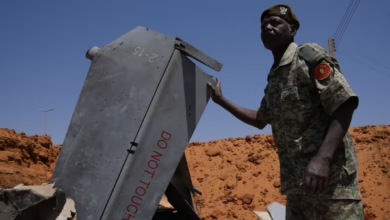
Drones and other arms supplied by the Islamic Republic helped the Sudanese military recapture ground in a conflict that’s left more than a hundred thousand people dead and drawn in foreign powers. But assistance from Iran and local Islamist fighters the US accuses of links to Tehran have become a liability as Sudan’s government tries to get on the good side of President Donald Trump.
Sudan’s military has conveyed to the US that it’s no longer looking to Iran for weaponry and wants to prove it’s a reliable partner for peace, said the people who include regional diplomats and a senior Sudanese security official. They asked not to be identified because the deliberations are private.
The army is aware that alignment with Iran has allowed its paramilitary opponents, the Rapid Support Forces, to brand it a religiously motivated and extremist force, according to the security official.
The strategy now is to rebuild greater cooperation with the US and Saudi Arabia, the person said. Washington last year sanctioned army chief Abdel Fattah Al-Burhan, accusing him of destabilizing Sudan.
The US has also designated as a terrorist group the Sudanese Muslim Brotherhood, defining the group as the Sudanese Islamic Movement, members of which once ruled the country, and an armed wing, the al-Baraa Bin Malik Brigade. The latter is allied with Sudan’s military and accused by the US of conducting mass executions of civilians.
The latest shift underscores how the push for peace in Sudan has collided with Washington’s confrontation with Tehran. The US has led efforts to broker a truce in the Sudanese conflict at the same time as waging a war on Iran — the same power that’s armed Sudan’s military along with proxy forces in the Middle East including Hezbollah in Lebanon and Houthi rebels in Yemen.
Israel, meanwhile, has a keen interest in Sudan distancing itself from its arch-foe Iran. Sudan’s government in 2020 — then led by members of both the army and RSF pledged to recognize Israel, although the act was never fully implemented.
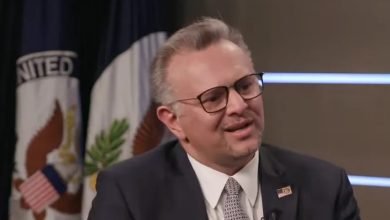
A US State Department spokesperson said Islamists in Sudan continue to have ties with Iran.
“Sudanese Islamists continue to actively obstruct efforts to reach a ceasefire to end the current war and are cultivating ties with and receiving technical support from the Iranian government, including the Islamic Revolutionary Guard Corps,” the spokesperson said.
The spokesperson said Sudanese Muslim Brotherhood fighters continue to receive training and other support from Iran’s IRGC, while both the RSF and the Sudanese army have acquired weapons from unspecified foreign actors and used them against civilians.
The al-Baraa Bin Malik Brigade has denied having links to Iran and says it’s committed to working under the military’s leadership. The Sudanese official said Burhan has recently moved to retire army generals seen as overly sympathetic to Islamists.
Sudan’s military rekindled relations with Iran in late 2023 after a roughly seven-year pause during which Khartoum favored Saudi Arabia. The thaw led to Iran supplying attack drones, Bloomberg reported.
Repeated peace-brokering attempts by the US and others have failed to stem the conflict, which the United Nations says has caused the world’s worst humanitarian crisis. Talks involving regional powerbrokers have stalled, with sticking points including whether either of the warring sides should play a role in any transitional government.
Two foreign officials who tracked previous Iranian shipments said there has been no sign of recent support. The Sudanese government, which recently returned to the recaptured capital, Khartoum, is instead looking to Turkey as an alternative source of assistance, the security official said.
Turkey has previously delivered TB2 combat drones and munitions to Sudan, according to people familiar with the matter. The government declined to comment on the issue or on arms exports by private companies.
The RSF has been accused by the US and others of genocide during the war. The militia frequently describes Sudan’s army as being riddled with religious extremists.
Sudan’s military, human rights groups and UN experts have alleged the UAE backs the RSF. Abu Dhabi has repeatedly denied that, saying it supports neither side and an immediate ceasefire and political transition are vital.
Both the RSF and military were once key enforcers of Sudanese dictator Omar al-Bashir, who espoused Islamist principles and was overthrown in 2019.
As well as its formal forces, the army has marshaled other fighting groups that include former pro-democracy activists as well as the Islamists. The State Department says the Brotherhood has contributed more than 20,000 fighters.