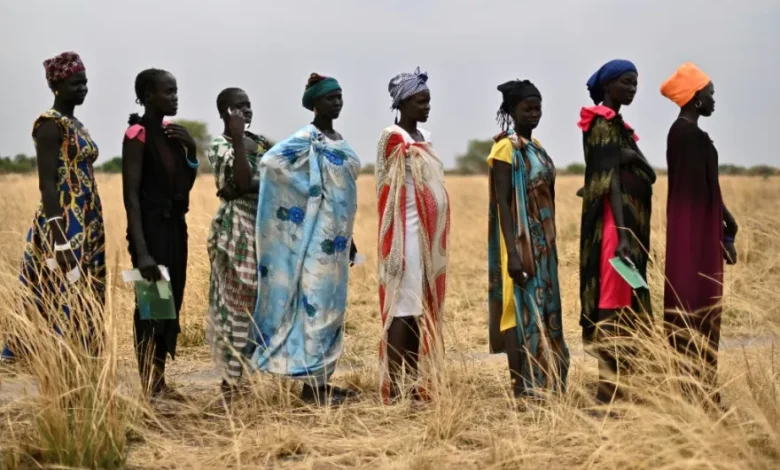
Rhino: The United Nations said on Monday that about 7.7 million people in South Sudan, nearly 60 percent of the population of the country plagued by violence and climatic disasters, are at risk of severe malnutrition next year.
The humanitarian situation in South Sudan, the world’s poorest country, has deteriorated due to the worst flooding in decades and the arrival of large numbers of refugees from neighboring Sudan, which is at war.
The latest UN report, based on the IPC (Integrated Food Security Classification Framework) index, which includes five hunger threshold levels, predicted an increase in the number of people at risk of acute food insecurity.
The latest assessment estimates that in April, 7.69 million people, including 2.1 million children, will be at risk of “not being able to consume enough food to put their lives or livelihoods at immediate risk” (level 3 or above), up from 7.1 million this year. Of these, 63,000 will find themselves in a “catastrophic” food situation, the stage (5) that precedes famine.
“Year after year, we observe that hunger is at its highest levels in South Sudan,” Mary Ellen McGroarty, WFP’s Country Director for South Sudan, said in a statement. “When we look at the areas with the highest level of food insecurity, it is clear that a combination of desperation, conflict and the climate crisis is the main cause.” South Sudan, which is prone to climate disasters, is facing the worst flooding in decades, which has displaced 380,000 people and affected 4.1 million, according to the United Nations Office for Humanitarian Affairs (OCHA). It must also deal with the arrival of 810,000 people who fled the war that broke out in April 2023 in neighboring Sudan, according to UN data.
Politically, the country is paralyzed by corruption and disputes stemming from a civil war that killed 400,000 people and displaced millions between 2013 and 2018. In September, the government announced the postponement of the first elections in the country’s history, scheduled for December, for two years. South Sudan’s economy suffered a major blow to its main source of revenue when a major oil pipeline burst in Sudan in February, causing the local currency to plummet and prices of basic commodities to soar.