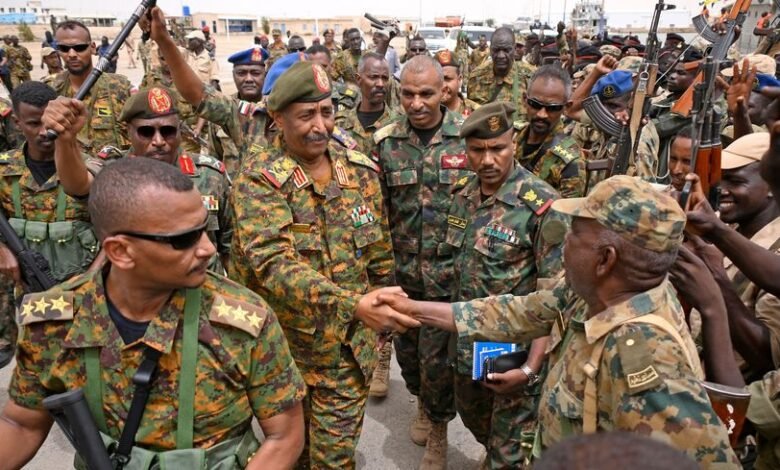
After 15 months of fighting with the paramilitary Rapid Support Forces (RSF), the Sudanese army appears increasingly weak and vulnerable.
Sudan-RSF
The war in Sudan, which began in the capital Khartoum, has spread to 10 of Sudan’s 18 states, with the Rapid Support Forces (RSF) overrunning Sudanese army garrisons in eight state capitals.
The RSF is currently besieging the city of El Fasher in North Darfur, in an attempt to take control of the last army strongholds in the western Darfur region of the country. This escalation has drawn international condemnation.
The RSF’s recent seizure of Foula, the capital of West Kordofan state, and most of Sennar state has revived fears that the RSF could take over the entire country.
Calls for the resignation of the head of the Sudanese Armed Forces, General Abdel Fattah al-Burhan, were widespread following the RSF’s seizure of Wad Madani. The city was considered a safe haven for individuals displaced by the conflict in Khartoum until the arrival of the RSF in December.
Calls for al-Burhan to step down have intensified as the RSF continues to expand and the war continues to threaten what remains of Sudan’s conflict-free areas.
However, a change in leadership alone may not be enough to save the Sudanese army. According to Tijani Ibrahim, former Minister of State for Finance and Economy, the issues plaguing the military are structural
Ibrahim told The New Arab: ‘The army was structured to protect the regime, not the state.’
Ibrahim was a minister in the government of the late Sadiq al-Mahdi, Sudan’s last elected prime minister. Al-Mahdi’s government was overthrown by Omar al-Bashir, who ruled Sudan from 1989 until he was removed from power following nationwide protests in 2019.
After successfully carrying out a military coup, al-Bashir began a process known as ‘empowerment’, which facilitated the rise of Islamist-leaning officers within the Sudanese Armed Forces (SAF). This process also led to the removal of officers who were seen as opponents of the new regime.
In addition to becoming a more politicized force, the military became increasingly immersed in business, with the emergence of companies linked to the military and its senior officers. These companies operated without state oversight and came to control large sectors of the economy over the past three decades.
‘The first beneficiaries [of corruption] were those [in the army] holding the rank of colonel and above, as the army did not spend much money on foot soldiers and their combat capability,’ Ibrahim added.
Decades of underinvestment in the Sudanese army’s capabilities have allowed the RSF to grow into the de facto infantry of the security sector. Al-Bashir formalized the RSF by decree in 2013, and by the time of the current war, its forces had grown to roughly the size of the Sudanese army.
Even before the war, the RSF was seen as more capable of fighting the insurgency in Darfur and controlling the streets of Khartoum, after mass protests against al-Bashir’s rule broke out in 2018. RSF soldiers also made up the bulk of the Sudanese forces deployed as part of the Saudi-led coalition in its war with Houthi rebels in Yemen.
The SAF’s weaknesses became apparent early on in the war when it turned to mass recruitment in the hope of containing the RSF.
The ‘popular resistance’, as it is known, was widely welcomed by the public, with tens of thousands of recruits signing up to join it, but for many, it was a sign that the army was in a weak position in the face of the RSF it is currently fighting.
Moreover, the effectiveness of mobilizing volunteer recruits to fight the RSF was soon thwarted by logistical challenges, and citizens repeatedly complained that the army was dragging its feet in organizing the popular resistance and handing out weapons to trainees who had completed training.
‘There were very enthusiastic conscripts there [Sinja], but they didn’t do much because they weren’t armed. If they were armed, they wouldn’t have obeyed the army’s orders to withdraw,’ Hatem told Al-Araby Al-Jadeed.
*Hatem, 22, recently fled the city of Sinja in Sennar state after it was attacked by the RSF. In his opinion, many of the SAF’s losses are due to the fact that volunteer recruits, who are often the most eager to participate in combat, are not properly armed.
The recruits Hatem knew personally in Sinja were ‘ready to die at any moment [fighting the RSF], because they are defending their hometown,’ he said.
Given the low public trust in the army and the increasing risk of potential atrocities by the RSF in frontline states, citizens have directly appealed to Burhan to arm them as soon as possible.
In a recent video posted in Manaqil, the army’s last stronghold in Jazira State, a man from the crowd can be heard telling Burhan: ‘We don’t need your men, we need vehicles and heavy weapons.’
In addition to having better equipped, trained, and experienced fighters, the RSF has shown that it is growing stronger as it seizes more territory. This has allowed them to acquire vast stockpiles of weapons from Sudanese Armed Forces garrisons that have fallen into the hands of the Sudanese Armed Forces, and they control important border areas from which fighters and more weapons can get into the hands of the RSF.
The RSF offensive in Darfur, which enabled them to take control of almost the entire region in late October and early November of 2023, was facilitated by several factors, including ‘new military supply lines running through Chad, Libya and South Sudan’, as reported by the UN Panel of Experts on Sudan.
These advantages were reinforced by the fact that the RSF captured the Yarmouk Ammunition Complex, Sudan’s largest weapons manufacturing facility, which contained massive stocks of bombs, artillery, rifles and armored vehicles in June last year.
The move deprived the SAF of much-needed firepower and prompted it to seek weapons from external partners, namely Russia and Iran.
But after more than a year of war, the SAF has given little indication of being able to correct its course before it is too late.
‘The SAF suffers from an inability to be more self-critical,’ says Harry Verhoeven, a senior researcher at Columbia University and author of Water, Civilization and Power in Sudan: The Political Economy of Islamic Military State Building,’ told The New Arab.
Verhoeven added: ‘It is the RSF that is doing all the work, making the moves and creating the facts on the ground, and the army from day one has been responding rather than taking the initiative, this is the simple truth.’
Despite the dire humanitarian crisis in Sudan, which the Director of Operations and Advocacy at the United Nations Office for the Coordination of Humanitarian Affairs in Sudan, Edem Wosorno, described as ‘the worst humanitarian disaster in recent memory’, army generals are still determined to continue fighting despite their weakened position on the battlefield.
‘There will be no negotiation and no truce even if the war lasts 100 years,’ Yasser al-Atta, the assistant commander-in-chief of the Sudanese army, declared in a recent statement.
With no hopes of a ceasefire or change in strategy in sight, the current trajectory of the conflict could lead to the implosion of the SAF, and with it the complete disintegration of the state.
* From Al-Araby Al-Jadeed – Name changed at the request of the interviewee.