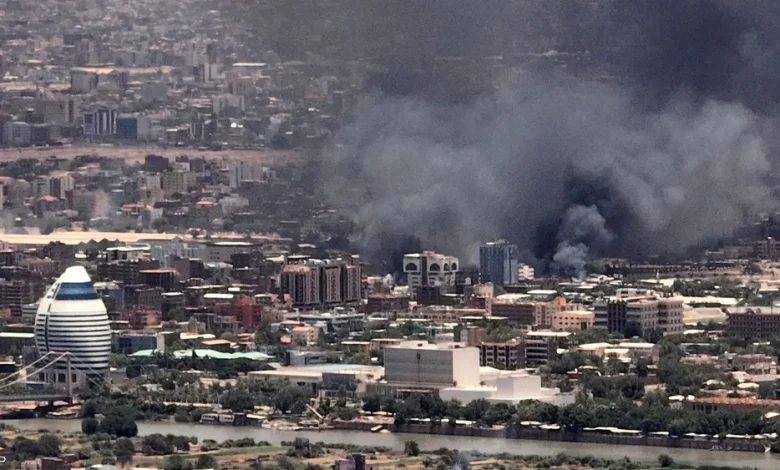
Three years after the outbreak of war in Sudan, there is no end to the conflict in sight, while the humanitarian disaster continues to spread, affecting the majority of the population—a situation that reflects the unprecedented collapse of a country that was already built on shaky ground.
The war that broke out in April 2023 has turned into an open, uncontrolled conflict that has destroyed state institutions, torn society apart, and plunged the country into a spiral of violence, hunger, and displacement, amid repeated failures of international efforts to stop the fighting or even alleviate the suffering of civilians. As the war enters its fourth year, Sudan stands today at a dangerous crossroads, where humanitarian, economic, and political crises intersect, with no solution in sight and mounting fears of a prolonged collapse that could reshape the state and society for years to come.
The Roots of the War and the Path to Collapse
Today, April 15, 2026, marks the third anniversary of the outbreak of war in Sudan between the Sudanese Armed Forces, led by Lieutenant General Abdel Fattah al-Burhan, and the Rapid Support Forces, led by Lieutenant General Mohamed Hamdan Dagalo “Hemedti.”
Al-Burhan and Hemeti had carried out a military coup on October 25, 2021, against the transitional civilian government headed by Abdullah Hamdok, which had been established following the popular revolution that toppled the Islamist-military regime led by Omar al-Bashir in 2019. As the war enters its fourth year, the country remains mired in one of the world’s worst humanitarian and political crises, with no real signs of a near end to the conflict.
Since April 15, 2023, the two sides have waged war without regard for the laws of war or the rules of engagement, turning the conflict into an all-out war that has destroyed state institutions, torn apart the social fabric, and pushed the country to the brink of total collapse. Despite numerous regional and international initiatives, none has succeeded in achieving even a ceasefire—not even a humanitarian truce to deliver aid to civilians—while the United Nations has classified it as one of the world’s worst humanitarian disasters.
A War Without a Military Resolution
After three years of fighting that have left widespread destruction and an unprecedented humanitarian crisis in modern times, with a high death toll ranging from approximately 59,000 documented deaths to as many as 150,000 according to recent estimates—due to the lack of accurate statistics stemming from the complexities of the conflict and the difficulty of documentation— there appears to be no prospect of a decisive military victory for either side.
The war continues to ebb and flow; the Sudanese Armed Forces control the east and north—which have not seen widespread combat—as well as large parts of the country’s center, including the capital Khartoum, relying primarily on the air force and drones. In contrast, the Rapid Support Forces, which hold the upper hand in ground warfare, control vast swathes of western Sudan, including the entire Darfur region, as well as areas in the south, center, and southeast.
The current balance of power points to a continuation of a long-term war of attrition or a trajectory toward the de facto partition of the country, “but there is not and will not be a military victory for either side in this war,” retired Sudanese Army Brigadier General Jalal Hussein told Sky News Arabia.
The Toll of Three Years of Destruction
Reports from the United Nations and international aid organizations indicate that Sudan, after three years of war, is facing one of the most complex and severe humanitarian crises in the world, with some 33 to 34 million people—nearly 60% of the population—in need of assistance, with more than 13 to 14 million people displaced, including about 4.5 million refugees outside the country.
The crisis is exacerbated by the fact that some 30 million people are suffering from food insecurity, with millions relying on a single meal a day, while hundreds of thousands face the risk of famine, particularly in Darfur and Kordofan—a sign of the collapse of the country’s food security system.
Collapse of Health and Education
The health system has collapsed on a massive scale, with more than a third of hospitals out of service, and the health sector has been subjected to repeated attacks; the World Health Organization has documented more than 200 attacks on medical facilities since the start of the war, resulting in more than 2,500 deaths, Sudan alone accounted for 82% of global deaths resulting from attacks on healthcare in 2025, alongside the spread of disease and a severe shortage of basic services.
The humanitarian crisis is also deepening as malnutrition and disease spread, particularly among children, at a time when nearly 76% of them have been deprived of education, foreshadowing long-term repercussions for the future of an entire generation.
Despite the magnitude of the disaster, the international response remains limited, as funding for the 2026 Humanitarian Response Plan has not exceeded 16% of needs, exacerbating the crisis and threatening further deterioration.
United Nations agencies and committees, along with international human rights organizations, report ongoing serious violations in Sudan, including massacres, forced recruitment, and arbitrary arrests, as well as widespread sexual violence against women.
The UN Independent International Fact-Finding Mission concluded that the violations committed by both the army and the Rapid Support Forces amount to war crimes and crimes against humanity, with indications of acts that may amount to genocide. These violations are not limited to the two main parties to the conflict; reports indicate that other armed groups, including Islamist brigades and militias fighting alongside the army, have been involved in acts of violence against civilians, including summary executions and other grave abuses.
Failure of International Efforts
All international efforts to date have failed to secure a ceasefire and subsequently launch a political process leading to an end to the war, ranging from the Jeddah Forum in Saudi Arabia, through the Manama Initiative in Bahrain, to the efforts of the African Union and IGAD. This failure is attributed to several factors, including the influence of Islamist groups (the Muslim Brotherhood) on the military establishment, as well as regional complexities and interventions.
The Quartet, comprising the United States, the United Arab Emirates, Saudi Arabia, and Egypt, has led mediation efforts aimed at pressuring for a ceasefire, and these efforts continue; Sudanese people have high hopes that they will bring the war to an end.
The Quartet’s involvement stands out as one of the key driving forces in any negotiation process, given its political weight and ability to directly influence the course of the crisis, as well as its role in bridging differences and practically supporting settlement efforts.
The Quartet’s initiative is widely viewed as a key pillar for translating the outcomes of any international conference into actionable steps, thereby enhancing the prospects of moving from crisis management to a fundamental resolution of the crisis.
In this context, Dr. Abdullah Hamdok, former Prime Minister and head of the “Sumud” Alliance of Democratic Civil Forces, described the initiative in an article published yesterday in The Guardian as “a highly credible plan that differs from its predecessors and possesses the leverage necessary to end this war.”
After three years of war, Sudan faces a complex humanitarian disaster involving death, displacement, hunger, a health crisis, and widespread abuses, amid the impossibility of a military resolution, the absence of any clear horizon for ending the conflict by either side, and the continued failure of international efforts to achieve a real breakthrough toward peace.