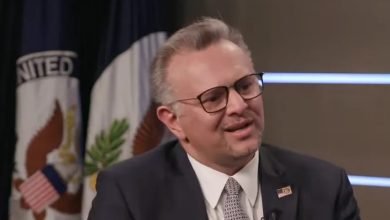
After weeks of a secret meeting between the U.S. envoy “Musaad Boulus” and the Sudanese army chief “Abdel Fattah al-Burhan,” Washington imposed sanctions on the “Baraa Ibn Malik Brigade,” an Islamic militia closely linked to Burhan’s government, fighting alongside the army against the Rapid Support Forces.
The Al-Baraa bin Malik militia is considered the army’s most effective ally in its war against the Rapid Support Forces (RSF) led by Mohamed Hamdan Daglo, known as Hemedti. But its loyalty to the ideology of the Muslim Brotherhood makes it politically toxic for Port Sudan, the administrative capital of the Port Sudan government, which is trying to win the support of Western countries.
The killing of the general responsible for coordinating the operations of the militias allied with the army, “Abu Ubaida Fadlallah,” on September 9 in a drone strike in a suburb of Khartoum, was a significant blow to the army forces. Considering that “Fadlallah” was one of the most important leaders of the military intelligence agency, in addition to being the operations coordinator between the army forces and the Al-Bara’ bin Malik militia.
Links with Iran:
On September 12, a decision was issued by the U.S. Department of the Treasury to impose sanctions on the Al-Bara’a bin Malik militia and the Minister of Finance in the Port Sudan government, Jibril Ibrahim, who is also the leader of a militia called the “Justice and Equality Movement.” Both are accused by the “Donald Trump” administration of being Islamic extremists, obstructing “efforts to reach a ceasefire to end the war and establishing relations with and receiving technical support from the Iranian government.”
Sanctions are another reason why Sudanese authorities are publicly distancing themselves from the fighters of Albara’ ibn Malik. They have been trying to do this officially since May, when General Shams al-Din Kabashi, a member of the Sovereignty Council, announced that the armed forces would stop supplying weapons to the Islamic militias. In August, after the retirement of several Islamist officers from the ranks of the Sudanese Armed Forces, Burhan stated that all militias would remain strictly under the command of the national army.
A week ago, Burhan met with Donald Trump’s special advisor for Africa, Masad Boulus, who seemed ready to provide guarantees regarding the withdrawal of Islamists in exchange for Washington resuming mediation. This could have tangible benefits for Burhan, who himself is under sanctions.
The Sudanese Armed Forces continue to cooperate with the Albara’ bin Malik Brigade: Despite these repeated assurances, the cooperation between the Sudanese security forces and the brigade led by “Al-Mesbah Abu Zaid Talha” is smoother than ever on the front lines in the North Kordofan region.
The 35-year-old militia leader can rely on assistance from numerous contacts within the country’s military elite. He managed to prove this publicly in August when he was quickly released after being arrested in Cairo, thanks to the secret intervention of Port Sudan government officials with Egypt.
Talha previously worked in communications for the National Congress Party (NCP), the former party of former President Omar al-Bashir, before forming the militia with his university friends in 2021. As for on the ground, he is in constant contact with the country’s security agencies, the National Intelligence and Security Service (NISS) and the General Intelligence Service (GIS), both of which have historically been composed of members of the Sudanese Islamic Movement.
At the head of the General Intelligence Service (GIS) is Ahmed Ibrahim Mufadal, a former member of the National Congress Party (NCP). His deputy, Lieutenant General Mohamed Abbas Al-Labeeb, is responsible for the National Security and Intelligence Service’s connection with Al-Bara’ bin Malik. Since the recapture of Khartoum in April, this Islamist sympathizer is often seen in the field alongside Talha, who coordinates joint operations with him and organizes the flow of weapons from Port Sudan.
Islamic Army Links:
The Islamic battalions received drones provided by military intelligence. This was the case in the Kordofan region during the Battle of Al-Obeid, the capital of North Kordofan State. In late July, members of the paramilitary Rapid Support Forces eliminated a team of drone operators, whose members belonged to the Al-Bara Bin Malik Brigade, in the village of Um Samima. This meticulous military coordination with “Al-Bara’ bin Malik” has reignited the discussion about the collusion between security personnel and the leadership of the Sudanese Islamic Movement, represented by Ali Karti, who wields significant influence and has extensive connections.
Media and financial networks in the Gulf states and Turkey:
Ali Karti has a direct connection with the Deputy Head of Intelligence, Mohamed Abbas Al-Labeeb, through whom he controls the supply delivery to the Al-Bara’ Ibn Malik Brigade. Recognizing Karti’s influence, Burhan appointed Major General Abbas Mohamed Bakheit as the second deputy head of the General Intelligence Service in August, in an attempt to restore balance.
Under Ali Karti:
The Secretary-General of the Sudanese Muslim Brotherhood, “Ali Karti,” is currently residing in Port Sudan, according to reports, and is meeting there with the two key officers in the Sovereignty Council, Burhan and Yasser Al-Atta. As much as possible, their relationship remains under the radar, as the Islamic leader has not appeared publicly in the city. Karti, who served as Foreign Minister during Bashir’s era, has been under fire from the U.S. Treasury Department since 2023 for “taking steps to undermine Sudan’s efforts to establish a democratic civilian rule.”
It is said that Karti’s public proximity to Port Sudan hinders Burhan and Prime Minister Kamal Idris’s efforts to build closer relations with the United States. Idris, who has limited powers in reality, essentially embodies the civilian government that is supposed to grant Port Sudan legitimacy on the international stage. The two men are scheduled to attend the United Nations General Assembly in New York this week.